Contents
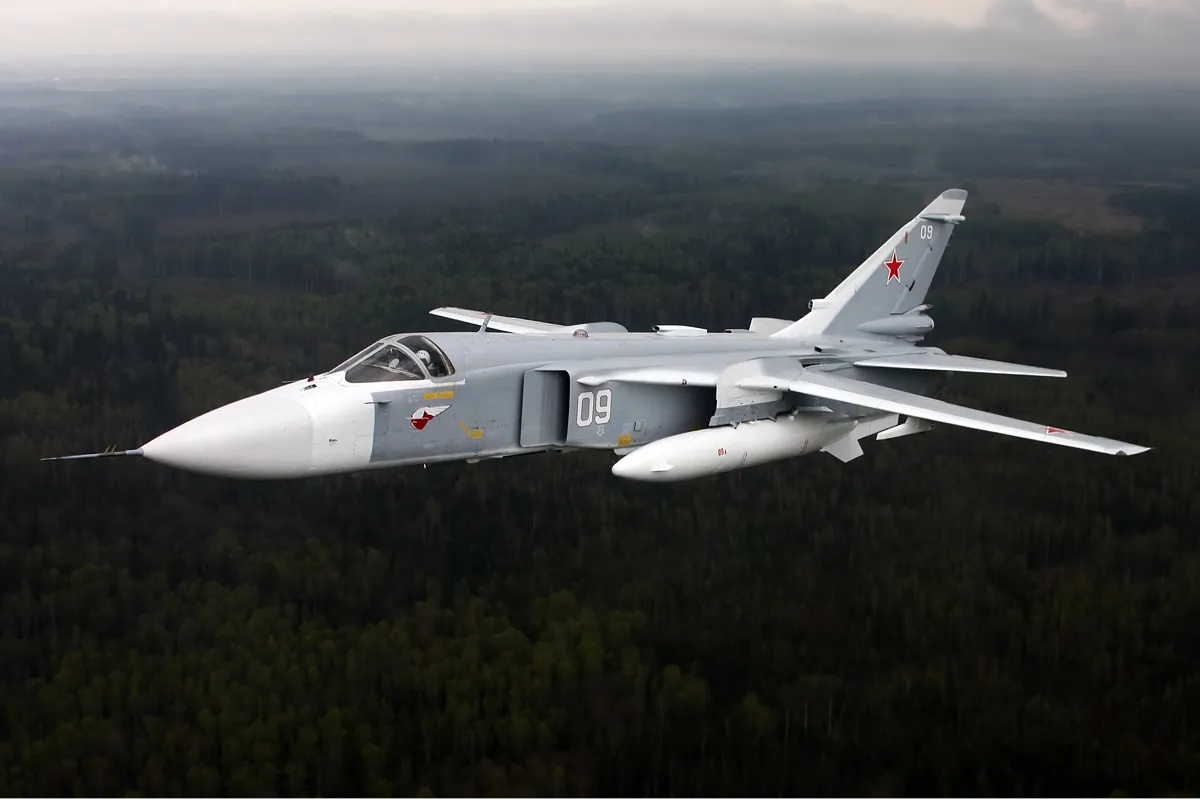
The Sukhoi Su-24 is a twin-engine, variable-geometry strike aircraft built for low-level, all-weather attack missions. The Sukhoi design bureau developed it for the Soviet Air Forces as a precision bomber able to find and hit ground targets at night and in bad weather, a capability earlier Soviet attack types lacked. Known to NATO by the reporting name “Fencer,” it flew for the first time on 2 July 1967 and remains in service1 today with Russia, Ukraine and a handful of other air forces, more than half a century after its first flight.
Design and development
The requirement traced back to Soviet Air Forces dissatisfaction with the Sukhoi Su-7B, accepted in 1961, which lacked the all-weather precision strike capability commanders wanted. Early studies under the internal names S-6 and S-32 found that the Su-7 airframe was too small to hold all the avionics the mission demanded, so Sukhoi started a clean-sheet design, officially sanctioned on 24 August 1965 under the internal designation T-61.
The first prototype, T-6-1, was completed in May 1967 and made its first flight on 2 July with test pilot Vladimir Ilyushin at the controls. That early design used four lift jets to shorten the take-off run, but the approach proved impractical: the extra engines cut into fuel capacity and made the aircraft unstable in flight. By 1968 Sukhoi’s engineers had seen the variable-geometry wing of the American General Dynamics F-111 and adopted the same solution; the redesigned prototype, T-6-2I, first flew on 17 January 1970. Government trials dragged on until 1974 because of the complexity of the new avionics suite, and the first production aircraft had already flown on 31 December 1971. The type was formally accepted into Soviet Air Forces service as the Su-24 on 4 February 19751.
Specifications
The Su-24 is 22.53 m long with a wingspan of 17.64 m when the wings are spread; swept fully back for high-speed flight, the span shrinks to 10.37 m. It carries a crew of two, a pilot and a weapons systems officer, seated side by side, and has a maximum take-off weight of 43,755 kg. Power comes from two Lyulka AL-21F-3A afterburning turbojets, each rated at 109.8 kN with afterburner. Ferry range is 2,775 km, but combat radius falls sharply on a low-level attack profile: flying lo-lo-lo with 3,000 kg of ordnance, the Su-24’s combat range is only about 615 km1.
Variants
The baseline Su-24 was the initial production version, built from 1971 to 1983 in about 500 examples and armed with Kh-23 and Kh-28 missiles. It was followed by the Su-24M, NATO reporting name “Fencer-D,” an enhanced model built from 1981 to 1993 in roughly 770 examples with an inflight-refuelling probe, a laser designator and compatibility with a wider range of weapons; later aircraft were upgraded under the Su-24M2 programme with the SVP-24 navigation and targeting system and modernised avionics. Sukhoi also built the Su-24MK, an export version with reduced avionics produced between 1988 and 1992. Two specialised variants dropped the attack role altogether: the Su-24MR, NATO name “Fencer-E,” a reconnaissance aircraft built in about 130 examples with panoramic cameras and side-looking radar in place of the attack radar, and the Su-24MP, NATO name “Fencer-F,” an electronic-intelligence version built in about 10 examples1.
Operators and service
Production ran from 1967 to 1993 and totalled about 1,400 aircraft. The Su-24 saw its first combat deployment with Soviet forces in Afghanistan in 1984 and again in 1988, without reported losses. It later flew in the 2008 Russo-Georgian war, the Syrian civil war from 2011, and Sudan’s intervention in the Yemen war from 2015; a Russian Su-24M was shot down by Turkish F-16s near the Turkey-Syria border on 24 November 2015. Today it is flown by Russia’s Aerospace Forces and Naval Aviation, as well as Algeria, Iran, Sudan and Ukraine; Syria, Iraq, Belarus, Kazakhstan, Libya, Uzbekistan and Azerbaijan have also operated the type, though most of those fleets have since retired or transferred their aircraft. Ukraine’s air force flew 10 to 20 operational Su-24s at the start of Russia’s 2022 invasion and has since adapted survivors to launch British Storm Shadow cruise missiles, using them for long-range strikes including a strike on the Russian Black Sea Fleet’s Sevastopol naval base in September 20231.
Safety record
Sukhoi’s test programme was costly: ten fatal accidents occurred during the Su-24’s development, killing thirteen Sukhoi and Soviet Air Force test pilots, and the type went on to average more than five crashes a year in service. Among later peacetime accidents, a Russian Su-24M crashed in Chelyabinsk Oblast on 30 October 2012 after its nose cone fractured in flight, though the crew ejected safely; an Algerian Su-24 crashed during a training flight on 13 October 2014, killing both crew members; and a Su-24 crashed on takeoff at Russia’s Khmeimim air base in Syria on 10 October 2017, killing both crew1.
Similar aircraft
- General Dynamics F-111 Aardvark: the American variable-geometry strike aircraft whose wing design Sukhoi’s engineers studied while developing the Su-24.
- Panavia Tornado: a later European variable-geometry strike aircraft built for the same low-level, all-weather attack role.
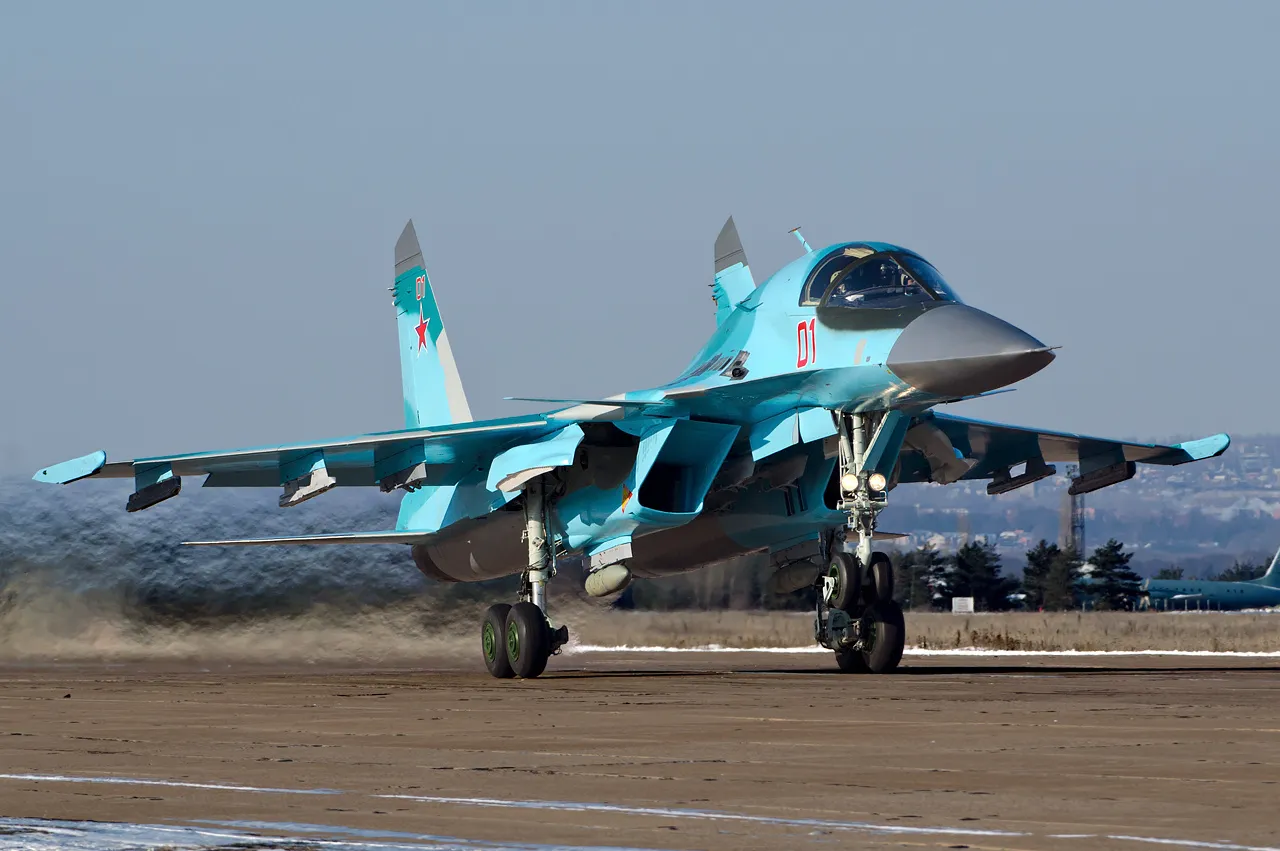
- Sukhoi Su-34: the Su-24’s eventual successor in Russian service, a heavier side-by-side-seat strike aircraft built on the Su-27 airframe.