Contents
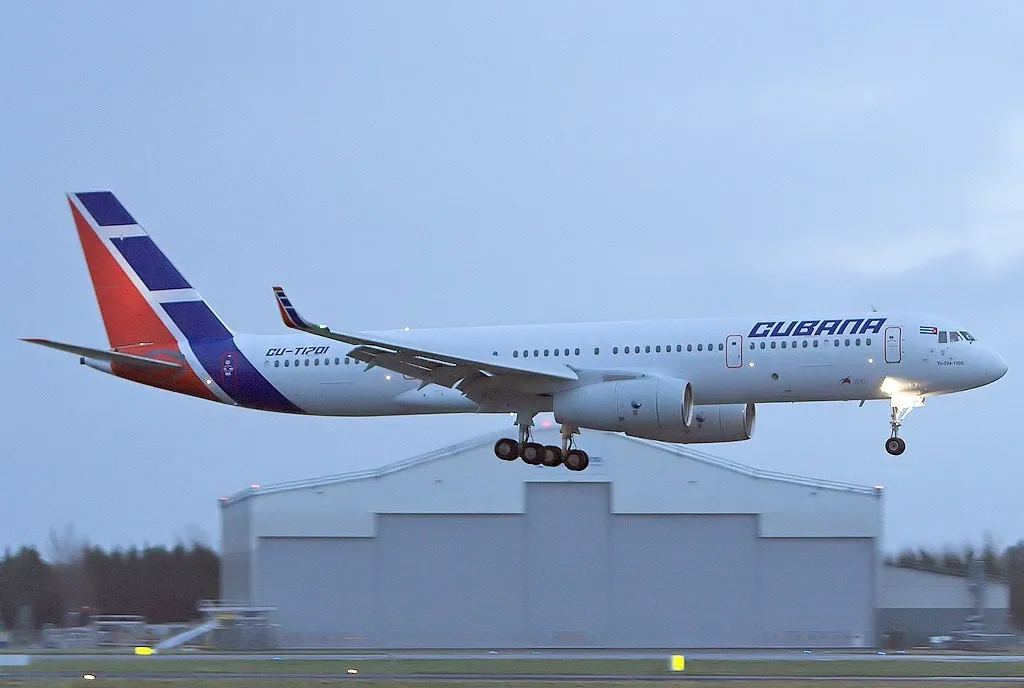
The Tupolev Tu-204 is a twin-engined medium-range narrow-body jet airliner, designed by Tupolev and produced by Aviastar-SP and Kazan Aircraft Production Association. It was built to replace the Tu-154 trijet and can be used for both passenger and cargo transportation2. Its designers intended it to be broadly equivalent to the Boeing 7571, with slightly lower range and payload.
Design and development
The Tu-204 was developed for Aeroflot as a replacement for the Tu-154 and made its maiden flight in January 1989. The Tupolev Design Bureau introduced about 700 design innovations to improve the aircraft’s structural, aerodynamic and technical performance. It has supercritical wings and winglets, and its flight deck has a glass cockpit with six screens2 and fly-by-wire systems. The wings and tail are relatively resistant to ice build-up1, so no anti-icing systems are fitted to them.
The first certificate for the type, with PS-90A engines, was issued in 1994. Production is split between two plants: Ulyanovsk builds the Tu-204 series and Kazan the Tu-2141.
In March 2022 the head of Rostec raised the possibility of relaunching large-scale Tu-214 production because of international sanctions. In August 2022 United Aircraft Corporation announced plans to produce 70 Tu-214s by 2030, at least 10 to 12 aircraft a year, and in December 2025 Rosaviatsiya approved modifications replacing foreign systems with Russian ones1.
Specifications
The basic Tu-204 is 46 m long with a 42 m wingspan. Its cabin is 30.18 m long, 3.57 m wide and 2.16 m high and seats 210 passengers in a single class, or 164 to 193 in two or three classes. Economy and business class use 3-3 and 2-2 seating2 respectively.
The aircraft has a maximum take-off weight of 103,000 kg. Two Aviadvigatel PS-90A turbofans each produce 157 kN of thrust, and their sound attenuation systems meet ICAO stage 4 noise requirements. The Tu-204 cruises at 850 km/h, with a range of 4,300 km and a service ceiling of 12,600 m. The original flight deck is laid out for three crew members2.
Variants
The Tu-204C is the cargo model of the original Tu-204, able to carry trays and containers weighing 30 t. The Tu-204-100 and -200 are an advanced version fitted with an extra fuel tank to increase the range; their freighter counterparts, the -100C and -200C, add a forward main deck freight door. The Tu-204-120 and -220 carry non-Russian avionics and two Rolls-Royce RB211-535 engines2 of 192 kN, and Egypt’s Cairo Aviation became the first operator in November 19981.
The Tu-204-300 is a shortened derivative, about six metres shorter than the basic Tu-204, with Vladivostok Air as debut customer. The Tu-204SM, an improved Tu-204-100, first flew in December 20102 with a cockpit for a two-pilot crew, though by 2016 United Aircraft Corporation said Tupolev had frozen development work on the aircraft. The Tu-214, first flown on 21 March 19961, is technically a Tu-204-200 built in Kazan, with extra fuel tanks for a higher gross weight; it is also the basis for government special-mission versions, among them the Tu-214ON for Open Skies treaty flights and the Tu-214PU airborne command post.
Operators and service
Vnukovo Airlines was the launch customer and went bankrupt in 2001. In January 2011 about 51 Tu-204s had been ordered by 11 customers, with operators including Red Wings Airlines, Vladivostok Avia, Aviastar-TU and Rossiya. Customer orders listed at the time included Air China Cargo, Transaero and Iran Air2. In 2016 a United Aircraft Corporation vice president said every company that had ordered the Tu-204 had gone bankrupt1.
As of September 2026, 14 aircraft were in commercial service. Five Tu-214SR communications relay aircraft are operated by the Special Flight Unit Rossiya for the Russian government. In early 2024 Aeroflot said it intended to move its order exclusively to MC-21 jets1.
Safety record
The first hull loss came on 22 March 2010, when Aviastar-TU Flight 1906 crash-landed short of the runway near Moscow Domodedovo1 at night in fog, seriously injuring four of the eight crew; the Interstate Aviation Committee (MAK) attributed it to pilot error.
On 29 December 2012 a Red Wings Tu-204-100V overran the runway at Vnukovo after a repositioning flight from Pardubice. MAK found the cause in actuator maladjustment and reverse locking of both engines3 and in crew actions that did not comply with the flight operation manual, which left the aircraft without effective braking until it hit obstacles at about 190 km/h. Five of the eight crew were killed1.
Similar aircraft
- Boeing 757: the airliner the Tu-204 was meant to match1, which has slightly more range and payload.
- Tupolev Tu-154: the predecessor the Tu-204 replaced, a trijet2 where the Tu-204 has two engines.
- Irkut MC-21: the jet Aeroflot preferred in 2024, partly because the Tupolev has no two-member cockpit1.