Contents
The Gerbera is a Russian multi-purpose drone1 made to look like the Iranian-designed HESA Shahed 136 at a fraction of its price. A December 2024 report by the Institute for Science and International Security (ISIS) names JSC Alabuga in Tatarstan as its maker and describes it as a multi-functional decoy. Analysts quoted by ABC News said it was being used as a decoy to reduce the efficiency of Ukraine’s air defences3 during drone strikes, while Ukraine’s Defence Intelligence (HUR) says it can also scout and relay signals4 for other drones. HUR identified versions with a small warhead2 in November 2024, and Ukraine’s air force names Gerberas alongside Shahed-type drones5 in its reports on Russian night attacks.
Design and development
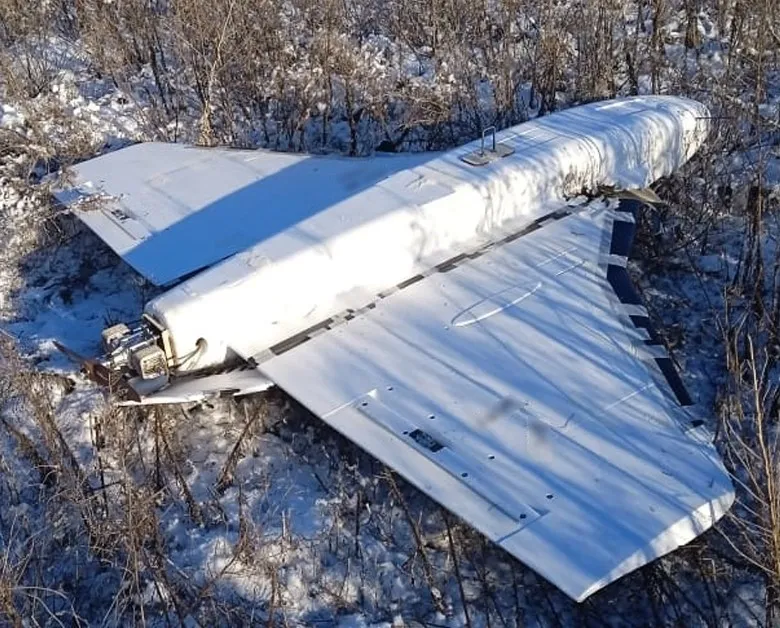
Open-source material suggests it first appeared on the battlefield in late July 20242. Photos of an example apparently brought down over the Kyiv region on 24 July spread on Ukrainian social media, and The War Zone said it reportedly had no warhead fitted. On 28 July a Russian unit called Stalin’s Falcons released a video saying the drone was developed by the Gastello Design Bureau6. According to Defense Express, that presentation showed signals intelligence, kamikaze and decoy versions7.
HUR tells a different story. In November 2024 it named the Chinese model-aircraft maker Skywalker Technology4 as the real developer, saying the company makes the fuselage and ships assembly kits that are finished at drone plants in Alabuga. Defense Express pointed out that the Gerbera does not appear in Skywalker’s catalogue. HUR’s sanctions database lists Alabuga companies among the firms tied to the drone8.
The airframe is built from cheap materials. ISIS describes a plywood frame inside a painted foam body2, and ABC News reported that it is slightly smaller than the Shahed-1363 and almost indistinguishable from it on radar. The War Zone noted that, like the Geran, it has a large delta wing, though with prominently cranked leading edges, and a single vertical tailfin6 in place of the Geran’s wingtip surfaces.
ISIS found that the electronic parts in recovered drones were mostly designed and made by Western firms, among them Texas Instruments, Analog Devices and STMicroelectronics, with a handful of Chinese parts and none from Russian companies. Ukrainian officials put the cost of one Gerbera at about $10,000. HUR spokesperson Andriy Chernyak gave Reuters the same figure and set it against up to $200,000 for a Shahed9. ISIS added that JSC Alabuga is thought able to turn out up to 50 Gerberas a day2.
Specifications
Kyiv Post gave the drone’s size in February 2025 as 2 metres long with a 2.5-metre wingspan9 and its weight as about 10 kg. HUR’s sanctions database repeats the wingspan but lists a heavier maximum take-off weight of 18 kg, a top speed of 160 km/h8 and a working altitude of up to 3,000 metres.
Range figures differ by source and version. Kyiv Post reported a reach of up to 300 km without a warhead9, while HUR’s database gives a flight range of 600 km8. For the camera-guided attack version, Defense Express estimated only a few dozen to about a hundred kilometres7, depending on its video link.
Power usually comes from a Chinese-made DLE60 two-stroke 60 cc engine2, and ISIS found a Stinger 70 cc twin engine in one recovered example. HUR’s database says the drone is launched from an elastic or pneumatic catapult8.
Sensors and weapons
Defense Express noted that Gerberas had usually been used as unarmed false targets10. HUR said in November 2024 that the reconnaissance fit includes a stabilised Topotek camera and a mesh-network modem4 from Xingkay Tech, and Defense Express reported that a sample downed in July 2024 connected through a Ukrainian 4G SIM card7.
In February 2025 Defense Express reported that warheads had been noticed in downed Gerberas for the first time, and that Russia had started fitting warheads of up to 5 kg. Electronic warfare specialist Serhii Beskrestnov, who said warheads of up to 5 kg could be fitted, shared a photo of one with a 2.5 kg high-explosive fragmentation warhead10. ISIS gave a higher figure of roughly 10 kg2 for some versions and noted that not all carry explosives. Defense Express described the attack version as flown by hand through a camera link7, much like an FPV drone.
Operators and combat use
Defense Express reported in April 2025 the first documented case of an armed Gerbera used in a direct strike attempt on a Buk-M1 air defence system11, shown in a video published by Russian sources; analyst Oleksandr Kovalenko noted that the system had not been destroyed. In July 2025 Kyiv Post reported that Russian forces were by then flying Gerberas for reconnaissance and even strikes12, not only as decoys.
Ukrainian units report shooting the drones down in numbers. In May 2025 Ukraine’s Unmanned Systems Forces said one of its units had downed 24 drones of the Gerbera type13 along with 76 Shahed-136s. For the night to 8 November, Ukraine’s air force said Russia attacked with 164 attack drones of the Shahed type5, 112 of them jet-powered, together with Gerbera and “Parodiya” decoy drones, and that 137 drones were shot down or suppressed.
During the incursion into Poland in September 2025, debris analysis by Polish authorities and media pointed to likely Gerbera-type drones14; Prime Minister Donald Tusk said 21 drones were detected, and Polish and Dutch aircraft shot down at least three. In Lithuania, a drone that entered from Belarus on 28 July 2025 was found at the Gaižiūnai training ground and identified as a Russian-made Gerbera carrying approximately 2 kg of explosives15. Lithuania’s defence minister said it may have strayed in by accident.
Variants
Beyond the decoy, reconnaissance and armed versions, HUR described an enlarged Gerbera-2 in November 2026 with a range of up to 1,200 km, a 3-metre wingspan, a 2.6-metre fuselage and room for a warhead of up to 25 kg under Russian specifications it cited. HUR’s technical database credits the Gerbera-2 with 10 hours of endurance and a top speed of 200 km/h, and HUR said one carrying a warhead was found in mid-September on Poland’s Baltic coast. By February 2026 Beskrestnov had reported a Gerbera set up to carry an FPV drone16.
Similar drones
- HESA Shahed 136: the Iranian one-way attack drone the Gerbera imitates; the Geran-2 has surfaces at its wingtips6 where the Gerbera has one tailfin, and HUR puts its price at up to $200,0009.
- ADM-160 MALD: an American air-launched decoy from Raytheon that mimics US or allied aircraft to confuse air defences, powered by a turbojet with a range of up to 575 miles17.