Contents
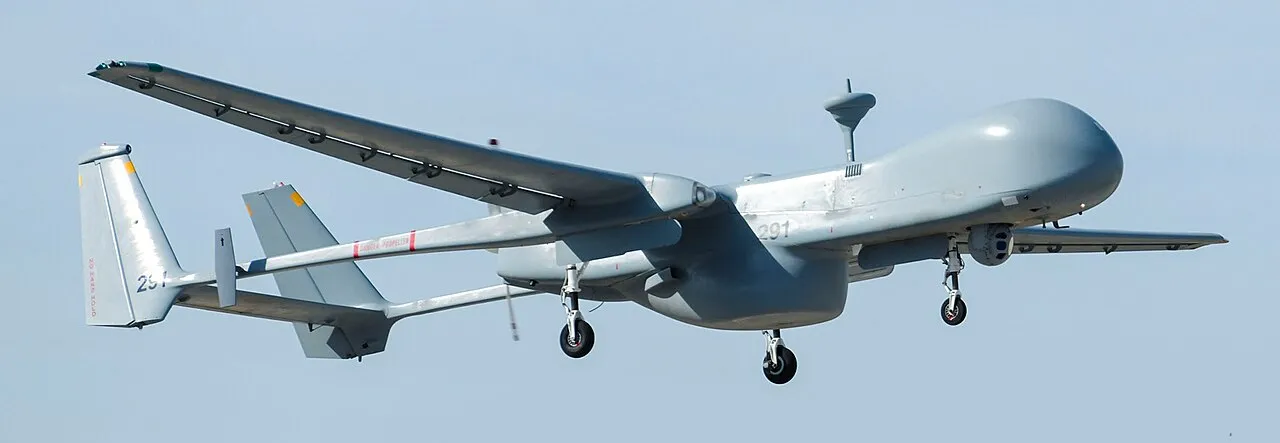
The IAI Heron (Machatz-1) is a medium-altitude long-endurance drone developed by the Malat division of Israel Aerospace Industries (IAI). It is built for strategic and tactical missions, and the Israel Air Force uses it for reconnaissance and intelligence gathering1. The Heron first flew in 1994 and entered service in 2005. All exported Herons are unarmed2.
Design and development
The Heron navigates with an internal GPS navigation device, flying either a pre-programmed profile, under manual control from a ground control station, or a combination of both. If it loses contact with the ground station, it can return to base and land on its own. Launch and recovery are fully automatic2, and the system has all-weather capabilities.
At a 2012 demonstration for the European border agency Frontex, the Heron showed its Automatic Takeoff and Landing3 capability at the Hellenic Air Force base at Aktio. On 16 September 2020 a Heron landed at Ben Gurion International Airport, which the press release called the first UAV landing at an international airport alongside commercial flights. The entire take-off, flight and landing4 were operated from the control station at Ein Shemer.
IAI unveiled the Super Heron at the February 2014 Singapore Air Show2 as a refinement of the Heron. The 2014 press release says its heavy fuel 200 horsepower engine5 and advanced propulsion system significantly enhance the drone’s capacity, rate of climb and performance. In 2021 IAI signed deals to sell and lease Heron Mk II systems to a central Asian country. The Mk II has a wider and stronger chassis6 for quick and easy maintenance, along with improved avionics and an improved and reinforced engine.
Specifications
The Heron is 8.5 metres long, with a wingspan of 16.6 metres1. It is powered by a single Rotax 916 piston engine of 160 kW driving a three-bladed pusher propeller. The specification data give a maximum take-off weight of 1,150 kg, a maximum speed of 207 km/h and a service ceiling of 10,000 m, with sensors totalling up to 250 kg2.
For the Heron Mk II, IAI gives an altitude of 35,000 feet, a maximum speed of 140 knots and up to 45 hours6 in the air.
The Heron has demonstrated 52 hours of continuous flight, but its effective operational flight time is less, according to payload and flight profile. For the Super Heron, the range is 250 km line-of-sight and 1,000 km by satellite control, and the cruising speed is 60 to 80 knots. Payload sensors send data to the ground control station in real time, over a direct line-of-sight data link2 or through an airborne or satellite relay.
Sensors and weapons
The Heron can carry thermographic and visible-light cameras, COMINT and ELINT intelligence systems and various radar systems. It is also capable of target acquisition and artillery adjustment2. At the 2012 Frontex demonstration it flew with IAI’s Multi-mission Optronic Stabilized Payload3 and a Maritime Patrol Radar from ELTA, an IAI subsidiary. The Heron 1s flying for Frontex in Greece are equipped with electro-optical day- and night-vision payloads7 and marine surveillance radars.
The Heron Mk II has a long-range reconnaissance sensor and radar6, and can carry additional payloads like COMINT and ELINT equipment. Turkey’s Herons use the ASELFLIR-300T2 thermal imaging and targeting system made by Aselsan, with stronger engines to compensate for its added weight.
India’s Project Cheetah, given fast-track approval on 14 July 2021, set out to upgrade and weaponise around 90 Heron UAVs. In 2023 India was reported to have dropped plans to arm its Herons. On 18 September 20252 Asian News International reported that India plans to acquire more Herons, and that the Army is expected to equip them with air-launched Spike NLOS anti-tank missiles.
Operators and combat use
Israel made significant use of the Heron during Operation Cast Lead in Gaza in 2008–2009, when Herons, Hermes 450s and Apache helicopters provided aerial surveillance. During the Gaza war a Super Heron was reported to have been shot down2, and the militant group PIJ claimed responsibility. In 20145 IAI said the Heron was in operational use with the Israel Air Force and twenty other users worldwide.
In 2019 IAI agreed with India’s Ministry of Defense to sell 50 Herons for 500 million US dollars1. As of 2024, India had lost 12 Heron Mk1s since it inducted the type in 2002, through human error, engine failures and loss of contact with ground stations. The Indian Air Force inducted four Heron Mk2s in August 20232.
Australia leased four Herons from the Canadian firm MacDonald Dettwiler and Associates for Afghanistan, with three airframes serving there and one kept in Australia for training. Its 5 Flight provided surveillance and reconnaissance support in southern Afghanistan from January 2010 to November 2014, and the RAAF said the aircraft completed more than 27,000 mission hours there. The Heron flew its final Australian mission on 23 June8, as the RAAF announced in 2017.
From 2010 Germany flew Herons in Afghanistan, leased from IAI and operated by Airbus. In 20169 it agreed to lease three Heron 1 unarmed surveillance drones for its mission in Mali, in a contract worth about $100 million. In December 2015, UAS Vision reported that the Heron-1 had reached its 70,000th flight hour10 in Afghanistan, used there by Western countries including Germany, France, Canada and Australia.
Frontex, the European Border and Coast Guard Agency, has used Malta-based Herons2 since 2021 to monitor migrant activity in the southern Mediterranean. In November 20227, on the recommendation of EASA, the Greek civil aviation authority issued its first permit for the Heron 1 to fly in Greek airspace for Frontex operations.
Variants
- Super Heron: shown in 2014 with a heavy-fuel 200-horsepower engine5.
- Heron Mk II: the wider, stronger airframe6 with a reinforced engine and stand-off sensors.
- Turkish Heron: fitted with Turkish electro-optical subsystems2 and stronger engines.
- EADS Harfang: a derivative of the Heron2 operated by France.
Similar drones
- IAI Heron TP: the enlarged Heron-TP model1, also known as the IAI Eitan2, which Germany chose as the armed successor model9 to the unarmed Heron 1.
- General Atomics MQ-1 Predator: the American drone was modified to carry and fire two AGM-114 Hellfire missiles11, while exported Herons are unarmed.
- Baykar Bayraktar TB2: the Turkish Armed Forces class it as a tactical UAV12, though international standards would make it a medium-altitude long-endurance drone like the Heron.