Contents
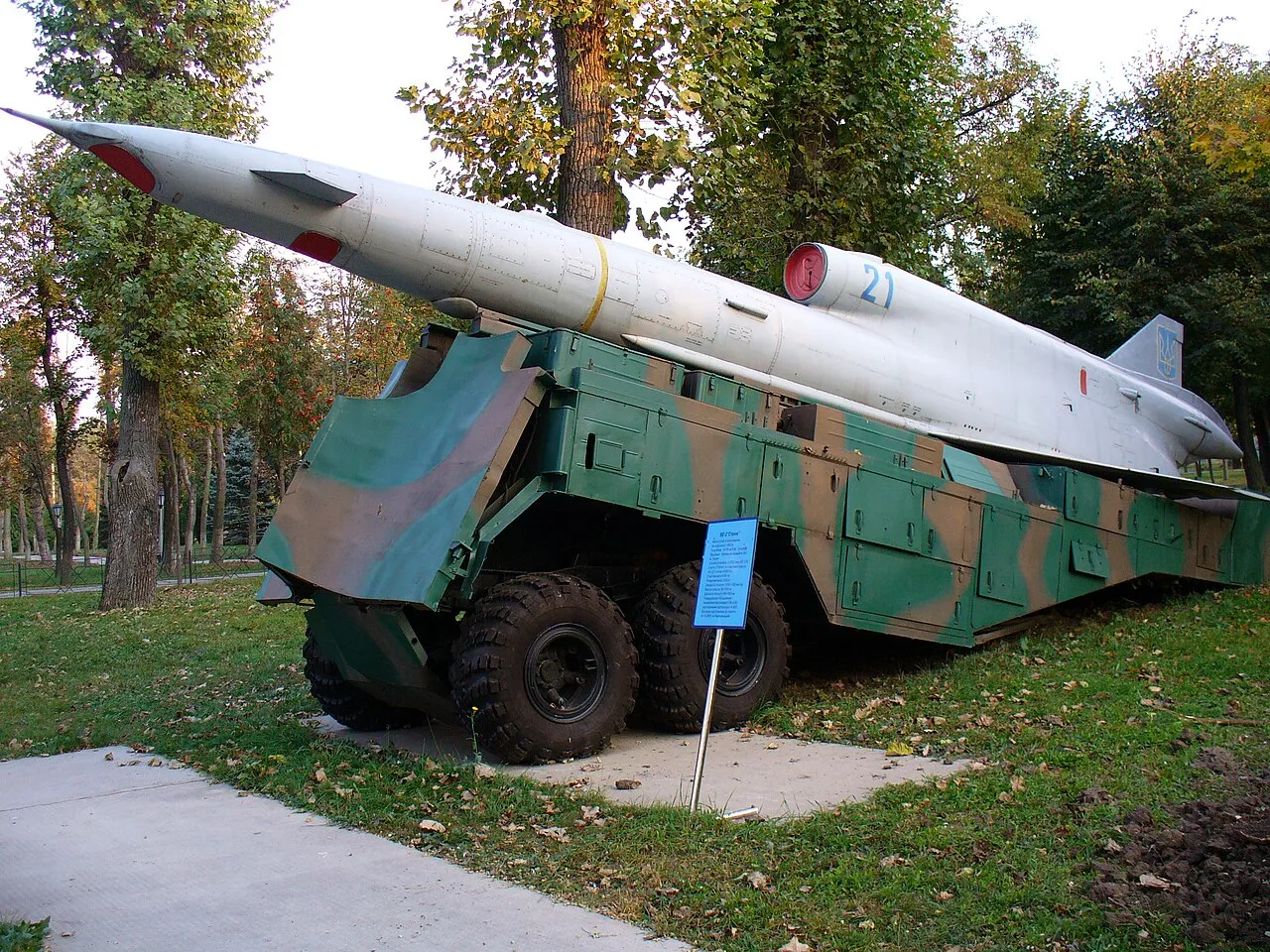
The Tupolev Tu-141 Strizh (“Swift”) is a Soviet reconnaissance drone1 that served with the Soviet Army during the late 1970s and 1980s, and with the Ukrainian Armed Forces since 2014. The War Zone (TWZ) describes it as more of a cruise missile than a traditional drone: it is rocket-launched from its trailer, flies a predetermined course at transonic speed while collecting intelligence, and is recovered by parachute. Ukraine modified them into long-range weapons3 to attack Russian strategic bomber bases several hundred kilometres behind the front line. In March 2022 TWZ called Ukraine the only known current operator2 of the type.
Design and development
The Tu-141 was a follow-on to the Tupolev Tu-123, and is a relatively large, medium-range reconnaissance drone. That predecessor first flew in 19602, while the Strizh entered Soviet service in the late 1970s. The Tu-141 itself first flew in 1974, and 152 were built1 between 1979 and 1989.
As with earlier Tupolev designs, it has a dart-like rear-mounted delta wing1, forward-mounted canards and a KR-17A turbojet mounted above the tail. It is launched from a trailer using a solid-propellant booster and lands with the aid of a tail-mounted parachute. After the parachute recovery, according to TWZ, it can be reset and used again2.
TWZ wrote in 2022 that Ukraine had upgraded the Soviet-era drone2 and made it useful following the invasion of Crimea in 2014.
Specifications
Aviacionline gives the Tu-141 a length of 14.33 metres3 and a height of 2.44 metres. Its wingspan is 3.88 m, and its gross weight 6,215 kg. A single Tumansky KR-17A turbojet of 19.6 kN1 powers it.
The drone can reach transonic speeds of up to 1100 kilometers per hour3, and has a range of up to 1,000 kilometres, with a maximum altitude of 6,000 metres. Its cruise speed is listed as 1,000 km/h1. With a range of about 650 miles2, TWZ notes, the Tu-141 can take on some of the missions of a manned tactical reconnaissance jet without the risk of losing the crew.
Sensors and weapons
In its original version the Tu-141 could be equipped with photographic or infrared cameras, and even radars3. Ukraine has also used the type as a target drone2, and TWZ wrote that it could act as a decoy.
For the Ukrainian strike conversion, Aviacionline wrote in December 2022 that there is no verifiable information listing the modifications3, but that the drone was clearly given navigation improvements, perhaps Western GPS equipment, and an explosive warhead. TWZ named relatively poor accuracy4 as a limitation of these drones in the strike role, unless more significant upgrades had been made to their guidance systems.
Operators and combat use
The Ukrainian Air Force pressed it back into service after 2014 for the war in Donbas. Its current operator is Ukraine’s 383rd UAV Brigade1; the Soviet Union is a former operator.
About midnight on 10 March 2022, a Tu-141 crashed in front of a student campus in Zagreb, Croatia, after flying over Romania and Hungary; there were no casualties. Croatian President Zoran Milanović said the drone flew over Hungary for over 40 minutes and was less than seven minutes in Croatian airspace. He said it flew in from Ukraine at an altitude of 1,300 metres and over 500 knots, and crashed when it ran out of fuel. The Ukrainian Air Force claimed that the drone did not belong to them. The Russian Embassy in Croatia said that Russia stopped using the Tu-1412 in the early 1990s. On 15 March the Croatian magazine Nacional cited an undisclosed source close to the defence ministry, who said the investigation had concluded that the drone belonged to the Armed Forces of Ukraine1 and carried a bomb.
On 3 July 20221, the governor of Russia’s Kursk region wrote on Telegram that air defences had shot down two Ukrainian Strizh drones.
On 5 December 20221, explosions were reported at two Russian airbases, Engels-2 and Dyagilevo. The Russian Ministry of Defense claimed that Ukraine used Soviet-made jet-powered unmanned aerial vehicles in the attacks, but that the drones were intercepted by Russian air defences. Russian media reported that two Tu-95MS Bear-H strategic bombers were damaged at Engels (Tupolev Tu-95), and the Russian ministry reported three maintenance personnel killed and five wounded at Dyagilevo. TWZ described confirmed damage4 to a Tu-22M3 (Tupolev Tu-22M) at Dyagilevo. The Kyiv Independent relayed a Politico report, citing two people familiar with the operation, that the drones were modified Tu-141 surveillance aircraft5 from the Soviet era.
Aviacionline reported a new attack by a Ukrainian Tu-141 on Engels in the early hours of 26 December 20223. The Russian Defense Ministry said the drone was shot down at low altitude while approaching the airfield; pro-Ukrainian sources claimed a bomber may have been hit. On 26 March 20231, Russia stated that it had downed a Tu-141 near Kireyevsk, causing three casualties and damage to an apartment block.
Variants
- Tu-141 reconnaissance drone: the Soviet version, which could carry a wide variety of payloads3 such as cameras and radars.
- Ukrainian strike conversion: the version described above, fitted with an explosive warhead3 and upgraded navigation.
Similar drones
- Tupolev Tu-143 Reys: a Soviet reconnaissance drone that strongly resembled the Tu-141, but was substantially scaled-down6. TWZ gives it a range of around 125 miles4, against roughly 650 miles for the Tu-141.
- Tupolev Tu-123 Yastreb: the predecessor, a supersonic strategic unmanned reconnaissance aircraft7 that was expendable and parachuted its payload to the ground for recovery.