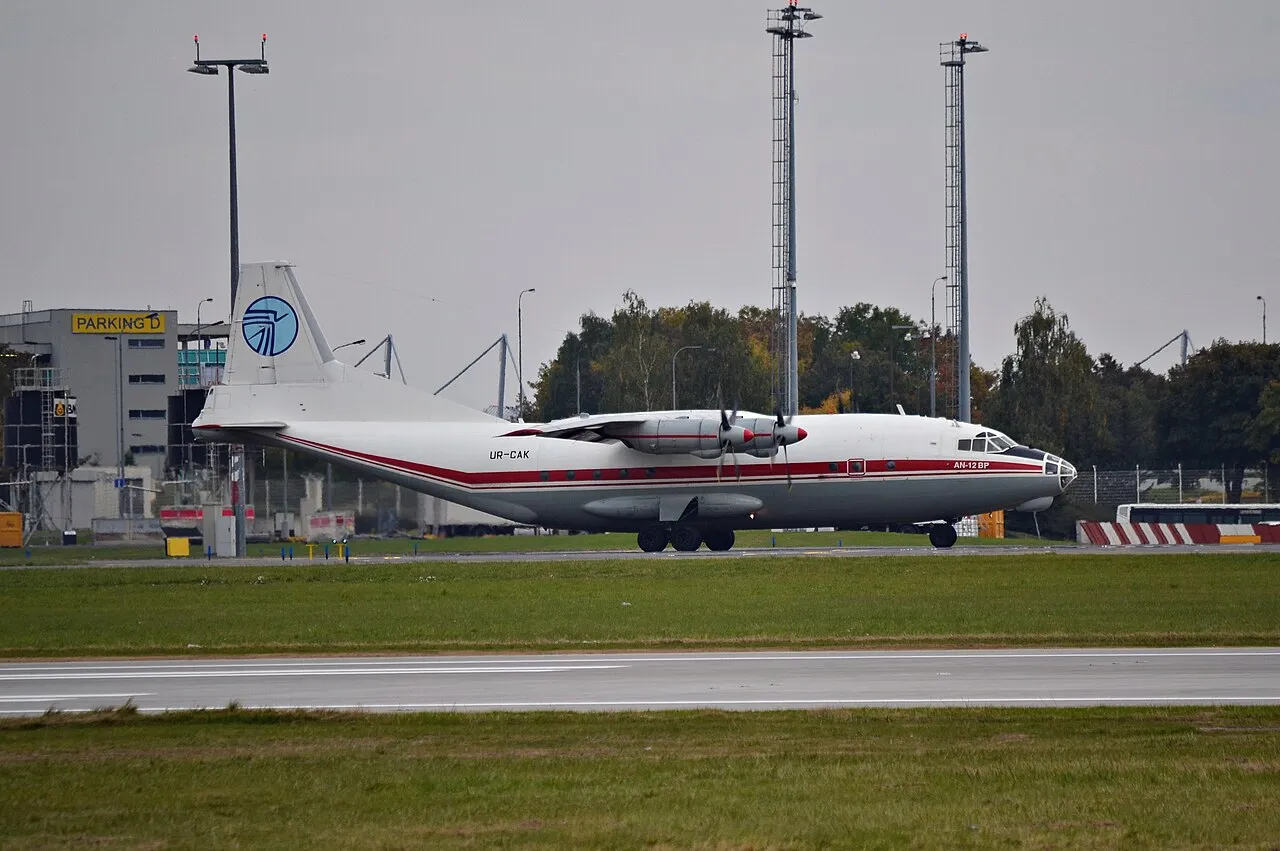
The Antonov An-12 is a four-engine turboprop cargo and military transport aircraft designed by Antonov. It entered Soviet military service in 1959, two years after its first flight, and carries the NATO reporting name Cub1. Built in large numbers through the 1960s and early 1970s, the type has outlasted the air force that commissioned it: a handful of cargo operators and some former-Soviet air forces still fly it today.
Design and development
Antonov designed the An-12 as a militarised version of its An-10 passenger transport, itself derived from the earlier An-8. The aircraft first flew on 16 December 1957 and was built around a rear loading ramp and a glazed nose for a navigator, features that let it carry oversized military cargo and paratroopers from rough airstrips. Four Ivchenko AI-20L or AI-20M turboprops, rated at 3,000 kW (4,000 shp) each, give it a cruise speed of around 570 km/h and a maximum take-off weight of about 61,000 kg. With maximum fuel it can range up to 5,700 km, falling to around 3,600 km with a full payload. Production ran from 1957 to 1973, with 1,248 aircraft built: the Irkutsk Aviation Plant built the first batches before output moved mainly to the Tashkent Mechanical Plant, which alone built 830 examples1, with further production at Voronezh and Kazan.
Variants
Antonov and its licensees adapted the basic airframe into around 30 different variants for specialist roles. The An-12BP became the standard tactical transport of the Soviet and allied air forces, with a higher maximum take-off weight and more fuel than the early production aircraft. Other versions covered electronic reconnaissance, weather research and civilian freight work. A proposed gunship variant modelled on the American AC-130, announced in 2019, was abandoned in 2021 as unsuitable1.
Operators and service
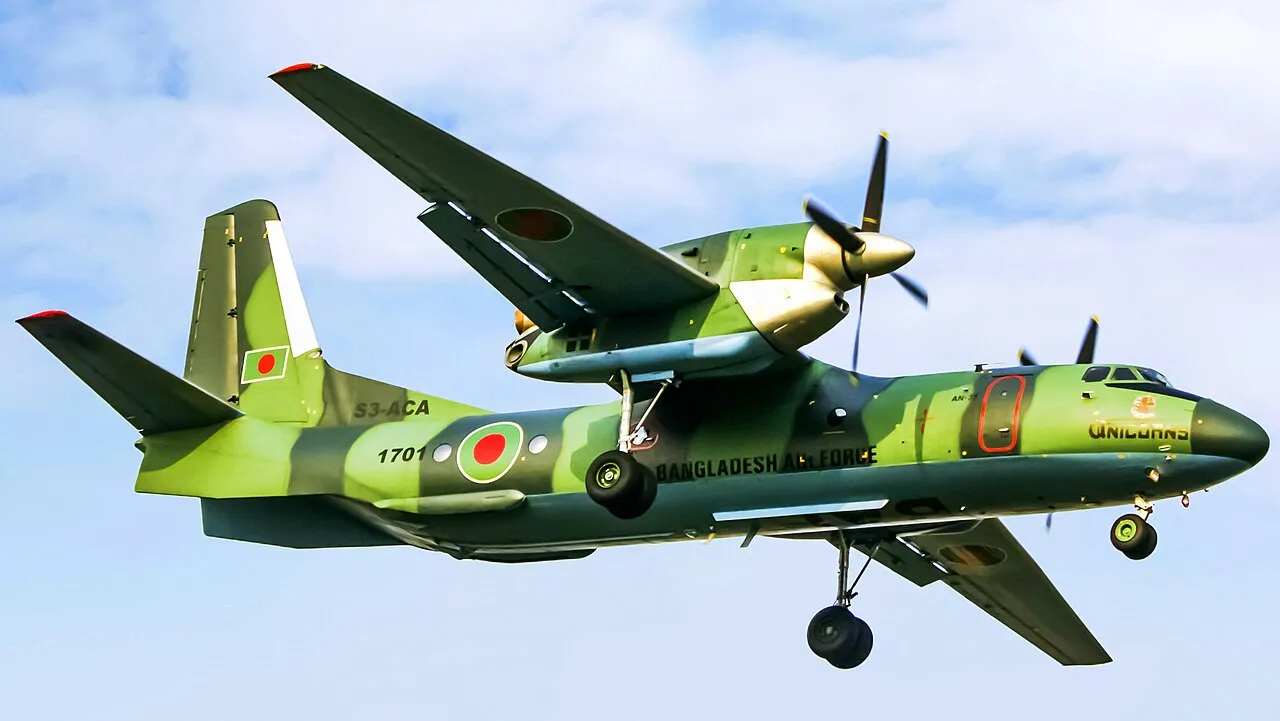
The An-12 served as the backbone of Soviet military airlift for decades. During the Soviet–Afghan War it carried paratroopers and equipment into Afghanistan, and Soviet soldiers nicknamed it the “Black Tulip” for the flights that carried the coffins of the dead back to Tashkent. After the Soviet collapse, successor air forces kept flying it: the Russian Aerospace Forces and Naval Aviation and the Uzbekistan Air and Air Defence Forces still operate the type, while the Ukrainian Air Force and Ukrainian Naval Aviation have since retired theirs. Several air forces outside the Soviet bloc also operated it and have since retired their fleets, among them India, which phased its An-12s out in the 1990s, and Bangladesh, which flew the type from 1973 into the 1980s1.
On the civil side, cargo carriers such as Ukraine Air Alliance, Cavok Air and Russia’s ATRAN Cargo Airlines kept examples flying commercially across the former Soviet Union, Africa and the Indian subcontinent. The United Arab Emirates temporarily banned the An-12 from its airspace in January 2009 and made the ban permanent in March 2010, after the type failed a civil aviation authority airworthiness evaluation. Today the type is retired by most air forces but still flown by a handful of cargo operators and some former-Soviet air forces1, typically crewed by two pilots, a flight engineer, a navigator and a radio operator, and able to carry up to 100 paratroopers or 20,000 kg of cargo.
Safety record
The An-12 has remained in military use long enough to suffer combat losses as well as accidents. Russia lost one An-12 on 1 June 2025, during Ukraine’s Operation Spider’s Web in the Russian invasion of Ukraine1.
Similar aircraft
- Ilyushin Il-76: a later, jet-powered Soviet military and cargo transport built for the same kind of tactical airlift role, linked to the An-12 as part of the Soviet transport lineage1.
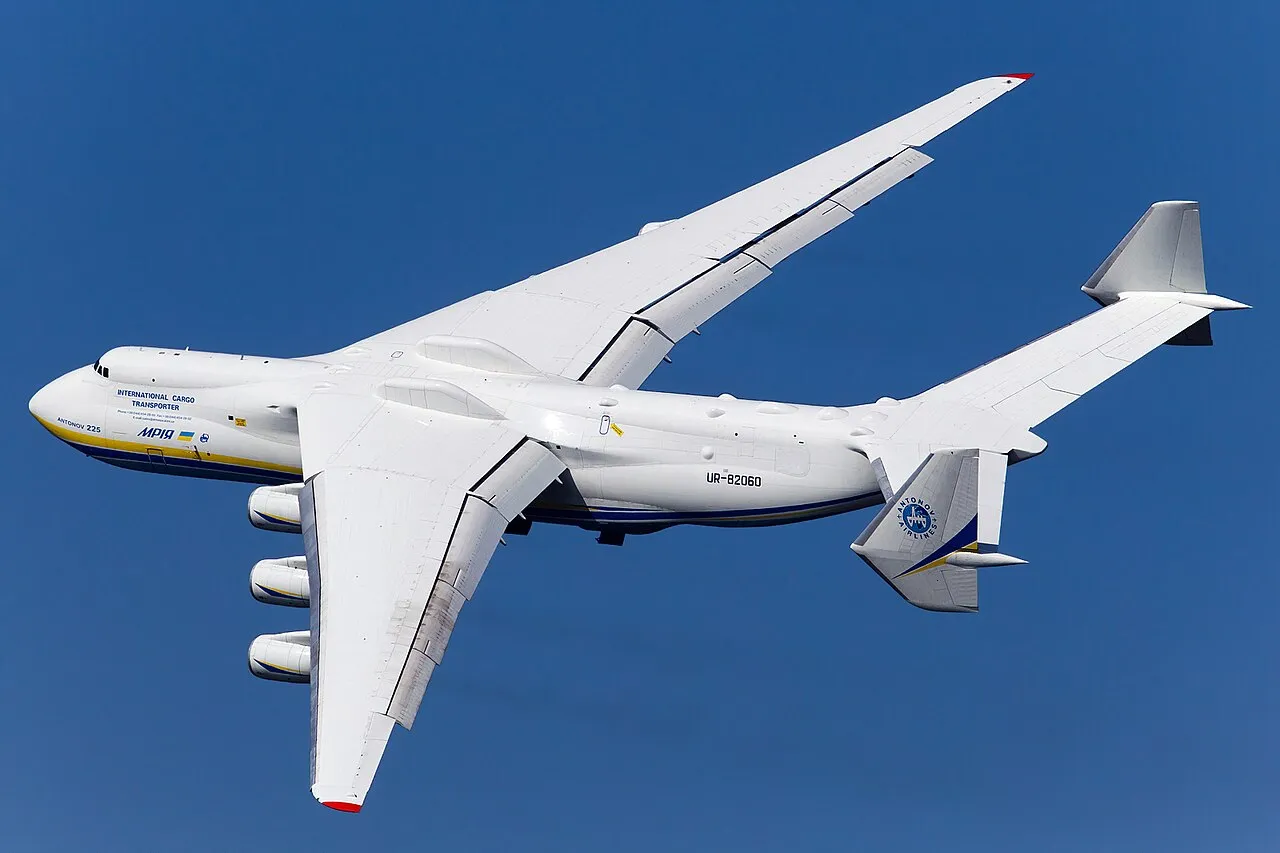
- Antonov An-124 Ruslan: a much larger Antonov military and civil freighter from the same design bureau, built for oversized cargo the An-12 cannot carry.
- Lockheed C-130 Hercules: the Western counterpart in size and role, a four-engine turboprop tactical transport of a similar era.