Contents
The Antonov An-26 is a twin-turboprop military transport aircraft built by Antonov, developed as a cargo and paratrooper variant of Antonov’s An-24 regional airliner. It first flew on 21 May 1969 and went on to become one of the Soviet Union’s most widely exported tactical transports, built in large numbers for the Soviet military and for air forces and cargo operators across the former Eastern Bloc, Asia and Africa. The type remains in service with Russia, Ukraine and a range of other military and civil operators1.
Design and development
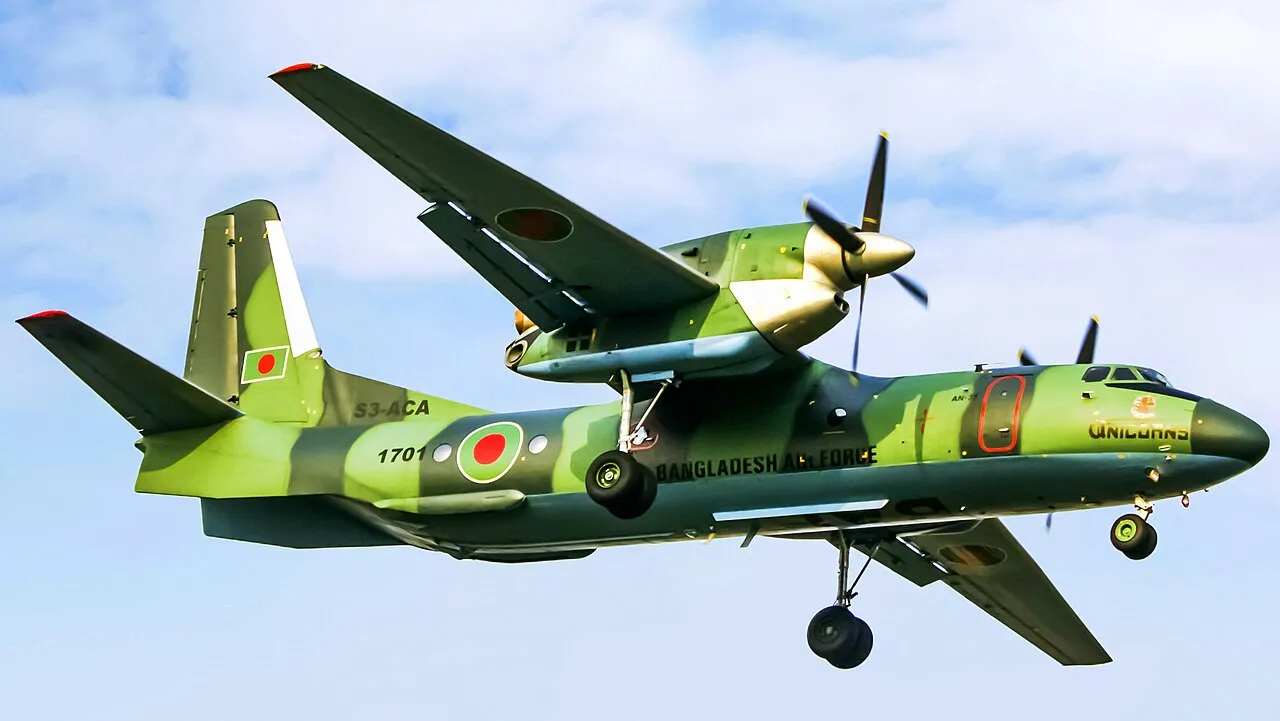
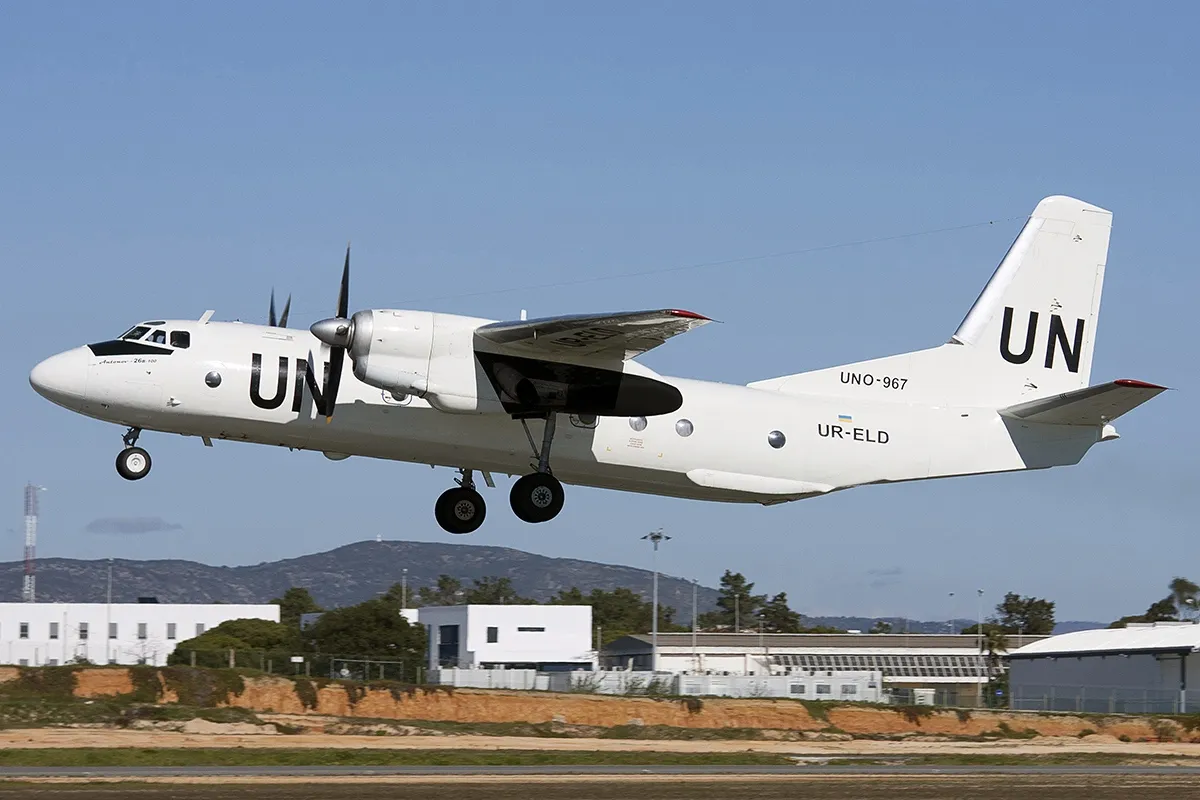
Antonov built the An-26 on the airframe of its An-24 passenger transport, but reworked the rear fuselage with a hydraulically operated loading ramp under an upswept tail, letting it load vehicles and paratroopers directly from the ground or drop cargo in flight. Power comes from two Progress AI-24VT turboprops, supplemented by a Tumansky RU19A-300 turbojet booster and auxiliary power unit mounted in the starboard engine nacelle, which gives the aircraft extra thrust for take-off from short or rough airstrips and electrical power on the ground. The aircraft is 23.8 m long with a wingspan of 29.3 m and a maximum take-off weight of 24,000 kg, cruising at around 440 km/h. With maximum fuel it can range up to 2,500 km, falling to about 1,100 km when carrying its maximum payload. A typical crew numbers five: two pilots, a radio operator, a flight engineer and a navigator. Antonov and its partners built about 1,403 examples from 19691, a total that includes the Chinese-built Xian Y-7 derivative produced under licence.
Specifications
In its troop-carrying role the An-26 seats up to 40 paratroopers, but the type was designed primarily as a freighter: with its seats removed it can instead carry 5,500 kg of cargo, or up to 24 stretchers in the medical evacuation role1. That flexibility, combined with the booster engine’s short-field performance, made it a standard support aircraft for Soviet and allied forces operating from unprepared strips.
Variants
The basic design spawned a series of specialised versions for roles ranging from survey work to electronic warfare, and the airframe was licence-built in China as the Xian Y-7H, which counts toward the roughly 1,403 total produced1. An uprated derivative, the Antonov An-32, fits more powerful engines in the same basic layout for operators needing better hot-and-high performance.
Operators and service
The An-26 flew widely across the Soviet bloc and with Soviet-aligned air forces elsewhere. Russia and Ukraine remain its largest military operators, with about 104 aircraft in Russian service as of 2016 and around 22 in Ukrainian service as of 2017, and China’s air force still flies 23 of the licence-built Xian Y-7 variant. Several African air forces, including Sudan, Chad and the Democratic Republic of Congo, also operate the type1, while a number of former Eastern Bloc air forces, among them Poland, Hungary, Bulgaria and the former Yugoslavia, have since retired theirs.
Civil cargo carriers adopted the An-26 for regional freight work, taking advantage of its ability to use short, unpaved runways that larger jet freighters cannot reach. Russian regional operators such as IrAero, Polar Airlines and KrasAvia and Ukrainian carriers such as Air Urga and ARP 410 Airlines1 kept examples flying commercially, alongside smaller operators elsewhere. The booster turbojet in the starboard nacelle, rarely needed in cruise, gave crews extra margin for take-off from high-altitude or hot airfields and from strips too short for the basic turboprop power alone.
Safety record
The type’s long military service, much of it in conflict zones, has produced a troubled accident record. Its deadliest crash killed 73 people aboard an Ethiopian Air Force aircraft near Addis Ababa on 14 January 1982, and other aircraft have been shot down during Cold War-era fighting in Afghanistan and Angola1, on top of losses from weather, mechanical failure and pilot error.
Similar aircraft
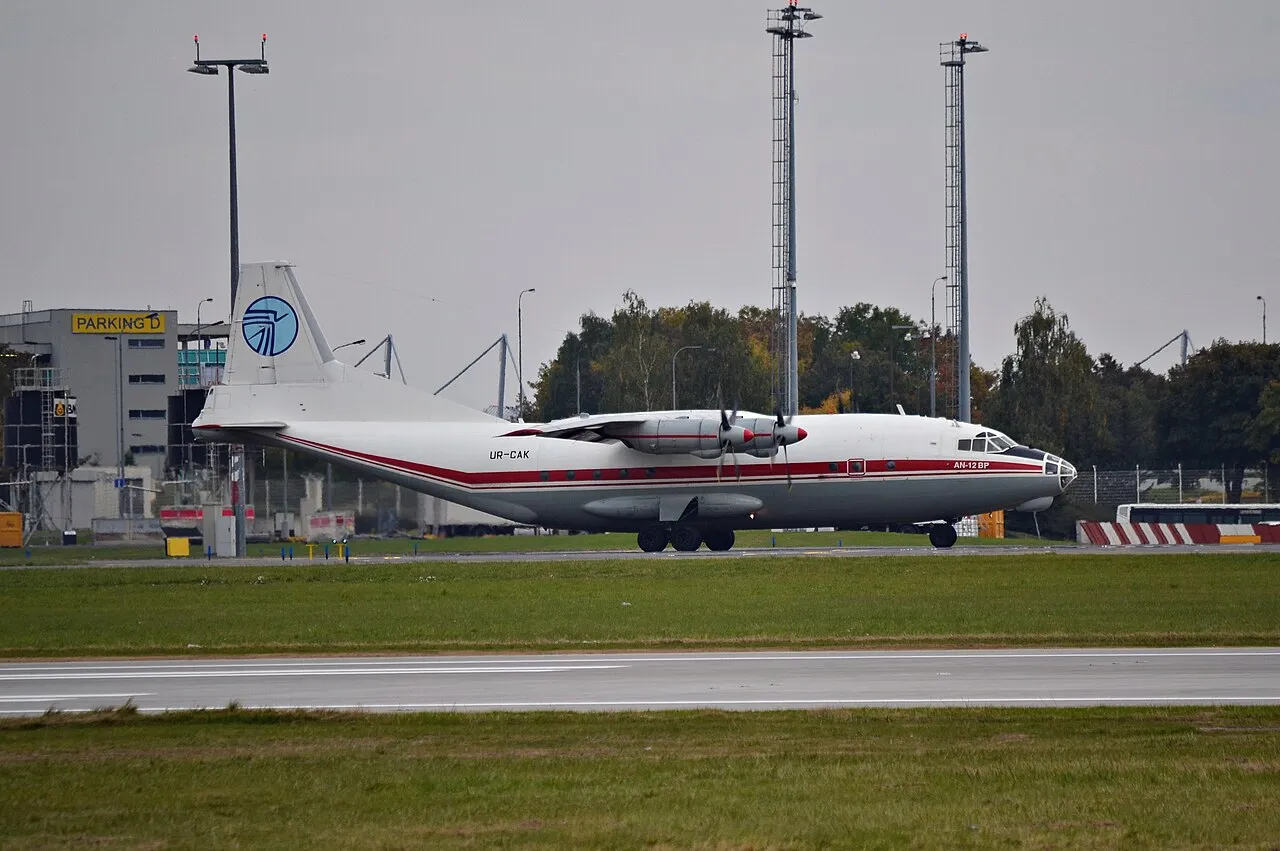
- Antonov An-12: a larger, four-engine Antonov military and cargo transport of the same Soviet lineage, built for the same kind of tactical airlift.
- Antonov An-32: an uprated derivative of the An-26 with more powerful engines, built for operators needing better performance from hot or high-altitude airfields.
- Antonov An-24: the passenger airliner the An-26 was derived from, sharing its basic wing, engines and fuselage.