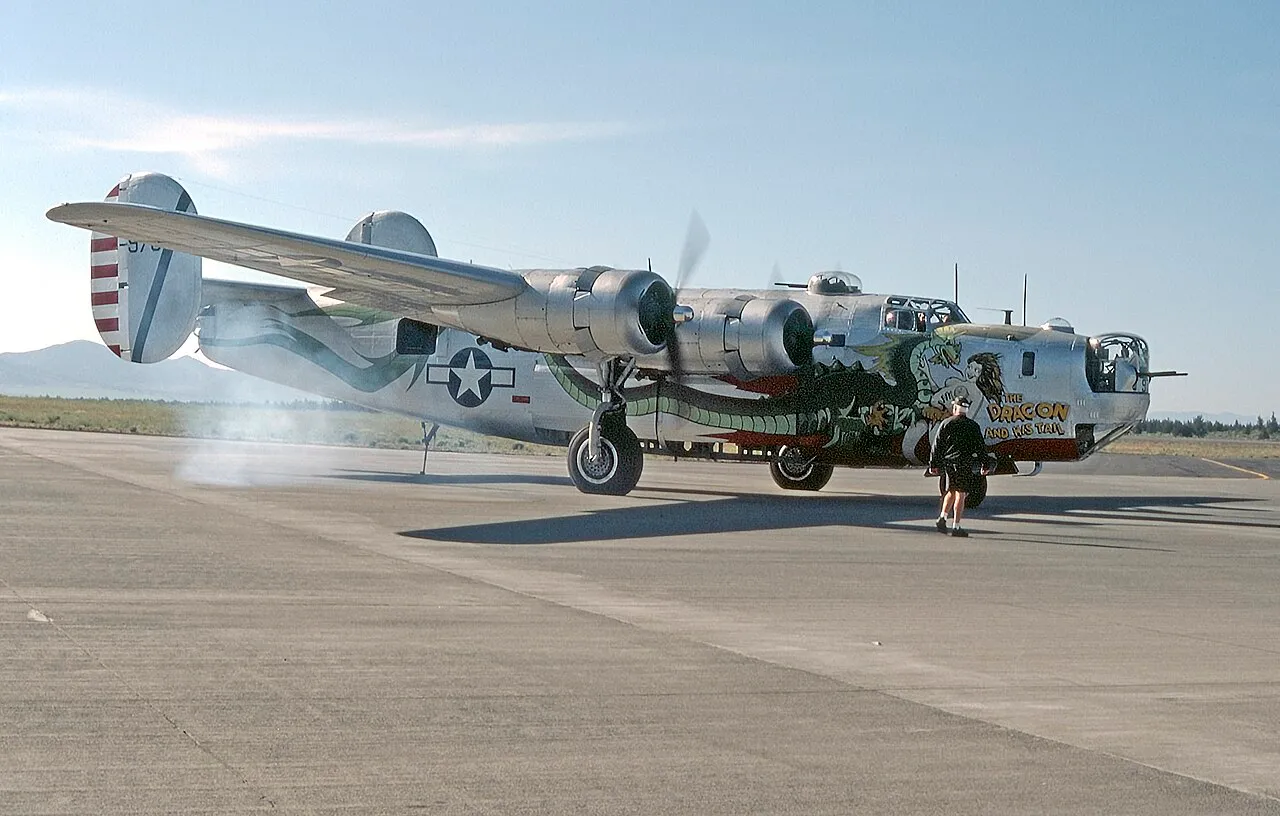
The Consolidated B-24 Liberator was an American heavy bomber built by Consolidated Aircraft and flown by the United States and its allies through the Second World War. It served as a long-range strategic bomber, maritime patrol aircraft and transport, and with about 18,500 built between 1940 and 19451 it became the most-produced American military aircraft of the war.
Design and development
Consolidated Aircraft had been asked in 1938 to build the Boeing B-17 under licence; after company executives visited Boeing’s plant, the US Army Air Corps instead issued a January 1939 specification for a new bomber with longer range, higher speed and a greater ceiling than the B-17. The design centred on the Davis wing, a high-aspect-ratio wing that gave the aircraft high cruise speed, long range and a heavy bomb load, mounted high on the fuselage to leave room for a large bomb bay below. The prototype first flew on 29 December 19391, and the type entered production soon after as orders arrived from both the US and Britain’s Royal Air Force.
The aircraft’s twin tail fins and slab-sided, deep fuselage made it visually distinct from the rounder B-17, and crews found it faster and longer-ranged than the B-17 but harder to fly in tight defensive formation. Wartime demand pushed production across multiple factories, including Consolidated’s own plants and a Ford Motor Company assembly line at Willow Run, Michigan, built specifically to mass-produce the bomber1.
Specifications
The production B-24J was 20.47 m long with a wingspan of 33.53 m and a maximum take-off weight of 29,484 kg. It was powered by four Pratt & Whitney R-1830 Twin Wasp turbo-supercharged radial piston engines, giving a cruise speed of about 346 km/h. Ferry range was about 5,955 km, though combat range with a bomb load was considerably shorter. A bomber crew numbered 11: pilot, co-pilot, navigator, bombardier, radio operator and gunners manning the nose, top, tail and ball turrets plus two waist positions1.
Variants
Beyond the baseline bomber, Consolidated and its partner factories built dedicated versions for other roles: the PB4Y-1 and later PB4Y-2 Privateer for the US Navy’s maritime patrol squadrons, and the C-87 Liberator Express, an unarmed transport derivative. The RAF flew its own Liberators under Lend-Lease, mainly for long-range maritime patrol against U-boats in the Battle of the Atlantic1.
Operators and service
The B-24 flew with the United States Army Air Forces, the Royal Air Force and other Allied air arms, serving in every theatre of the war from the Pacific to North Africa and Europe. It is remembered in particular for low-level raids on the Ploesti oil refineries in Romania in 1943 and for sustained strategic bombing campaigns alongside the B-17. After the war most Liberators were rapidly scrapped, but a handful remained in service with smaller air forces for decades; the Indian Air Force was the last operator, withdrawing its B-24s in 1968. The type is retired worldwide today1, with only a small number of restored aircraft still flying on the air-show circuit.
Similar aircraft
- Boeing B-17 Flying Fortress: the other mainstay American heavy bomber of the war, slower and shorter-ranged than the Liberator but considered easier to fly and better able to absorb battle damage.
- Avro Lancaster: the RAF’s principal heavy bomber, built for night raids over occupied Europe in the same period as the B-24’s daylight missions.
_1q2mX3.webp)