Contents
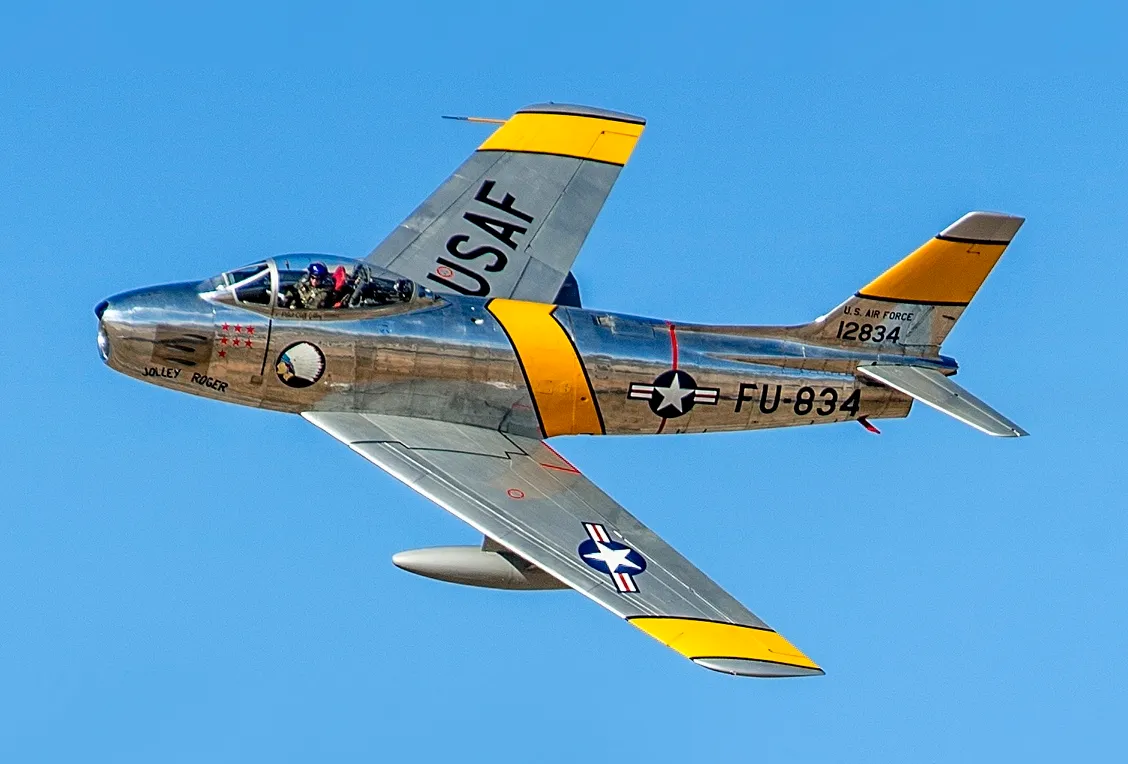
The North American F-86 Sabre is a swept-wing, single-seat jet fighter built by North American Aviation, the company that had earlier built the P-51 Mustang. It became the primary United States air combat fighter during the Korean War1, flying as both an interceptor and a fighter-bomber, and went on to serve with air forces around the world for decades after.
Design and development
The Sabre grew out of North American’s jet experience with the FJ-1 Fury, a straight-wing design proposed to the US Navy in late 1944. Early US Army Air Forces requirements produced four design proposals in 1945, one of which was developed as the XP-86. The decisive change came when engineers incorporated German wartime aerodynamic research showing that a thin, swept wing could cut drag and delay compressibility problems; wind-tunnel testing confirmed the approach despite initial scepticism, and the team settled on a 35-degree swept wing with modified NACA airfoils1.
The XP-86 prototype rolled out on 8 August 1947 and made its first flight on 1 October 1947, flown by George Welch at Muroc Dry Lake, California (now Edwards Air Force Base). Early aircraft used leading-edge slats, adapted from the Messerschmitt Me 262, for stability at low speed; later production replaced these with a solid “6-3” leading edge and, on the F-86F-40, a slatted wing again. The F-86E introduced an all-flying tail that greatly improved control at high speed. The type entered US Air Force service in 1949 with the 1st Fighter Wing1.
Specifications
Figures below are for the F-86F-40-NA variant. The Sabre is 11.3 m long with a wingspan of 11.91 m and a maximum take-off weight of 8,233 kg. It carries one pilot and is powered by a single General Electric J47-GE-27 turbojet rated at 5,910 lbf thrust; the original XP-86 prototype had flown with a less powerful J35-C-3 of 4,000 lbf, and the fighter-bomber F-86H later used a J73-GE-3 of 9,250 lbf. Ferry range with two underwing drop tanks was about 2,454 km, while combat range carrying two 1,000 lb bombs and two drop tanks fell to about 666 km1.
Standard armament was six 0.50-inch M3 Browning machine guns in the nose, firing at 1,200 rounds per minute and harmonised to converge at 1,000 feet; the F-86H swapped these for four 20mm cannon, and fighter-bomber versions could carry up to 2,000 lb of bombs and rockets along with external fuel tanks. A total of 9,860 Sabres were built between 1949 and 1956 by North American Aviation, Canadair, CAC, Fiat and Mitsubishi, over 7,800 of them in the United States, Japan and Italy alone1, making it the most-produced Western jet fighter of its generation.
Variants
North American itself built several distinct models: the F-86A (554 built) with the original J47 engine; the F-86E (456 built), the first with the all-flying tail; the F-86F (2,239 built), with an uprated engine and the slat-less “6-3” wing, later revised on the F-40 sub-variant with a slatted wing; and the F-86H (473 built), a deeper-fuselage fighter-bomber with the more powerful J73 engine. A radically different all-weather interceptor family, the F-86D/L, added radar and a distinctive nose radome and shared only about 25 percent of its parts with the day-fighter versions; 2,506 were built1.
Licensed production added further variants: Canadair in Canada built 1,815 Sabres in six marks with progressively more powerful Orenda engines; the Commonwealth Aircraft Corporation in Australia redesigned about 60 percent of the fuselage to fit a Rolls-Royce Avon engine with 50 percent more thrust, armed with 30mm Aden cannon and AIM-9 Sidewinder missiles, building 112; and Fiat and Mitsubishi built 221 and 300 aircraft respectively under licence. Specialised versions included the RF-86F reconnaissance aircraft, the two-seat TF-86F trainer, and QF-86F/H target drone conversions1.
Operators and service
Three USAF squadrons took the F-86 into Korean War combat in December 1950 to counter the Soviet-supplied MiG-15, which at first outperformed the Sabre in ceiling, firepower, acceleration, turn rate and climb; the F-86 was only marginally faster and relied on being able to out-dive the MiG. The improved F-86F arriving in 1953 closed the gap, helped by its APG-30 radar gunsight and generally more experienced pilots. Wartime US claims put the kill ratio at 10:1 (792 MiGs for 78 Sabres), but a later Air Force review, “Sabre Measure Charlie,” downgraded this by half to roughly 5:1; Soviet, Chinese and North Korean sources together acknowledge about 659 MiG-15 losses from all causes, and recent research puts the real F-86 kill ratio nearer 1.8:1 overall, and about 1.3:1 against Soviet-flown MiGs. The USAF lost 224 F-86s in the war, 78 of them in air-to-air combat, while more than 40 American pilots became aces flying the type1.
The Sabre went on to serve with more than 30 countries, including Japan, Spain and South Korea. Pakistan received 102 F-86Fs from 1954 and used them in the 1965 war, where Sidewinder-armed Sabres claimed 15 Indian aircraft, and again in 1971, when two Sabres engaged four Indian MiG-21s and shot one down without loss by exploiting the type’s low-speed handling. During the 1958 Taiwan Strait Crisis, US Navy-fitted Sidewinders on Taiwanese F-86s proved devastating against PLAAF MiGs. The last operator, the Bolivian Air Force, retired its Sabres in 19941, nearly half a century after the type’s first flight.
The Sabre also set records outside combat. Major Richard L. Johnson set a world speed record of 671 mph on 15 September 1948, and on 18 May 1953 Jacqueline Cochran became the first woman to break the sound barrier flying a Canadian-built Sabre Mk 31.
Safety record
The Sabre’s nose had a tendency to rotate prematurely on take-off, a handling trait that could lead to dangerous over-rotation. That risk was realised in a 1972 crash of a Canadair Sabre at a Sacramento air show, which killed 22 people and injured 28 on the ground1.
Similar aircraft
- Mikoyan-Gurevich MiG-15: the Soviet-built swept-wing fighter the Sabre was built to counter over Korea.
- North American P-51 Mustang: North American’s earlier piston-engined fighter, whose production experience fed into the Sabre’s design.
_1q2mX3.webp)