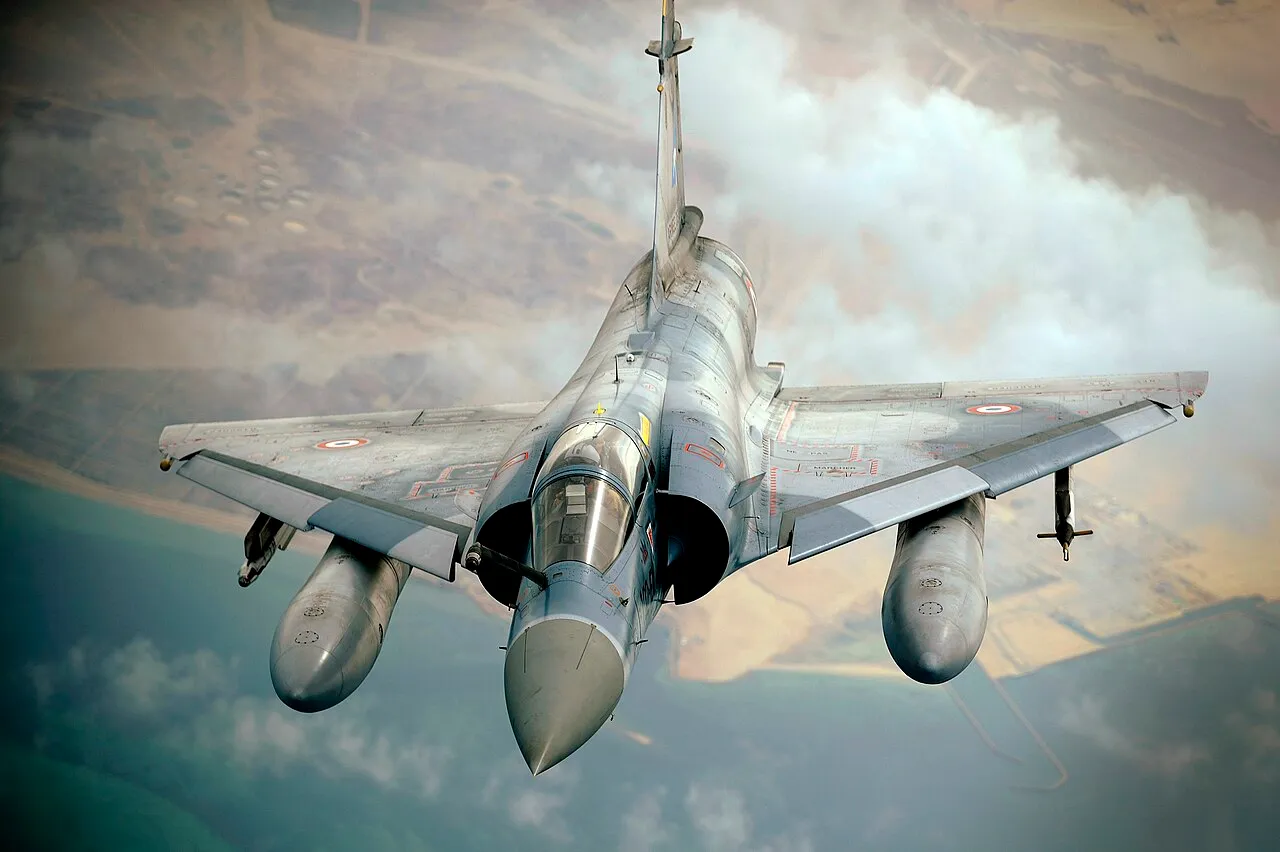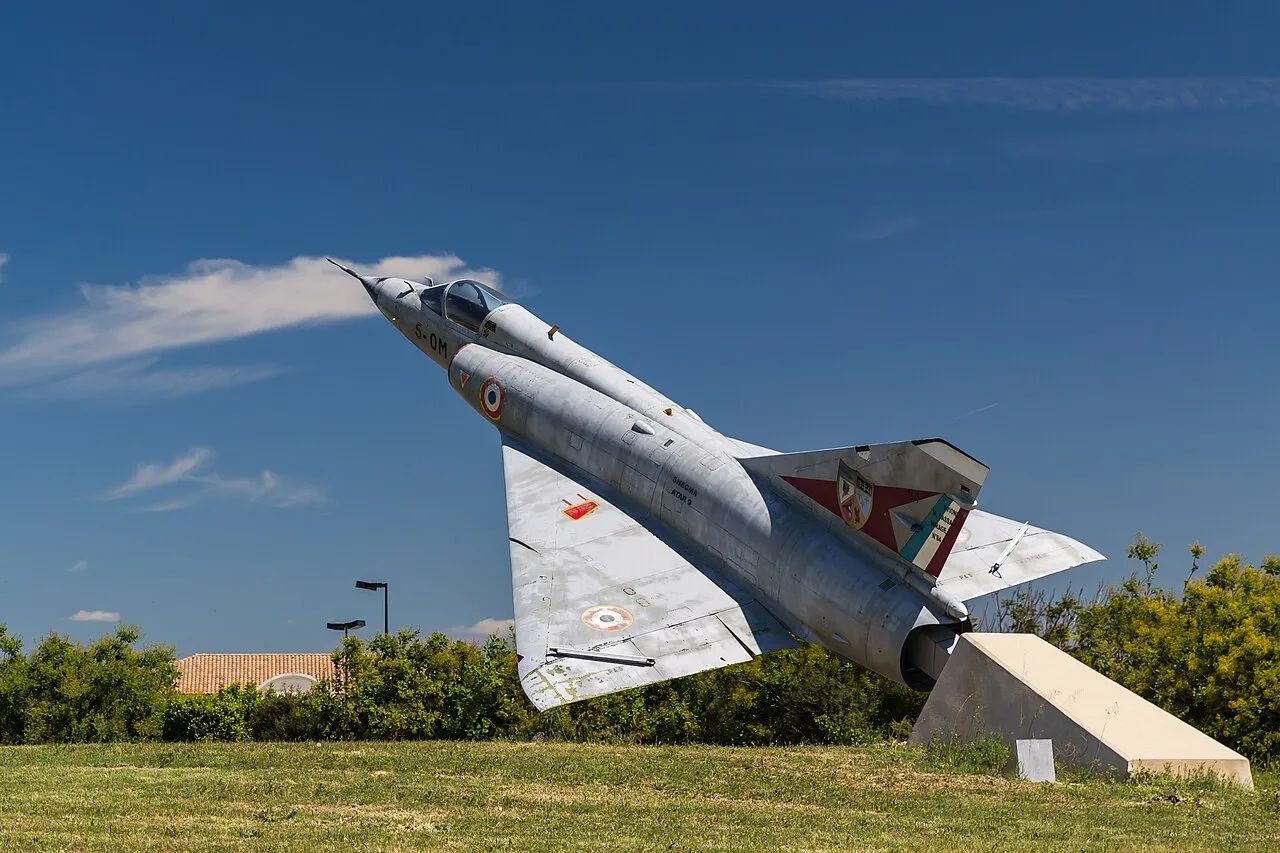
The Dassault Mirage III is a single-engine fighter-bomber with a delta wing that Dassault Aviation designed at the end of 1955. It was produced in large numbers for the French Air Force and many export customers, and its design was adapted into trainer, reconnaissance and ground-attack versions2. When the first Mirage III C landed at Dijon-Longvic on 7 July 19611, it was Europe’s first operational Mach 2 aircraft. As of 2023, Pakistan was the only country still operating it3.
Design and development
The Mirage III was built for the light interceptor programme the French Air Force defined after the Korean War. Its forerunner, the MD 550, first flew on 25 June 1955 and was later renamed Mirage I, but its performance was limited by its non-adjustable air intakes and a lack of engine power1.
The Mirage III 001 prototype first flew at Melun-Villaroche on 17 November 1956, with Roland Glavany at the controls. Its fuselage followed the area rule, which gave it a distinctive waisted profile. After its showing at the Paris Air Show on 11 June 1957, it reached Mach 1.8 in level flight on 19 September with its auxiliary rocket, and its air intakes then prevented any further increase in speed. The design office answered with a movable half-cone centrebody in the intakes1, known in French as the souris (“mouse”).
The French Air Force ordered 10 pre-production aircraft in April 1957 and 95 production Mirage III C in 1959. The pre-production Mirage III A first flew on 12 May 1958, and Roland Glavany used it to make western Europe’s first Mach 2 flight. In Dassault’s words, each aircraft had the same airframe and engine but could be delivered in any of four versions. The type entered operational service with the French Air Force on 19 December 19611.
Specifications
The Mirage IIIE is 15.03 m long, with a wingspan of 8.22 m. It weighs 7,050 kg empty, and its maximum take-off weight is 13,700 kg. It is powered by one SNECMA Atar 09C afterburning turbojet of 60.8 kN with afterburner, plus an SEPR 841 liquid-fuelled rocket engine of 14.7 kN2.
Its top speed is Mach 2.2, or 2,350 km/h at 12,000 m, and its service ceiling is 17,000 m. Its combat range is 1,200 km and its ferry range 3,335 km. The Mirage IIIC was armed with twin 30 mm DEFA cannon in the belly, and the IIIE can carry 4,000 kg of payload on five external hardpoints2, including bombs, reconnaissance pods or drop tanks.
Variants
The two-seat Mirage III B first flew on 20 October 1959. Its fuselage was lengthened for the second crew member, and its nose cone no longer contained radar. The Mirage III C was the interceptor version, and its first production-standard aircraft flew on 9 October 19601.
The Mirage III E was designed for low-altitude air strikes, with a fuselage lengthened by 30 cm and the more powerful Atar 9C engine. It first flew on 5 April 1961, and the French version was later fitted with the AN 52 tactical nuclear warhead. The Mirage III R, for tactical reconnaissance at low and medium altitudes, first flew on 31 October 19611. Variants of the IIIE were built under licence in Australia as the IIIO and Switzerland as the IIIS2.
The Mirage 5 grew out of a request to Dassault from the Israeli Air Force and first flew on 19 May 1967; it led directly to the Israeli Nesher. South Africa converted Mirage III airframes into the Atlas Cheetah, which fixed foreplanes distinguish from its Mirage predecessor2. Dassault’s Mirage III NG, meant to replace the Mirage III, 5 and 50, first flew on 21 December 1982 but was never exported1.
Operators and service
Dassault counts 1,401 Mirage III, 5 and 50 aircraft built since 1958, which served in 21 countries. France’s air force took delivery of 457 aircraft including 50 Mirage 5 F and withdrew the last from operational units in 19941.
Israel used its Mirages in the Six-Day War of June 1967; they typically flew as fighters after the first day, and Mirage pilots were credited with 48 of a claimed 58 Arab aircraft shot down in air combat. After that war France imposed an arms embargo on the region. South Africa took delivery of 16 Mirage IIICZ interceptors between December 1962 and March 1964, and the Swiss Mirage IIIS entered operational service in 1967. The Royal Australian Air Force withdrew its Mirage III in 19882, and 50 of the surviving fighters were exported to Pakistan. Brazil’s air force flew the type from 1972 to 20053.
In the 1982 Falklands War, Argentina’s Mirage IIIEAs lacked any aerial refuelling capability and had no more than five minutes over the combat area. In their one direct combat, one was shot down by a Harrier’s AIM-9L Sidewinder2 and another was destroyed by friendly fire.
Pakistan chose to buy 18 Mirage IIIEPs, 3 IIIDPs and 3 IIIRPs in 19672 and upgraded its fleet under Project ROSE. As of 2023 its air force operated 87 of the 135 Mirage III it received, with no scheduled decommissioning date, and Chengdu J-10CEs will eventually replace them. In Switzerland, a museum’s Mirage IIIDS, HB-RDF, made its last tourist flight on 25 May 2023, after the Swiss civil aviation authority withdrew its flight authorisation in October 20223.
Similar aircraft
- Dassault Mirage 2000: a Dassault delta-wing fighter with negative stability and fly-by-wire controls4.
- Mikoyan-Gurevich MiG-21: a Soviet Mach 2 fighter whose delta wing is paired with a tail5.
- Lockheed F-104 Starfighter: built around an extremely thin wing with a thickness-to-chord ratio of 3.36%6.