Contents
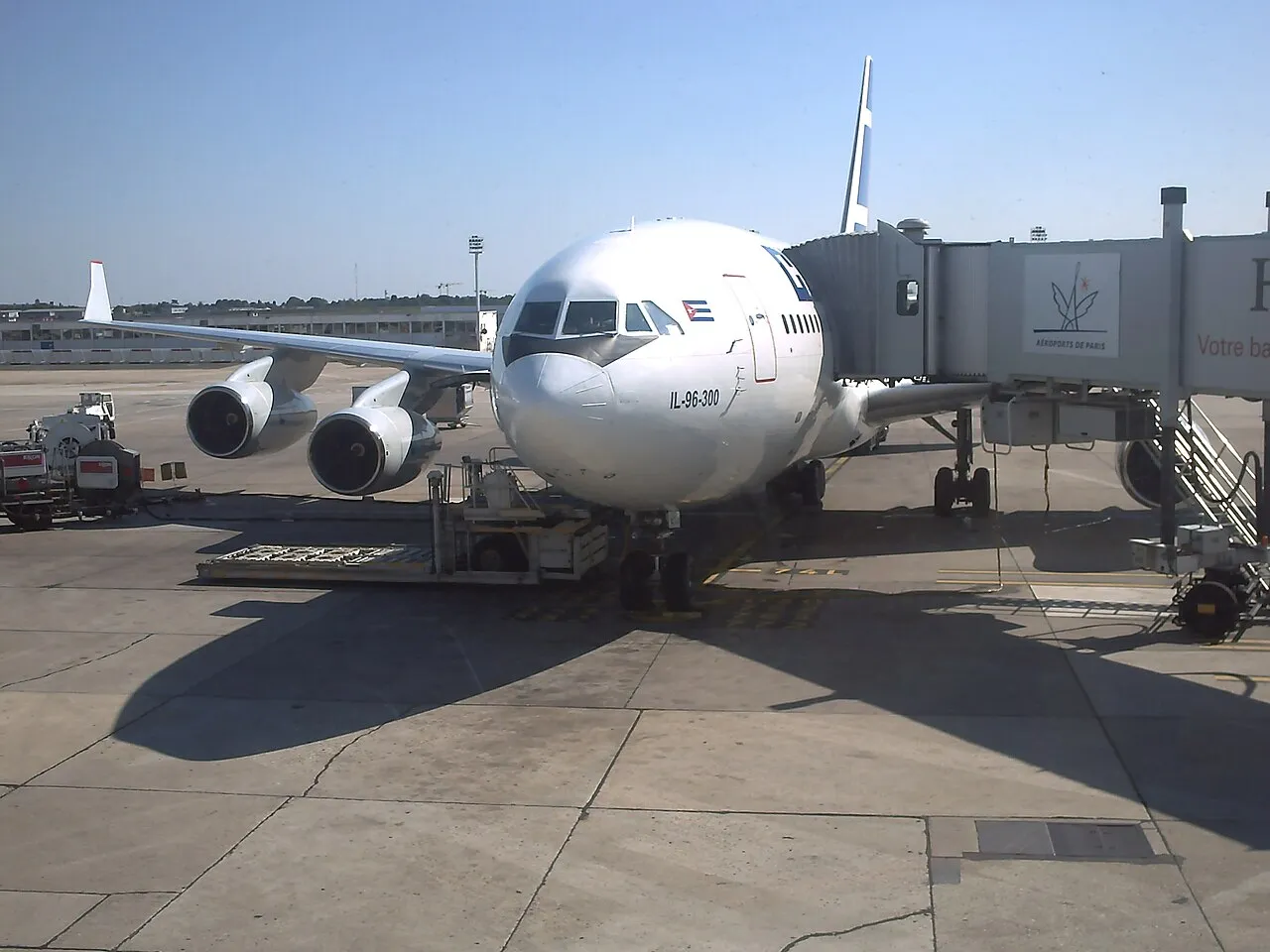
The Ilyushin Il-96 is a four-engined, long-range wide-body airliner designed by Ilyushin and built by the Voronezh Aircraft Production Association1. As of 2026 it carries Russian state and government passengers, flies cargo, and Cubana de Aviación remains its only commercial passenger operator2.
Design and development
Ilyushin designed the Il-96 to fix the shortcomings of its earlier wide-body, the Ilyushin Il-86, whose range fell well short of what Aeroflot needed on its longest routes. That shortfall pushed Ilyushin to plan a longer-range Il-86 derivative, the Il-86D, whose design was completed in 19762; the Il-96 that eventually followed it kept a fuselage about 4 metres shorter than the Il-86’s while adding supercritical wings, a triplex fly-by-wire flight control system and new avionics. The biggest change was its engine: the Il-96 replaced the Il-86’s older turbofans with four Aviadvigatel PS-90A turbofans1, a high-bypass design that cut fuel burn and lifted overall performance.
The prototype first flew on 28 September 1988, and Aeroflot began passenger service with the Il-96 in July 1993, flying it on routes that had previously relied on the ageing Il-62, including nonstop service between Moscow and destinations such as Havana and San Francisco2. The cockpit carries a six-screen electronic flight instrument system built around Collins digital avionics, along with a flight management system meeting RNP-1 navigation performance requirements, a ground-proximity warning system and a traffic-collision-avoidance system1.
Specifications
The main production version, the Il-96-300, is 55.35 metres long with a wingspan of 60.12 metres. Its maximum take-off weight is 250,000 kg, and its range is about 10,000 km with a 30-tonne payload, or 11,000 km with 262 passengers. Typical seating is 262 passengers in a two-class layout, with 18 business seats at a 54-inch pitch and the rest economy; Airport Technology also describes a specified 289-seat layout that raises the business-class count to 44 seats. It is powered by four Aviadvigatel PS-90A turbofans2, each rated at 16,000 kgf of thrust, giving the aircraft a top speed of Mach 0.84 and a service ceiling of 13,100 metres. Ilyushin designed the airframe for a service life of 20 years, 20,000 landings or 60,000 flight hours1.
Variants
The baseline Il-96-300 was followed by the stretched Il-96M, lengthened by 10 metres and re-engined with four Pratt & Whitney PW2337 turbofans, raising capacity to 312 passengers in a three-class layout with a range of about 10,400 km. That programme stalled when the US Export–Import Bank suspended financing talks for the engines and avionics2 after lobbying from Boeing. Ilyushin answered with an all-Russian stretch instead, the Il-96-400, powered by uprated PS-90A1 engines rated at 17,400 kgf and seating up to 436 passengers over a 10,000 km range, plus a freighter derivative, the Il-96-400T, rated to carry about 92 tonnes of cargo1.
A further passenger stretch, the Il-96-400M, first flew on 1 November 2023 with planned seating for 390 passengers; the Russian government put ₽3.6 billion (about $57.4 million) into the programme in 2017, a 2021 announcement said only two would be built rather than the mass production once planned, and starting in 2025 it was included in a national plan to prepare for mass production. Ilyushin also studied a double-deck Il-96-550 for 550 to 600 passengers and a tanker version meant to transfer more than 65 tonnes of fuel over 3,500 km2; both were cancelled, the tanker in favour of the Il-78M-90A.
Operators and service
Aeroflot flew seven Il-96-300s delivered between 1992 and 1994 before retiring its last example, bought by Cubana de Aviación in 2015. Cubana de Aviación is its only remaining commercial operator in passenger service. In Russia, the Il-96-300 carries the country’s leadership: the Il-96-300PU is the main presidential aircraft, flown by Yeltsin, Putin and Medvedev. The wider fleet of Il-96-300s otherwise flies with Russia’s special flight detachment and with Ilyushin itself, while a pair of Il-96-400T freighters fly with Sky Gates Airlines2.
Total production stands at 34 aircraft built since 1992, peaking at three in 1994. In August 2009, Russia’s industry minister announced that Il-96-300 production would cease, judging it commercially uncompetitive against Boeing and Airbus wide-bodies at a rate of barely one aircraft a year, while the Il-96-400T freighter was to remain in production2. Sanctions that followed Russia’s 2022 invasion of Ukraine blocked the country from buying Western-made airliners or parts, and with around three-quarters of Russia’s commercial fleet built in the West, officials revived interest in Soviet-era types: Russian airlines reactivated mothballed Il-96 and Tupolev Tu-204/214 jets from storage as part of 12 aircraft due back in service in 20263.
Safety record
No accident has caused a passenger or crew fatality in the Il-96’s service history. In 2005, Russia indefinitely grounded the Il-96-300 over braking-system faults found by transport inspectors. One airframe, RA-96010, was written off in a 2014 fire while in storage at Sheremetyevo2.
Similar aircraft
- Ilyushin Il-62: the older Soviet long-hauler the Il-96 took over from on Aeroflot’s longest nonstop routes2.
- Ilyushin Il-86: the Il-96’s direct predecessor, with a fuselage about 4 metres longer1 but shorter range and older engines.
- Airbus A340: another four-engined long-haul wide-body of comparable role and era2.