Contents
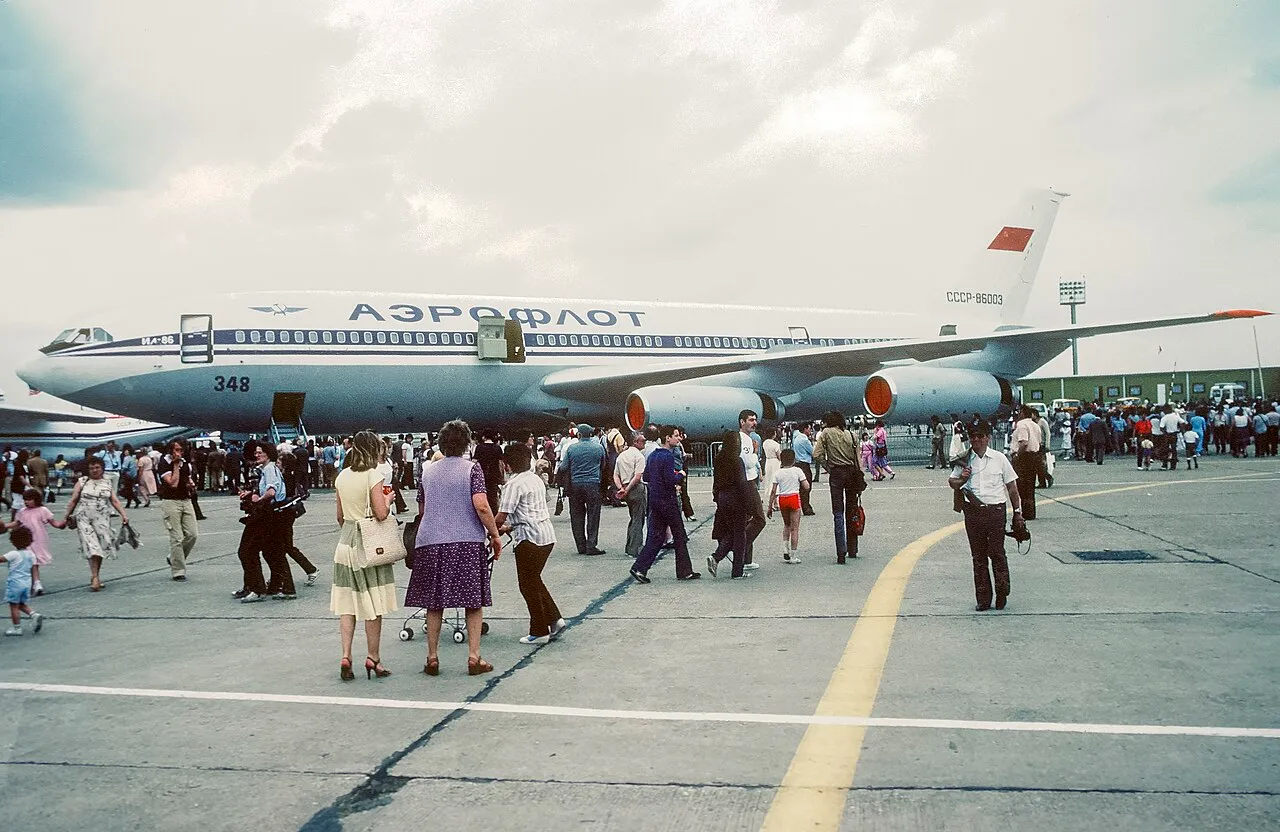
The Ilyushin Il-86 was the Soviet Union’s first wide-body airliner, built by Ilyushin and assembled at the Voronezh factory, today VASO. A total of 106 were built between 1976 and 19912, and as of May 2011 no civilian Il-86s remained in service1, though military command-post versions kept flying after that.
Design and development
The project began in the 1960s as the Soviet answer to Western wide-body jets such as the Boeing 747, after Aeroflot’s planners projected over 100 million annual passengers. The Soviet government launched a design competition in October 1967 for a 350-seat wide-body2 with substantial cargo capacity, which Ilyushin won. Ilyushin first favoured rear-mounted engines, as on its own Il-62, but switched to underwing pod-mounted engines1 after Soviet engineers met Boeing representatives on titanium and pylon-mounting technology, a meeting that may have made the difference.
The chosen Soloviev D-30 engine could not reach the required thrust, so Ilyushin fitted the Kuznetsov NK-86 instead, a version of the NK-8 with a 1.15-to-1 bypass ratio and drag-inducing grilles over its thrust reversers. Instead of pressing Soviet airports to modernise their ground equipment, engineers built the aircraft to work around existing runways and terminals: a self-loading luggage system let passengers carry bags to underfloor holds themselves1, and retractable airstairs built into the cargo hold2 let it board without ground stairs.
Design work began in earnest in 1974, and the Il-86 made its first flight on 22 December 19761. State acceptance trials began in April 1979, and the type entered service with Aeroflot in December 1980. It flew with a four-person flight deck crew of two pilots, a flight engineer and a navigator, and its cabin used an unusual 3+3+3 seat layout2, not the 2+4+2 rows common on Western wide-bodies.
Specifications
The Il-86 is about 60 metres long with a 48.06-metre wingspan and a maximum take-off weight of 215,000 kg, with a 6.07-metre-wide fuselage, the second-widest of any airliner until the Boeing 777 arrived. It is powered by four Kuznetsov NK-86 turbofans, each rated at 127.5 kN of thrust; Airways reports the engines were thirsty enough to burn nearly eight tonnes of fuel an hour2. Aeroflot seated 320 passengers in three classes, or up to 350 all-economy, with a cruise speed around 850 km/h and a range of about 5,000 km1.
Variants
Only the base Il-86 passenger version went into full production. Ilyushin also built four Il-86VKP airborne command posts, known to NATO as “Maxdome” and based at Chkalovsky air base near Moscow for the Soviet, then Russian, military. A longer-range Il-86D, ordered in June 1972 but evolved instead into the later Il-96, never entered production as such. A “minimum-change” development designated the Il-86V was test-flown on 1 June 1982 and ready for service by 27 April 19851, with a reported 450 seats fitted into the underfloor entrance vestibules; it may have seen military use rather than Aeroflot’s.
Operators and service
Aeroflot began flying the Il-86 on domestic routes from 1 February 1981, extending it to Eastern Europe that June and Western Europe that October; Airways describes the type as having mainly operated domestic Soviet routes2 throughout its career. On its longest routes it flew from Moscow to Havana via Shannon and Gander, and on to South American cities via Sal in Cape Verde. Only three Il-86s were exported, to China Xinjiang Airlines in 1990; after the Soviet Union broke up, the type passed to Siberia Airlines, Kras Air, Donavia, Pulkovo and Ural Airlines1, plus the flag carriers of Armenia, Kazakhstan, Uzbekistan and Ukraine.
Several factors pushed it toward retirement, Airways reports, among them the NK-86 engines’ fuel-hungry and noisy operation, which tightening airport noise rules turned into a serious liability2. From 1 April 2002, stricter ICAO “stage 3” noise rules took effect worldwide, and aviation analyst Vladimir Kornozov said the rule would hit charter operators flying big jets like the Il-86 especially hard; Russia’s own transport minister warned it could force the country to cancel 11,000 flights that year, since about 80 percent of Russia’s roughly 2,000 civilian aircraft3 did not meet the new standard. Aeroflot withdrew its Il-86s from 2006, with none left flying by May 2011; S7 Airlines (formerly Siberia Airlines) last flew the type in 2008. In March 2022, after Western sanctions cut Russian airlines off from new jets and spare parts, Russia’s transport minister said S7 Airlines would convert three stored Il-86s back to passenger use; aviation outlet Mentour Pilot called the plan questionable, given the jets had sat in storage for over a decade4. As of 2020, three Il-86VKP command-post aircraft remained in Russian Air Force service1.
Safety record
The Il-86 was never involved in a fatal accident during scheduled passenger service, though by August 2013 the type had been in at least 10 incidents, four hull losses and 23 fatalities among crew and ground staff. In March 1994, a parked Il-86 at Delhi was destroyed by a crashing Sahara India Boeing 737, which killed four aboard the 737, three on the Il-86, one on the ground1.
The type’s deadliest accident came on 28 July 2002, when an Il-86 operating Pulkovo Aviation Enterprise Flight 9560 crashed shortly after taking off from Moscow’s Sheremetyevo Airport, registration RA-86060, on a non-passenger repositioning flight to St Petersburg. Two seconds after lift-off, a fault in the trim toggle button spontaneously retrimmed the tailplane: the aircraft first climbed too steeply, then the nose-heavy trim sent it into a dive, and it crashed into a forest nearby, bursting into flames, killing 14 of the 16 crew on board; two flight attendants survived. Investigators initially suspected engine failure, and four days after the crash said the pilots may have made an incorrect response to that suspected engine failure5. The accident grounded the Il-86 fleet temporarily, and certification was restored in stages by early 20031.
Similar aircraft
- Boeing 747: also a four-engined wide-body, but Boeing’s 747-400 typically seated 416 passengers in a three-class layout6, well above the Il-86’s all-economy 350, and it sold to airlines worldwide instead of mainly to one state carrier.
- McDonnell Douglas DC-10: a Western wide-body of similar vintage; General Electric says airlines selected its 40,000 lb-thrust CF6-6 engine for the DC-10 in spring 19687; the Il-86 needed four smaller Kuznetsov turbofans for a similar job.
_Z2jNuNL.webp)