Contents
The Ilyushin Il-62 is a four-engined, long-range Soviet jet airliner built by Ilyushin and manufactured at the Kazan Aircraft Production Association1. Ilyushin designed it as a successor to the turboprop Il-18, intended to give Aeroflot a jet for intercontinental routes. It entered Aeroflot service on 15 September 1967 with an inaugural passenger flight from Moscow to Montreal2 and went on to carry Aeroflot and more than a dozen other national carriers on their longest routes for decades; a small number still fly today.
Design and development
The Soviet Council of Ministers approved the project on 18 June 1960, specifying an aircraft able to carry 165 economy passengers over 4,500 km or 100 first-class passengers over 6,700 km. The Kuznetsov design bureau developed the NK-8 turbofan alongside it. The prototype first flew on 3 January 19631, fitted with temporary Lyulka AL-7 engines because the NK-8 was not yet ready; that prototype was later lost during maximum-weight testing after it clipped a perimeter fence. The first production aircraft, with the intended NK-8-4 engines, flew in 1964, and the type was the world’s largest jet airliner when it first flew in 19632.
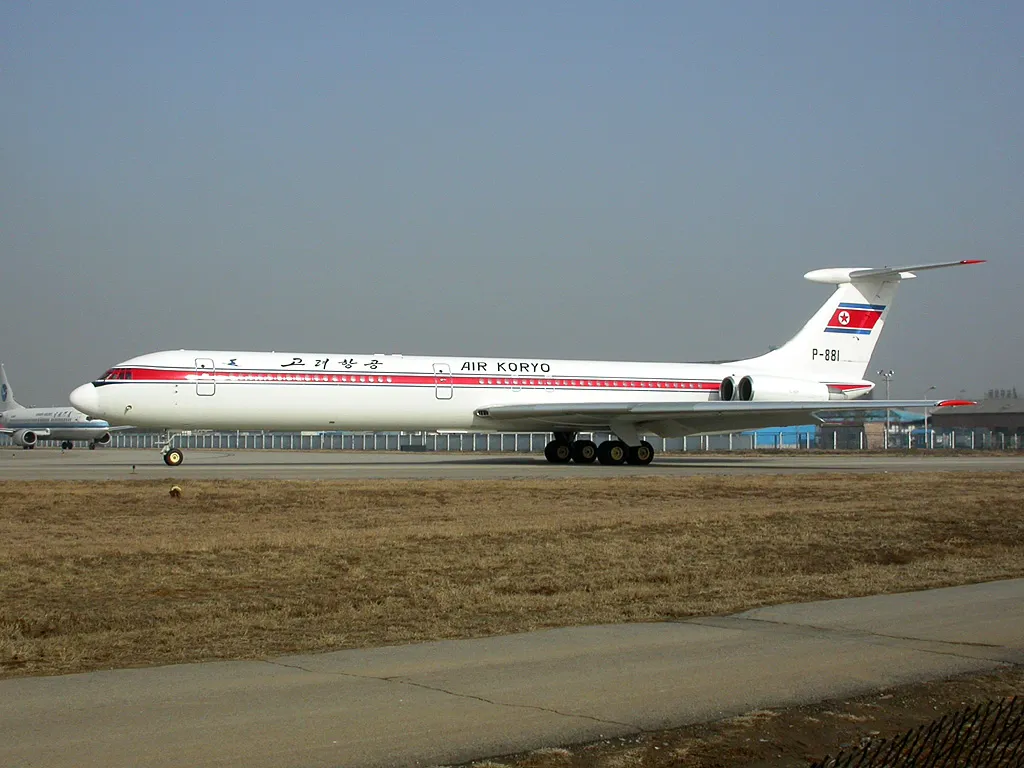
The Il-62’s most distinctive feature is its tail: four engines mounted in paired nacelles on each side of a T-tail, a layout dictated by the Soviet aerospace institute TsAGI and shared with only one other airliner, the British Vickers VC10. Moving the engines off the wing gave cleaner aerodynamics and a quieter cabin, at the cost of a heavier wing and fuselage structure and a risk of deep stall. It was also the first Soviet jet airliner with six-abreast seating, and it flew on unpowered, all-manual flight controls linked by steel cables, rods, pulleys and aerodynamic and weight balances. Because the engines sit behind the wing, an empty aircraft risks tipping onto its tail; Ilyushin fitted a retractable support strut under the rear fuselage to stop this on the ground2.
Specifications
The production Il-62 is 53.12 metres long with a wingspan of 43.2 metres. Typical seating runs 168 to 186 passengers depending on layout, flown by a crew of 3 to 5 on the flight deck — captain, first officer and flight engineer, with a navigator and radio officer on early aircraft — plus 4 to 8 cabin crew. The later Il-62M, the version most sources quote for performance, has a maximum take-off weight of 165,000 kg, a range of about 10,000 km with a 10,000 kg payload and a cruise speed of around 900 km/h. It is powered by four Soloviev D-30KU turbofans; the original Il-62 instead used four Kuznetsov NK-8 turbofans, each rated at 23,150 lb of thrust2.
Variants
The baseline Il-62 carried 174 passengers behind four Kuznetsov NK-8 engines and a crew of five. The Il-62M, introduced in 1973–1974 with four 24,250-lb Soloviev D-30KU engines, added simpler flaps, spoilerons and a tail fuel tank for more range, seated up to 186 passengers and became the dominant production version. The Il-62MK, from 1978, strengthened the wings and landing gear for medium-range use with up to 198 seats and roughly two extra tonnes of payload. A rare freighter conversion, the Il-62MGr, can carry 40,000 kg of cargo over 5,500 km. In all, 292 aircraft were built: five prototypes, 94 Il-62s and 193 Il-62Ms, with production continuing in small numbers until 1995 and a final airframe completed in 2004 for the Sudanese government2.
Operators and service
Aeroflot was the largest operator, flying 165 Il-62s by 1989 and using the type to open its first jet routes to the West and beyond, including the 1967 inaugural Moscow–Montreal service. More than 30 nations operated the type from 1967, with first exports to Czechoslovak Airlines in late 1969. East Germany’s Interflug flew 24 aircraft, Czechoslovakia’s state carrier 21 between 1969 and 1997, Cuba’s Cubana 27 different airframes before retiring its last in March 2011, and Poland’s LOT 23; the Soviet domestic carrier Domodedovo Airlines ran the largest non-state fleet, 45 aircraft, including the continuous Moscow–Petropavlovsk-Kamchatsky service, then the world’s longest internal route at 6,800 km. From 1971, KLM flew nine Aeroflot-owned Il-62s on Moscow–Amsterdam under joint Aeroflot/KLM markings, and Air France and Japan Airlines also operated Aeroflot-registered examples under similar arrangements. Between 1992 and 1996, Shannon Airport in Ireland handled up to eight Aeroflot Il-62s a day, around 2,400 flights and 250,000 passengers a year2.
The type also served as head-of-state transport for at least 14 countries, including the Soviet Union/Russia, East Germany, Cuba, North Korea and Czechoslovakia. North Korea’s government still owns two VIP Il-62Ms operated by Air Koryo, nicknamed Chammae-1 and Chammae-2. Numbers fell sharply as the fleet aged and operating costs rose against newer airliners: from 88 Il-62s in service in 2006 to 38 by September 2009. As of the most recent reporting, remaining civil operators include Air Koryo, with three aircraft, and Belarus’s Rada Airlines, with two Il-62MGr freighters, alongside limited use by the Russian Air Force2.
Safety record
Since entering service in 1963, the Il-62 has had 12 fatal accidents in civilian service — nine crashes, two landing overruns and one aborted take-off — with total fatalities exceeding 1,141. The deadliest was LOT Polish Airlines Flight 5055 on 9 May 1987, which killed 183 people after an uncontained engine failure started a cargo hold fire. Other notable accidents include Interflug Flight 450 in 1972, which killed 156 after an electrical fire from an unsecured air-conditioning coupling, and Aeroflot Flight 411 in 1982, which killed 90 after the crew shut down engines in response to false fire warnings. Even so, there were no fatal Il-62 accidents between 1989 and 2009, the period when the largest number of aircraft were in service, and among comparable rear-engined and early long-range jets — the Il-62, Vickers VC10, Boeing 707 and Douglas DC-8 — the Il-62M had the lowest hull-loss rate2.
Similar aircraft
- Vickers VC10: the only other airliner with the Il-62’s four-engines-on-the-tail layout, built in Britain for similarly long, thin routes2.
- Douglas DC-8: an American long-range jet airliner of the same generation, though with wing-mounted engines.
- Boeing 707: the Western airliner the Il-62 was built to compete with on intercontinental routes.
- Tupolev Tu-154: a later, shorter-range Soviet jet that became Aeroflot’s workhorse alongside the Il-62.
_Z2jNuNL.webp)