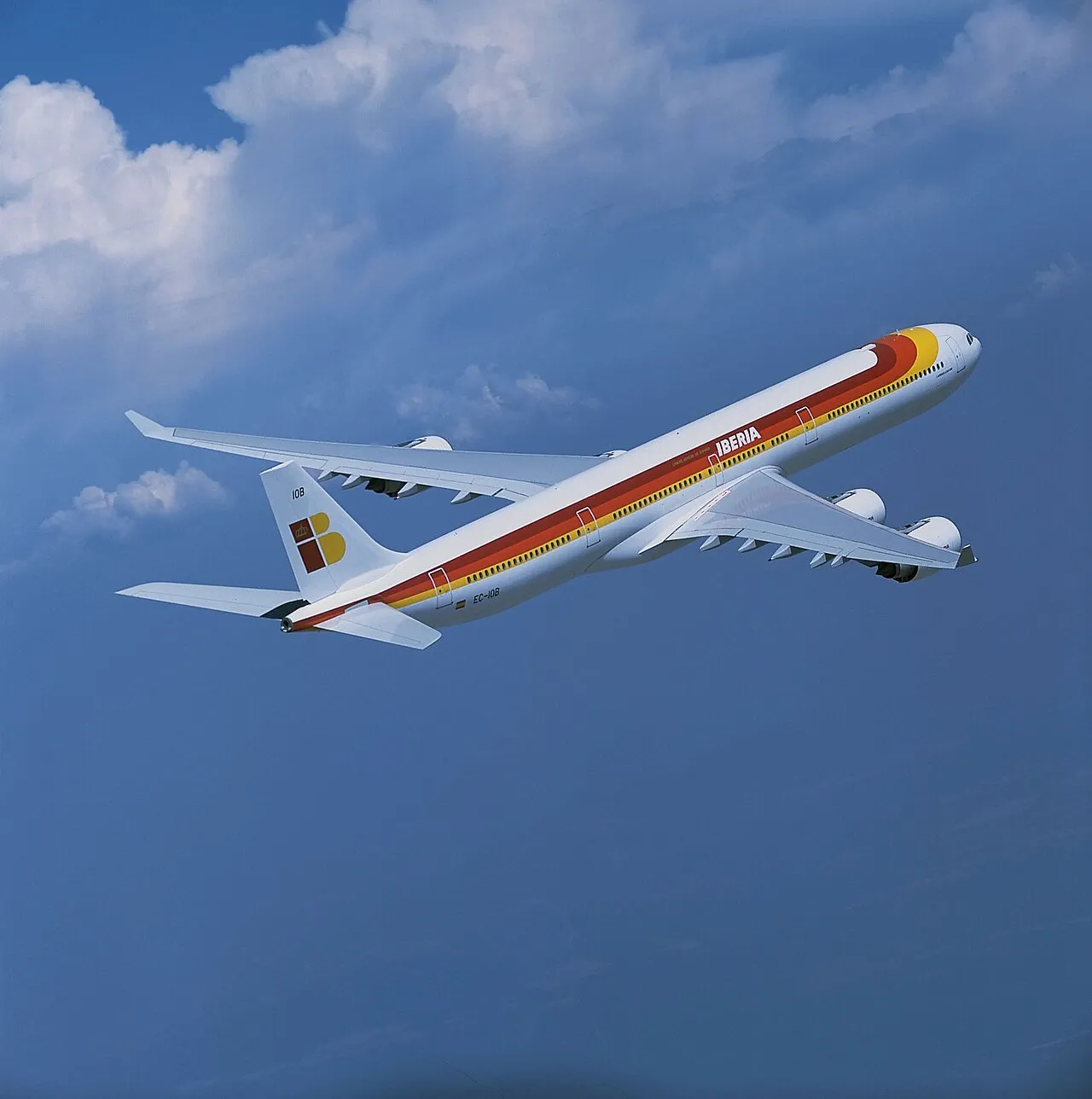
The Airbus A340 is a long-range, widebody passenger airliner built by Airbus with four engines rather than the two of most of its contemporaries. Airbus designed it for long-haul routes where four engines allowed operation beyond the range limits then placed on twin-engine airliners, particularly over water and remote terrain. The type has largely been withdrawn by major airlines1, replaced by more fuel-efficient twins, though a shrinking number still fly.
Design and development
The A340 made its first flight on 25 October 1991, as the A340-300, the first of the family to fly. It was developed alongside the twin-engine A330, sharing the same wing and fuselage cross-section but carrying four engines so it could fly long-haul routes that regulations of the time kept closed to twins. Airbus later stretched and re-winged the family: the A340-500 and A340-600, the longest-range and longest-fuselage versions, use a wider-span wing than the original A340-200 and A340-3001 and switch to Rolls-Royce engines.
Specifications
Length runs from 59.4 metres on the shortest variant, the A340-200, to 75.4 metres on the longest, the A340-600. The A340-200 and A340-300 share a 60.3-metre wingspan, while the longer-range A340-500 and A340-600 use a 63.45-metre wing. Maximum take-off weight ranges from about 276,000 kg on the A340-200/-300 to about 380,000 kg on the A340-500/-6001.
Range varies by variant rather than rising steadily with size: Wikipedia’s specifications table gives 13,500 km for the A340-200, 12,408 km for the A340-300, 16,670 km for the A340-500 and 14,450 km for the A340-600, with the shorter-fuselage A340-300 at the bottom of the range and the ultra-long-haul A340-500 at the top. Typical three-class seating follows the same per-variant pattern: 261 on the A340-200, 295 on the A340-300, 313 on the A340-500 and 379 on the A340-6001.
The A340-200 and A340-300 fly on four CFM56-5C turbofans, while the A340-500 and A340-600 use four Rolls-Royce Trent 500 engines. Airbus and its partners built 377 A340s between 1991 and 2012, before production ended in favour of the twin-engine A350. At 2011 list prices, a unit cost from about $238.0 million for the A340-300 to about $275.4 million for the A340-6001.
Variants
The family comprises four passenger variants. The A340-200 and A340-300, the original versions, entered service first and share the same 60.3-metre wing and CFM56-5C engines. The A340-500, aimed at ultra-long-haul routes, and the stretched A340-600, the largest and longest version, both use the wider-span wing and Rolls-Royce Trent 500 engines1 described above.
Operators and service
The A340 is retired from most of the major airlines that once flew it, with a shrinking number remaining in service, mainly with smaller carriers and government or VIP operators1. Its decline followed the spread of long-range twin-engine widebodies such as the Boeing 777 and Airbus A330, which fly the same routes on two engines at lower fuel cost, leaving the four-engine A340 at a competitive disadvantage once extended twin-engine operations became common over long-haul routes.
Similar aircraft
- Airbus A330: the twin-engine sister programme developed alongside the A340, sharing its wing and fuselage cross-section.
- Boeing 777: a long-range twin-engine widebody that took over many of the long, thin routes the A340 once flew.
_ZVY5TD.webp)
_Z1SYJMK.webp)
_approaching_JFK_Airport_1b71Hs.webp)
_(cropped)_Z2qDRzS.webp)