Contents
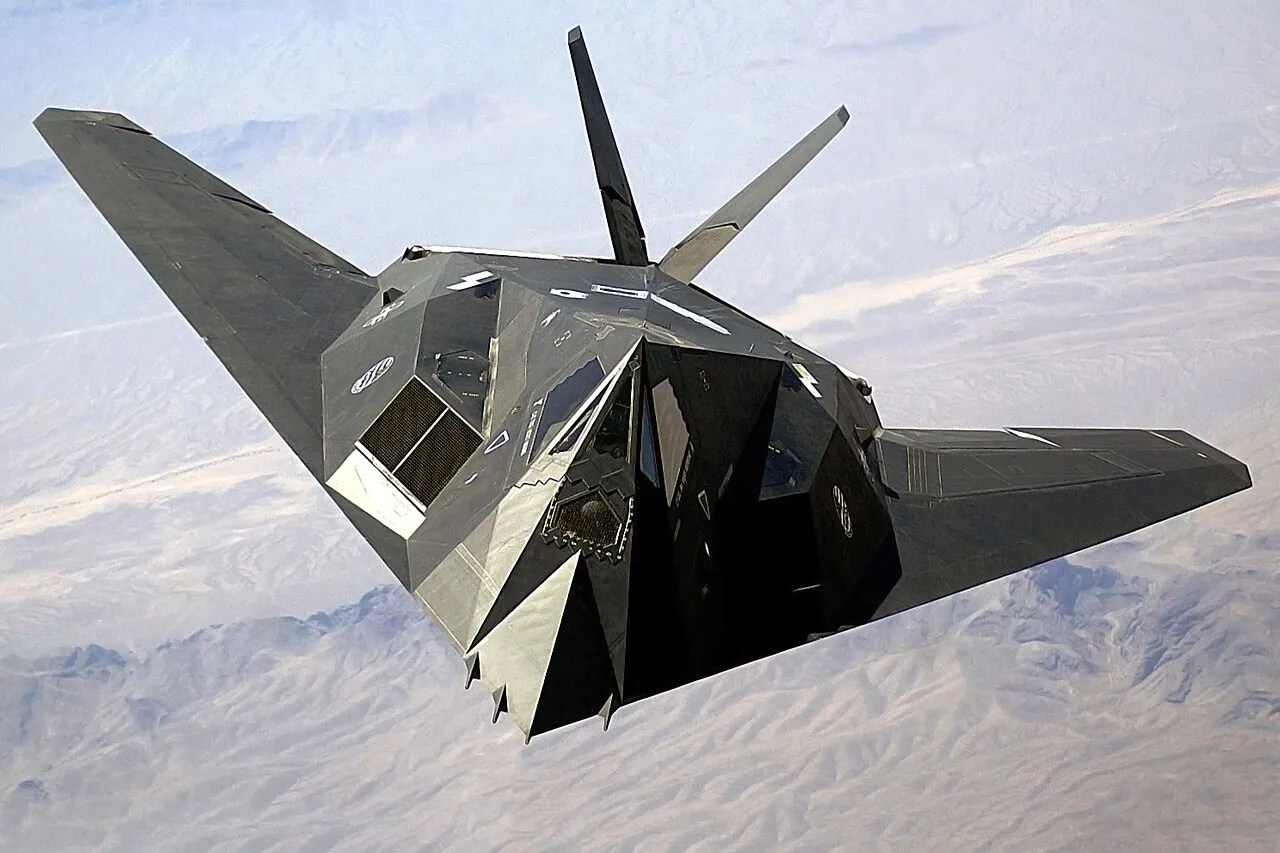
The Lockheed F-117 Nighthawk is a single-seat, twin-engine attack aircraft and the first operational aircraft designed from the outset around stealth technology. Lockheed’s Skunk Works division built it for the United States Air Force to penetrate dense air defences and strike high-value targets without being detected by radar. Despite the “F” fighter designation, it carries no air-to-air weapons and is a dedicated ground-attack type1.
Design and development
The program grew out of Cold War concern over increasingly capable Soviet surface-to-air missiles, and work on what became the F-117 began in the 1970s. DARPA contracted Lockheed’s Skunk Works in 1976 to build the Have Blue technology demonstrator, and after it proved the concept the decision to build an operational stealth aircraft followed on 1 November 1978. The underlying physics came from the Soviet mathematician Pyotr Ufimtsev, whose 1962 research showed that an object’s radar return depends on its edge configuration rather than its size1; Lockheed analyst Denys Overholser rediscovered the work in the 1970s once computers could finally handle the calculations it required.
The result is a faceted shape built from flat panels that scatter radar energy away from the receiver, giving the aircraft a radar cross-section of around 0.001 square metres. That shape makes the jet aerodynamically unstable, so it relies on fly-by-wire controls to stay in the air. The type first flew on 18 June 1981, reached initial operating capability in October 1983, and the US Air Force did not publicly acknowledge the program until 10 November 19881.
Specifications
The F-117 is 20.09 m long with a wingspan of 13.21 m and a maximum take-off weight of 23,814 kg. It is flown by a single pilot and powered by two General Electric F404-F1D2 turbofans, without afterburners, giving a top speed of about Mach 0.92 — the F-117 is subsonic by design, to keep its infrared signature down. Its combat range, flown without external fuel tanks, is about 1,720 km1.
Variants
Lockheed built 64 airframes between 1981 and 1990: five YF-117A prototypes and 59 production F-117A aircraft. Two further versions were proposed but never built: an F-117N “Seahawk” navalised variant for carrier operations and an export F-117B for allied air forces, both dropped for lack of interest and competing programs1.
Operators and service
The type flew only with the United States Air Force, based at Tonopah Test Range and later Holloman Air Force Base. It made its combat debut over Panama in 1989 and flew its largest campaign in the 1991 Gulf War, with about 1,300 sorties against roughly 1,600 high-value targets. It also flew over Yugoslavia, Afghanistan and Iraq1 in later conflicts.
The Air Force retired the F-117 from active service in 2008, mainly because newer types such as the F-22 Raptor had taken over its mission; the last aircraft left Palmdale for Tonopah on 11 August 2008. Around 45 airframes remain in flyable storage there, and the Air Force has kept some flying for research, testing and training, with sightings confirming activity as recently as 20251.
Safety record
The only confirmed combat loss came over Yugoslavia in 1999, when a surface-to-air missile shot down an F-117 during a NATO bombing campaign1; the pilot ejected and was recovered.
Similar aircraft
- Northrop B-2 Spirit: a later, larger American stealth design built around a flying wing for long-range bombing rather than precision strike.
- Lockheed Martin F-22 Raptor: the stealth air-superiority fighter that took over much of the F-117’s mission profile and helped prompt its retirement.