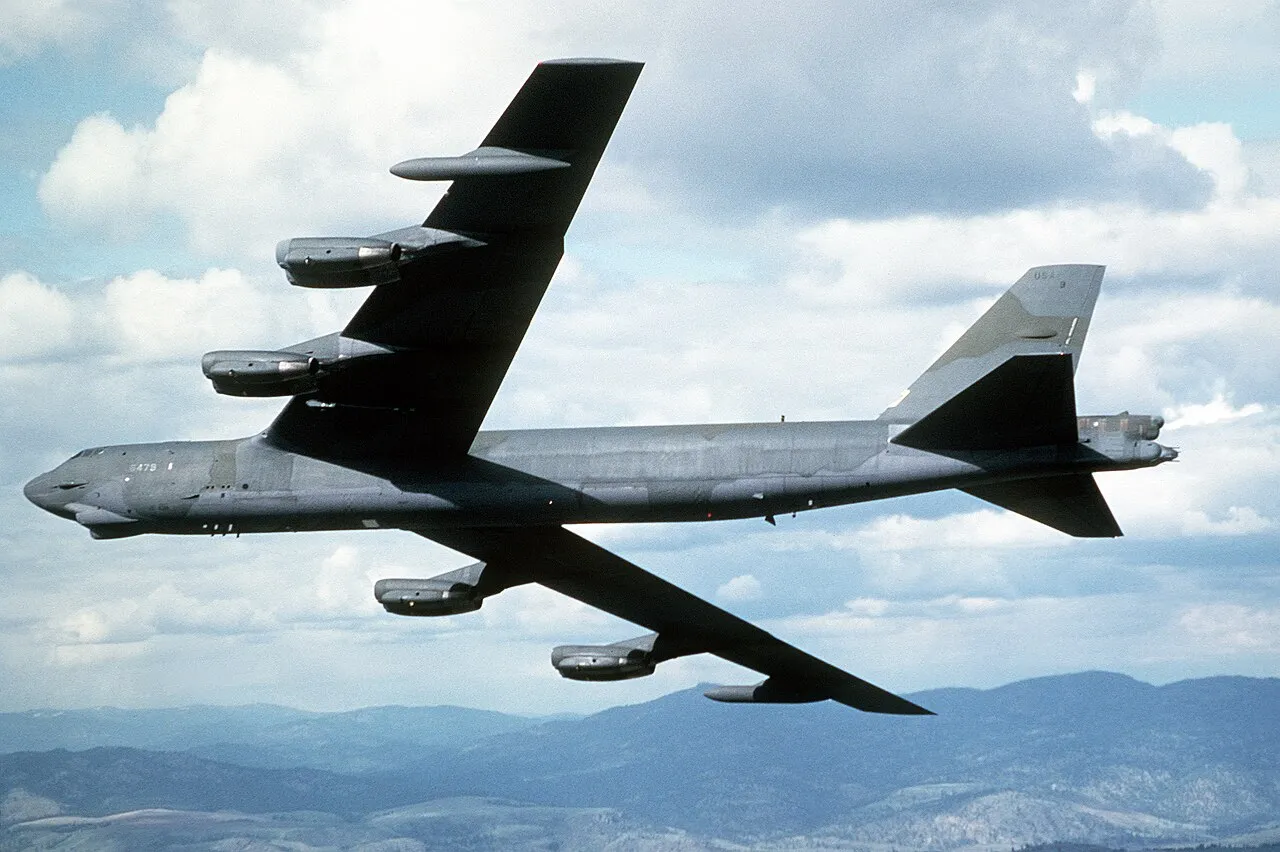
The Boeing B-52 Stratofortress is a long-range, subsonic, swept-wing heavy bomber, built to carry nuclear and conventional weapons over intercontinental distances. Boeing designed it for the United States Air Force as a strategic bomber2, and it has since been adapted to carry precision-guided munitions and cruise missiles on strike missions worldwide. More than seven decades after its first flight, the type remains in active service1.
Design and development
Boeing’s original B-52 design dated to the late 1940s, when the Air Force wanted a long-range, high-altitude strategic bomber to replace earlier piston- and turboprop-powered types. The prototype, the YB-52, made its first flight on 15 April 19522. Early production aircraft entered Air Force service through the 1950s, and Boeing kept refining the design through a series of lettered variants that changed engines, systems and structure while keeping the basic swept-wing, eight-engine layout.
The variant still flying today, the B-52H, first flew on 10 July 19602. It introduced the turbofan engines that replaced the earlier turbojets on previous models, improving range and reducing noise and smoke. Although no new B-52s have been built since the early 1960s, the Air Force has kept the surviving B-52H fleet flying through repeated rounds of structural, avionics and weapons upgrades instead of replacing the type outright.
Specifications
The B-52H is 48.5 metres long with a wingspan of 56.4 metres, a shape dominated by its long, slender fuselage and high-mounted swept wing carrying four underwing engine pods. Its maximum take-off weight is about 221,323 kg. It is powered by eight Pratt & Whitney TF33-P-3/103 turbofans1, mounted in four twin pods beneath the wings, and it cruises at around 819 km/h (442 kn)2.
Without aerial refuelling, the B-52H has a combat range of about 14,162 km (8,800 miles); its ferry range is about 16,330 km1, and air-to-air refuelling extends that further on long strike missions. The crew consists of five: a pilot, copilot, weapon systems officer, navigator and electronic warfare officer, a larger crew than later American bombers because the B-52’s systems automate far less of the navigation and weapons work; each crew member has a distinct station and set of instruments instead of sharing consolidated flight-deck displays. Unit cost reached a flyaway price of about $9.29 million per B-52H in 1955 dollars2, a figure that reflects the aircraft’s size, structure and the avionics of the era, not the extensive upgrades added since.
Variants
Boeing built 744 B-52s, including two prototypes, before production ended in 19622, across a series of lettered models from the B-52A to the B-52H that changed engines, avionics and structure over the production run. The breakdown by model, from the earliest test airframes to the last off the line, was 3 B-52As, 50 B-52Bs, 35 B/RB-52Cs and 170 B-52Ds, then 100 B-52Es, 89 B-52Fs, 193 B-52Gs and 102 B-52Hs3, with the earliest models restricted to testing before squadrons took later variants into service. Only the B-52H remains in service1; earlier variants were retired, scrapped or placed in museums decades ago.
Operators and service
The B-52 flies exclusively with the United States Air Force, where it has served as the Strategic Air Command’s principal bomber since the 1950s; by 1990, twelve of the command’s eighteen bomb wings flew the type. The first operational B-52, a B-52B delivered to the Strategic Air Command on 28 June 1955, began a service record that has since included conventional bombing missions over Vietnam and, decades later, a show of force and precision strikes during the 1991 Gulf War. Beyond land strikes, the type has also flown sea surveillance, anti-ship missile and aerial mining missions3. Over its long career it has flown in numerous American combat operations since entering service in the 1950s2, and the Air Force has continued to keep the B-52H in active service1 as its sole operator, flying it as part of the country’s long-range strike and nuclear deterrence forces.
Similar aircraft
- Northrop B-2 Spirit: a stealth flying-wing bomber the Air Force intended to complement rather than fully replace the B-52, built for penetrating defended airspace that the older design increasingly avoids.
- Tupolev Tu-95: a Soviet-era, turboprop-powered long-range strategic bomber of a similar era and role, still flown by Russia on patrol and strike missions much as the B-52 is flown by the United States.
_ZbySau.webp)
_ZnEDr2.webp)