Contents
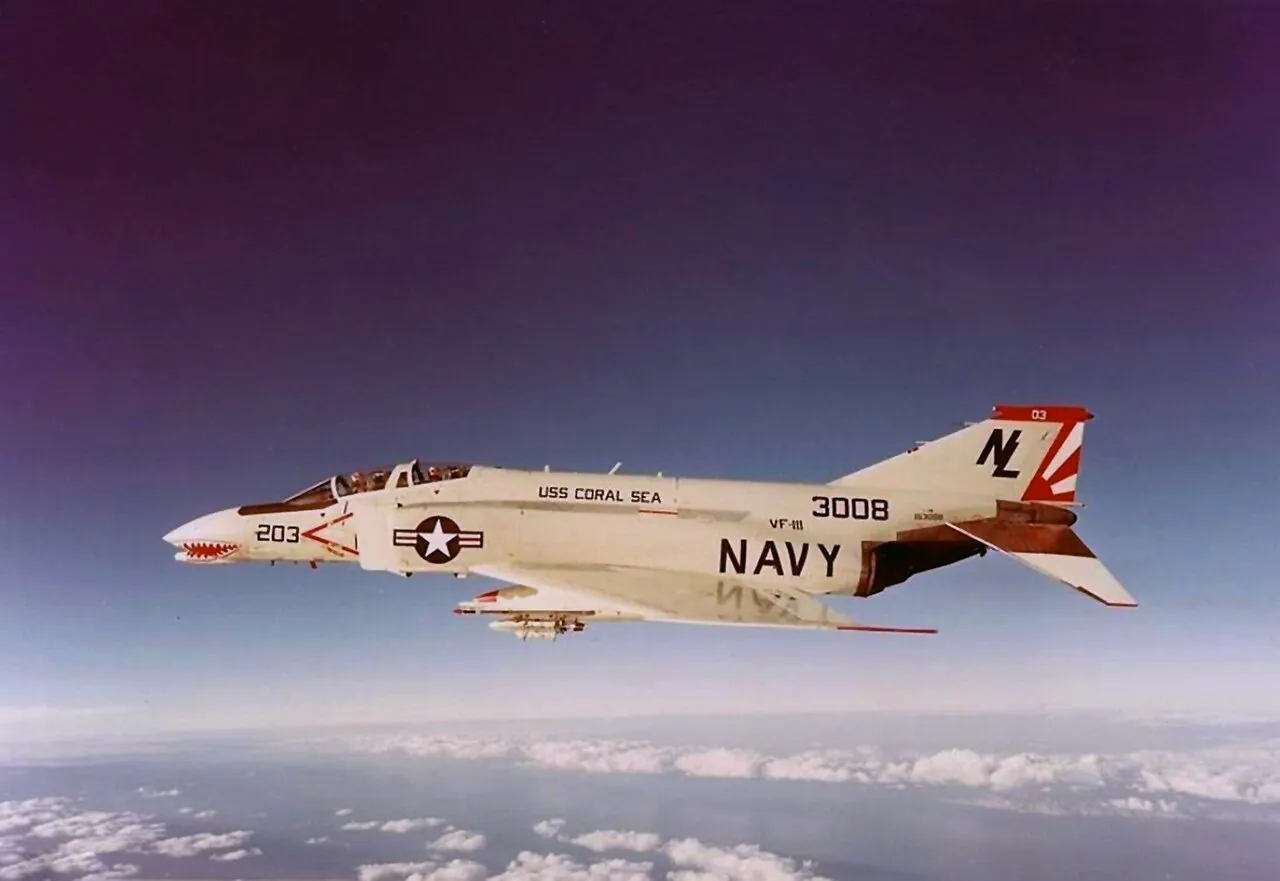
The McDonnell Douglas F-4 Phantom II is a tandem-seat, twin-engine supersonic fighter-bomber designed by McDonnell Aircraft Corporation, which became McDonnell Douglas in a 1967 merger. Built originally as an all-weather fleet-defence interceptor for the US Navy, it grew into a multi-role type flown as an air-superiority fighter, ground-attack bomber, reconnaissance platform and dedicated air-defence-suppression aircraft. It remains, by number built, the most-produced American supersonic military aircraft in history1, and a handful of air forces still fly it today.
Design and development
McDonnell’s design traces back to a 1953 proposal to the Navy for a modular derivative of its F3H Demon, which the Navy turned down because existing fighters already met its needs. By May 1955 the Navy’s requirement had shifted to an all-weather fleet-defence interceptor, and the need to operate advanced radar against the expected information load of future air combat drove the addition of a second crew member. The resulting prototype, the XF4H-1, made its first flight on 27 May 1958, and on 17 December 1958 it beat the rival XF8U-3 Crusader III in competition1, a result driven in part by the Navy’s preference for a two-seat type.
The airframe made extensive use of titanium and combined 45-degree swept wings with distinctive outer “dogtooth” leading-edge extensions and a 23-degree anhedral (drooping) tailplane, both aimed at keeping the aircraft controllable at high angles of attack. Early flight testing forced a redesign of the air intakes, which eventually gained some 12,500 small holes to bleed off slow-moving boundary-layer air ahead of the engines. The type carried the AN/APQ-50 all-weather intercept radar, later upgraded to the AN/APQ-72, and could load more than 18,000 lb (8,165 kg) of weapons across nine external hardpoints. Designers omitted an internal gun on the belief that missiles had made the cannon obsolete, a decision that proved costly once the type met MiGs over Vietnam1 at the close ranges where its Sparrow and Sidewinder missiles were least reliable; later F-4Es added a built-in 20 mm cannon to correct it.
Specifications
The F-4E, the most-produced variant, is 19.2 m long with an 11.7 m wingspan and a maximum take-off weight of 28,030 kg. It is powered by two General Electric J79-GE-17A after-burning turbojets, cruises at around 940 km/h and, fitted with external tanks, has a ferry range of about 2,699 km; its unrefuelled combat radius without tanks is far shorter, around 680 km. The jet seats two crew in tandem, a pilot and a weapon systems officer or radar intercept officer who operates the radar and weapons systems. In 1965 dollars a Phantom cost roughly $1.9-2.4 million to build1.
Variants
The Navy’s early production model, the F-4B, numbered 649 aircraft and carried the Westinghouse APQ-72 radar; the follow-on F-4J added the AN/AWG-10 fire-control system, the first operational fighter radar anywhere with look-down/shoot-down capability, across 522 built. Many were later rebuilt as the smokeless-engined F-4N and F-4S, the latter adding leading-edge slats for better manoeuvrability, while the unarmed RF-4B reconnaissance version, 46 built, had to fly straight and level at 5,000 feet while its cameras operated1.
For the Air Force, the F-4C combined air-to-air and ground-attack roles under Defense Secretary Robert McNamara’s unified-fighter policy, and the F-4D followed in June 1967. The definitive F-4E added the internal 20 mm M61A1 Vulcan cannon, leading-edge slats and uprated engines, becoming the most widely built version, while the F-4G Wild Weasel carried radar-warning receivers and anti-radiation missiles for suppressing enemy air defences and the unarmed RF-4C flew reconnaissance. The United Kingdom bought Rolls-Royce Spey-engined F-4K and F-4M variants for the Royal Navy and Royal Air Force, and Japan built its own F-4EJ under licence, with Mitsubishi Heavy Industries producing 138 of the type’s 5,195-aircraft total through 20 May 19811.
Operators and service
Of the 5,195 Phantoms built, 2,874 went to the US Air Force and 1,264 to the Navy and Marine Corps, with the remainder flown by foreign air arms. The Navy’s VF-121 “Pacemakers” received the first F-4As on 30 December 1960, and the type flew 84 combat tours for the Navy during the Vietnam War; its last carrier landing came on 18 October 1986, from an F-4S of VF-202 “Superheats” aboard USS America. The Air Force’s 12th Tactical Fighter Wing reached initial operational capability in October 1964, and its last operational F-4G Wild Weasels retired on 26 March 19961.
Overseas, the type flew for air forces including Australia, Egypt, West Germany, Greece, Iran, Israel, Japan, Spain, South Korea, Turkey and the United Kingdom, most of which have since retired it: West Germany in December 2013, Egypt in 2020, Japan in 2021 and South Korea in 2024. As of June 2025 roughly 98 Phantoms remained in active service worldwide, with Greece flying 17, Turkey 19 and Iran about 62; Turkey’s are expected to serve until at least 2030. Retired American airframes found a further role as target drones: BAE Systems converted 314 aircraft into QF-4s and QRF-4s, with the programme’s last flight on 27 May 20151.
Safety record
The Phantom’s heaviest losses came over Vietnam, where 761 F-4 and RF-4 aircraft were lost across all US services. Navy Phantoms were credited with 40 air-to-air victories against 73 lost in combat, seven to enemy aircraft, 13 to surface-to-air missiles and 53 to anti-aircraft fire. Air Force crews claimed 107.5 MiG kills for the loss of 445 fighter-bombers, and combined US forces claimed 150.5 MiG kills at a cost of 42 Phantoms lost in air combat; North Vietnam’s own figures differ, crediting its MiG-21s with shooting down 103 F-4s for the loss of 54 MiG-21s. The war also produced the US military’s first jet aces since Korea, including Air Force Captain Charles DeBellevue, the conflict’s highest-scoring American ace with six victories. Losses were far lighter in the 1991 Gulf War, where deployed F-4Gs and RF-4Cs lost one RF-4C in a pre-war accident and one F-4G to enemy fire damaging its fuel tanks. Outside combat, the Phantom also set performance records, reaching an absolute speed of Mach 2.585 in November 1961 and an absolute altitude of 98,557 feet in December 19591, with some of its speed records standing until the F-15 Eagle arrived in 1975.
Similar aircraft
- Grumman F-14 Tomcat: the tandem-seat, twin-engine fighter that replaced the F-4 in US Navy fleet-defence service.
- Mikoyan-Gurevich MiG-21: the Phantom’s principal Cold War adversary over Vietnam and the Middle East, built in far greater numbers.
- McDonnell Douglas F-15 Eagle: the air-superiority fighter that succeeded the F-4 in US Air Force service, designed partly in reaction to the Phantom’s missile-only Vietnam experience.