Contents
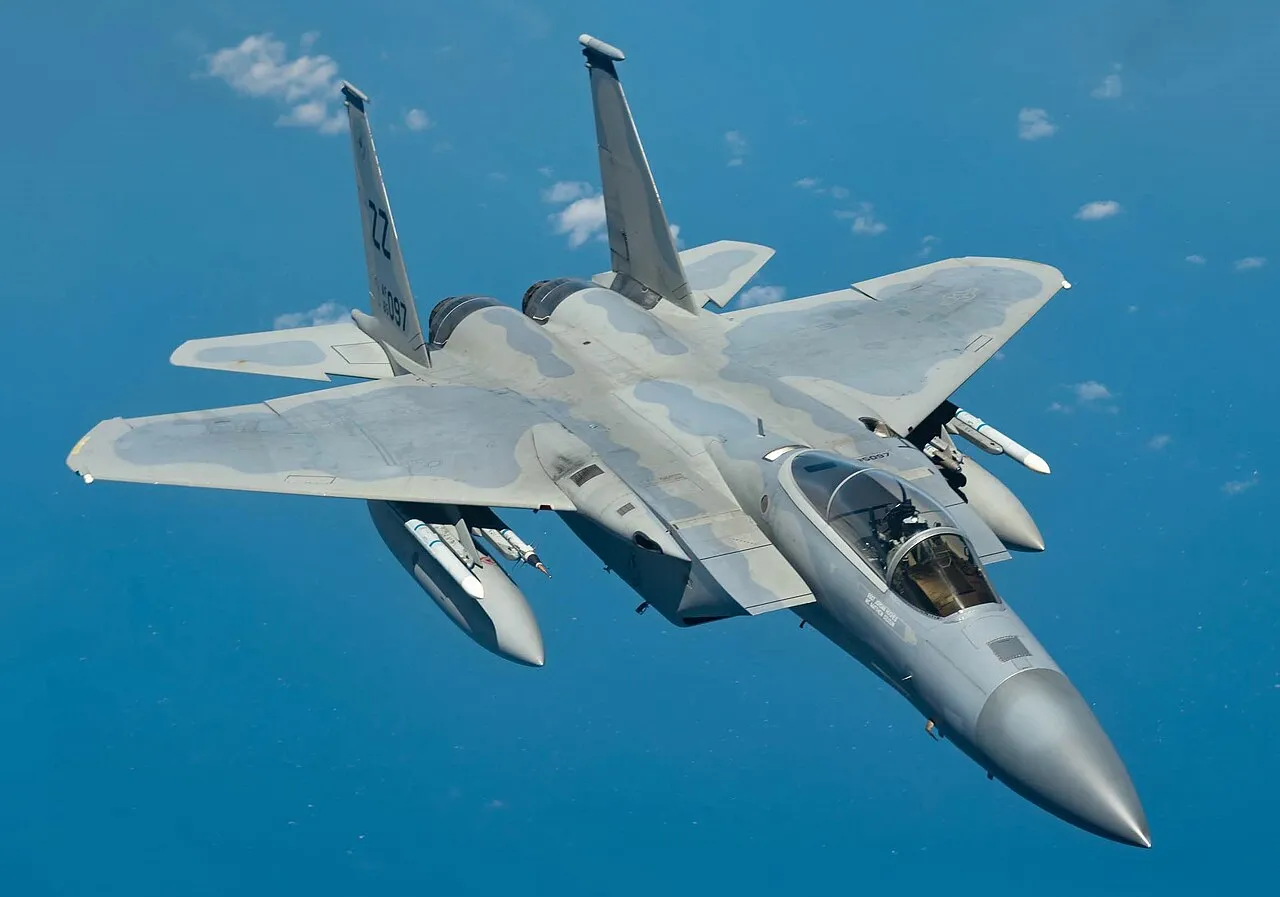
The McDonnell Douglas F-15 Eagle is a twin-engine, all-weather air-superiority fighter built by McDonnell Douglas, which Boeing absorbed in a 1997 merger and which now markets the type. Designed as a dedicated dogfighter rather than a multirole compromise, it later spawned the two-seat F-15E Strike Eagle for ground attack. Decades after it first flew on 27 July 1972, the air-to-air F-15 variants have never lost a single aircraft in aerial combat1.
Design and development
The F-15 grew out of Air Force studies in the 1960s for a dedicated air-superiority fighter, a reaction to the mixed results of missile-reliant designs such as the F-4 Phantom II over Vietnam. Colonel John Boyd’s energy-manoeuvrability theory, which favoured power and agility over raw speed, shaped the requirement the Air Force formally released in October 1965. McDonnell Douglas won the resulting competition on 23 December 1969, and the prototype made its first flight on 27 July 1972, with the type entering service in 19761.
Engineers prioritised low wing loading and a thrust-to-weight ratio exceeding 1:1, letting the jet turn tightly at up to 9 g without bleeding off airspeed and climb to 30,000 feet in around 60 seconds. The airframe mixes 37.3% aluminium, 29.2% honeycomb structure and 25.8% titanium. Its original AN/APG-63 radar introduced “look-down/shoot-down” capability, able to pick out targets roughly 100 miles away even against ground clutter, backed by an internal M61 Vulcan 20 mm cannon and AIM-7 Sparrow or, later, AIM-120 AMRAAM missiles1.
Specifications
The F-15C is 19.43 m long with a 13.05 m wingspan and a maximum take-off weight of 30,844 kg. It is powered by two Pratt & Whitney F100-PW-220 afterburning turbofans and cruises at around 919 km/h, with a top speed near Mach 2.5. Fitted with external tanks it can ferry about 5,556 km, though its unrefuelled combat radius without tanks is far shorter. The baseline F-15A and F-15C are single-seat aircraft, while the F-15B, F-15D and F-15E carry a second crew member1.
Variants
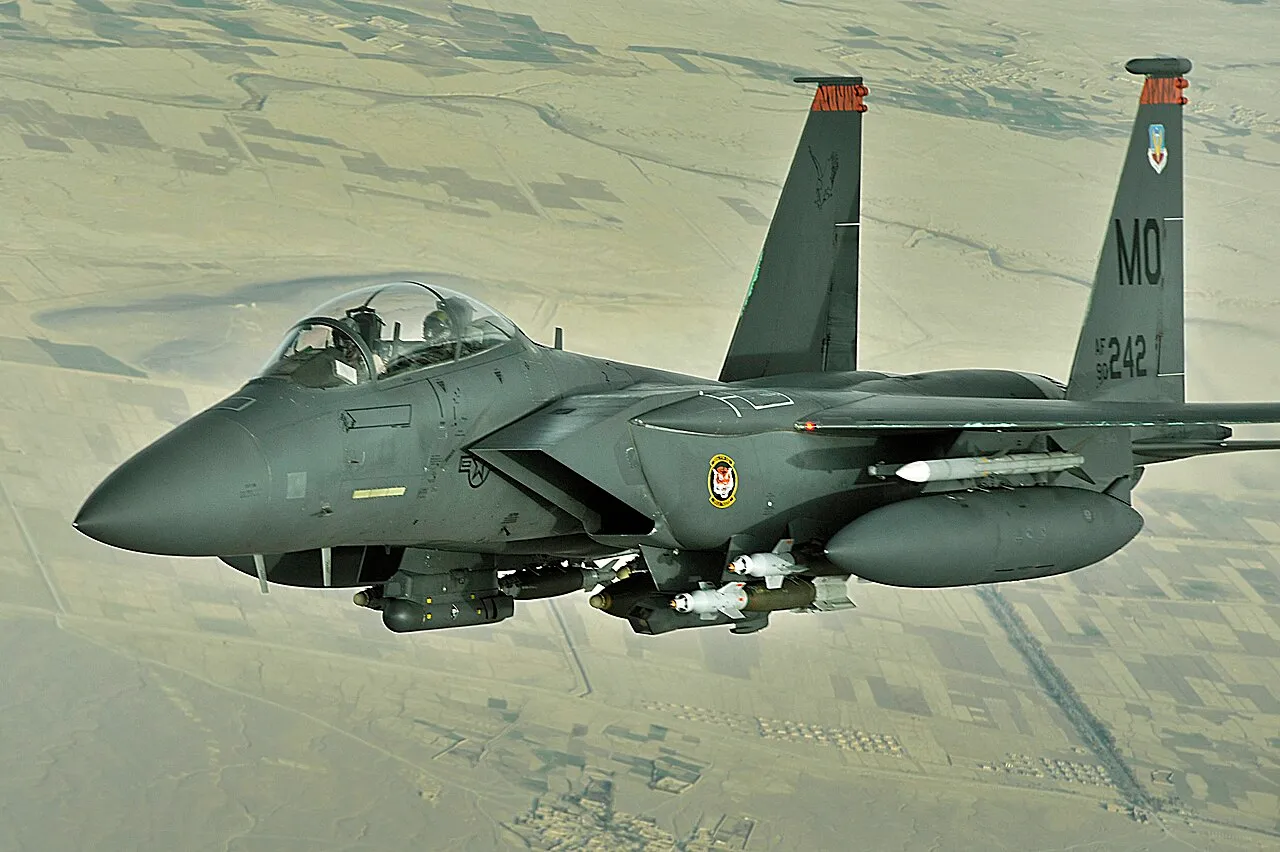
The original F-15A and two-seat F-15B entered production from 1972 to 1979, totalling 384 A-models and 61 B-models. The improved F-15C and F-15D followed from 1979 to 1985 with extra internal fuel capacity and upgraded avionics, adding 483 C-models and 92 D-models. The two-seat F-15E Strike Eagle entered service in 1989 as a dedicated strike variant with the AN/APG-70 radar and LANTIRN targeting pods, trading some of the air-superiority jet’s agility for a heavy ground-attack payload. Japan built its own version under licence as the F-15J, and in 2020 the US Air Force ordered the modernised F-15EX to replace retiring F-15C/D airframes1.
Operators and service
Beyond the US Air Force, the type has flown with the Israeli Air Force, the Japan Air Self-Defense Force and the Royal Saudi Air Force among its main operators. In total 1,198 F-15A/B/C/D/J/DJ aircraft were built. The US Air Force flew its last active-duty F-15C sortie on 24 January 2025 as part of a planned retirement of the remaining C/D fleet by 2026, while the newer F-15EX enters service to maintain air-superiority numbers alongside the F-22 Raptor1, restarting F-22 production having been judged cost-prohibitive. The F-15E Strike Eagle derivative is expected to keep flying into the 2030s.
Safety record
The air-to-air F-15 variants have compiled an unbeaten record in aerial combat: more than 104 victories and no losses to enemy fighters. Israeli pilots, who fly the type, scored over half of those kills, including 41 Syrian aircraft destroyed during the 1982 Lebanon War. US Air Force F-15Cs added 34 confirmed air-to-air kills of Iraqi aircraft during the 1991 Gulf War. Across their service history, the A/B/C/D models have not suffered a single loss to enemy action1.
Similar aircraft
- Lockheed Martin F-22 Raptor: the stealth air-superiority fighter the US Air Force developed as the F-15’s eventual successor, now flying alongside it.
- Sukhoi Su-27: a Soviet twin-engine air-superiority fighter of a similar era and weight class, designed in part as a counter to the F-15.
_10Vvmy.webp)