_(522-03)_Z26QJ04.webp)
Contents
The Mil Mi-26 is a Soviet heavy-lift helicopter, designed by the Mil Moscow Helicopter Plant and built by Rostvertol. It is the largest helicopter to have gone into serial production, built to move cargo, vehicles and troops that no other helicopter could lift, and it remains in service with Russia and a handful of other operators today1.
Design and development
Mil began the type, internally Project 90, under chief designer Marat Tishchenko after the earlier V-12 heavy-lift design had stalled, aiming for a more practical successor able to carry the loads the V-12 was meant for without its unwieldy size. A central design requirement was to keep the helicopter’s empty weight under half of its maximum take-off weight, a target Mil met partly through the VR-26 transmission, a non-planetary split-torque gearbox that weighs 3,639 kg but can absorb 14,700 kW of power. The helicopter also carries an eight-blade main rotor1, one more blade than most heavy helicopters of its era, to spread the lifting load.
The prototype made its first flight on 14 December 1977, the first production aircraft rolled out on 4 October 1980, and development was complete by 1983, with the type entering Soviet military and civilian service by 1985. The design’s lifting power is still a world record: in 1982 an Mi-26 set the FAI record for the greatest mass lifted to 2,000 metres, 56,768.8 kg1.
Specifications
The Mi-26 is 40 m long and has an eight-blade main rotor 32 m in diameter. Its maximum take-off weight is 56,000 kg, and it can carry up to 20 tonnes of cargo. With a full cargo load it has a range of about 500 km, extending to 1,920 km ferry range with auxiliary fuel tanks. It cruises at 255 km/h and operates up to a ceiling of 4,600 m. Power comes from two ZMKB Progress (Lotarev) D-136 turboshaft engines rated at 8,500 kW (11,400 hp) each. In its transport role the cabin holds up to 90 troops, or 60 stretchers for medical evacuation, and the flight deck is crewed by five: two pilots, a navigator, a flight engineer and a flight technician1.
Variants
The baseline military transport, known to NATO as Halo-A, was followed by the Mi-26T, a civil cargo version that entered production in 1985, and the related Mi-26TS/TC civil transports. The Mi-26TM is a flying-crane variant with a gondola slung beneath the nose for the operator to watch the load directly, while the Mi-26TP carries a 15,000-litre retardant tank for firefighting. A dedicated medevac model, the Mi-26MS, can carry up to 60 stretchers, and the Mi-26P is a 63-seat passenger version. The newest variant, the Mi-26T2 with modernised avionics, began serial production on 22 May 2015, and a military derivative, the Mi-26T2V with NPK90-2V avionics, first flew in August 2018. Two prototypes of an airborne command post version, the Mi-27, were built in 19881.
Operators and service
The Mi-26 has flown military missions for Algeria, Cambodia, the Democratic Republic of the Congo, Equatorial Guinea, Jordan, Kazakhstan, Mexico, North Korea, Russia and Venezuela, and in civilian service with China’s Flying Dragon Aviation and Russia’s UTair Aviation. Belarus, Belgium, India, Peru, Ukraine and the Soviet Union itself have flown and since retired the type. It has done some unusual work beyond routine transport: an Mi-26 airlifted a 23,000-year-old frozen woolly mammoth carcass out of the Siberian tundra in October 1999, and civilian Mi-26s in Afghanistan in 2002 recovered stranded US Army MH-47E Chinook helicopters from mountainous terrain. Thirty Mi-26s, some fitted as the Mi-26S with shielded cabins and liquid tanks, took part in the Chernobyl clean-up in 1986, and the type later moved heavy earth-moving equipment to landslide-blocked “quake lake” sites after the 2008 Sichuan earthquake. Production and upgrades continue: Rostvertol delivered Mi-26T2 helicopters to the Russian Aerospace Forces in 2016, 2017 and 2019, and to export customers including Jordan, and Iran’s Red Crescent Society announced plans in September 2024 to buy up to 20 new Mi-26s1.
Safety record
The Mi-26’s worst loss came on 19 August 2002, when Chechen separatists shot down an overloaded Mi-26 with a surface-to-air missile near Khankala, killing 127 people, the greatest loss of life in any helicopter crash. A Moldovan-registered Mi-26 operated by Pecotox Air was shot down in Helmand province, Afghanistan, in July 2009, killing six Ukrainian crew members. In a non-combat accident, an Indian Air Force Mi-26 crashed seconds after take-off from Jammu airport on 14 December 2010; an investigation found improperly fastened cargo had unbalanced the aircraft, and India later retired its remaining Mi-26s1.
Similar aircraft
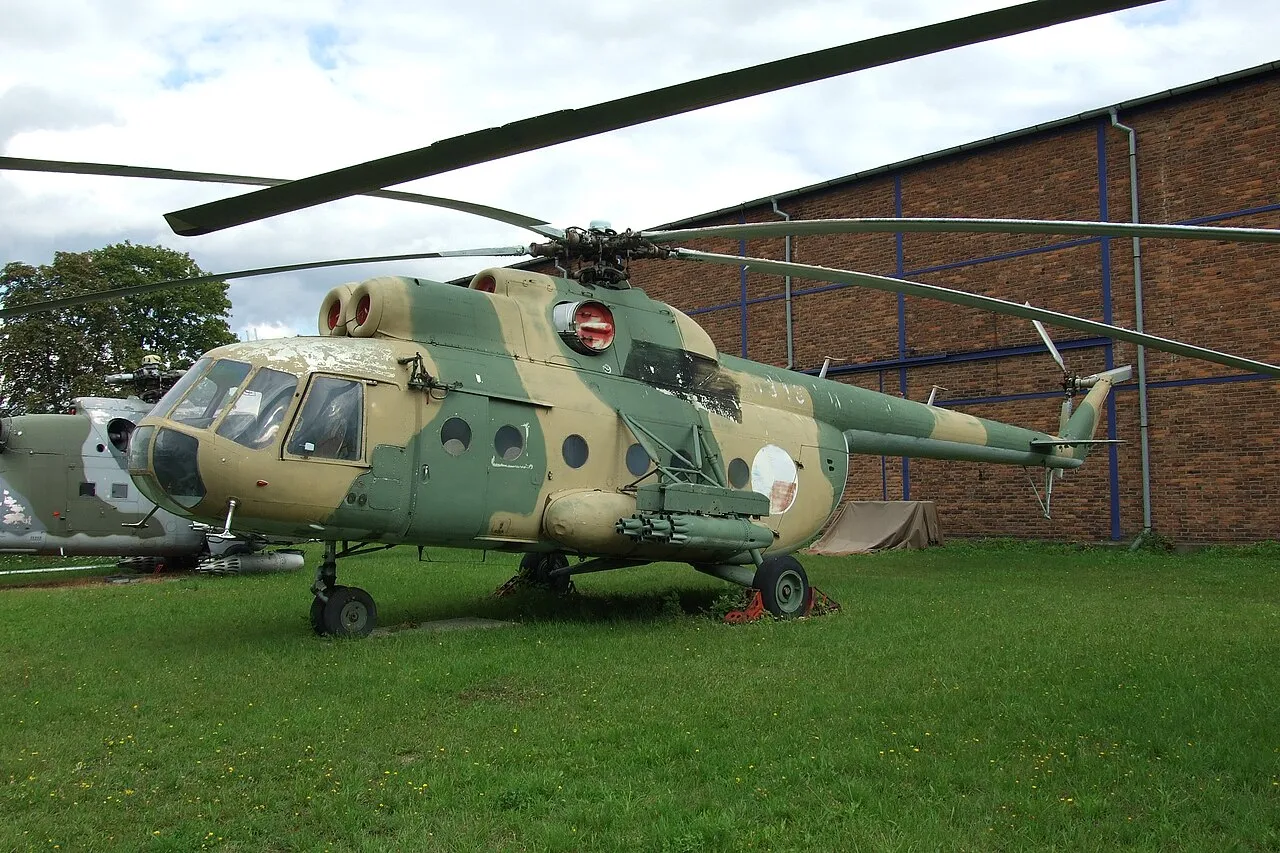
- Mil Mi-8: a much smaller Mil transport helicopter and the most-produced helicopter in history, built by the same design bureau for general-purpose rather than heavy-lift work (Mil Mi-8).
- Sikorsky CH-53K King Stallion: the US military’s heavy-lift helicopter, roughly comparable in role though well short of the Mi-26’s lifting capacity.
- Boeing CH-47 Chinook: a tandem-rotor heavy transport helicopter widely used by Western forces for cargo and troop lift (Boeing CH-47 Chinook).