Contents
The Mil Mi-28 is a Russian twin-engine attack helicopter built by the Mil Moscow Helicopter Plant, with production aircraft assembled by Rostvertol1. Designed as a dedicated anti-tank gunship rather than a troop carrier, it flies with a crew of two, a pilot and a weapons officer, and remains in service with Russia and a handful of export customers2.
Design and development
Mil began work on the type in 1980 under chief designer Marat Tishchenko, following on from the Mi-24 program that had started in 1972, and the prototype made its first flight on 10 November 1982. Unlike the Mi-24, the Mi-28 dropped the troop compartment entirely to concentrate on the anti-tank role. The Soviet Air Force ran it against the rival Kamov Ka-50 in a fly-off and chose the Ka-50 as its primary anti-tank helicopter in October 1984, but Mil kept developing the Mi-28 to meet foreign demand for Soviet attack helicopters2, and it later displaced the Ka-50 as Russia’s main production attack type.
Specifications
The Mi-28 is 17.01 m long excluding its rotors, with a main rotor diameter of 17.2 m; unlike a fixed-wing aircraft, it has no wingspan in the usual sense. Maximum take-off weight is 11,500 kg. It is powered by two Klimov VK-2500 turboshaft engines, each rated at 1,636 kW (2,194 hp). Range on internal fuel is 435 km with a 5% fuel reserve; with a 10-minute loiter factored in, combat range drops to 200 km, while ferry range with four drop tanks extends to 1,100 km. Its maximum cruise speed is 270 km/h, with a top speed of 320 km/h2.
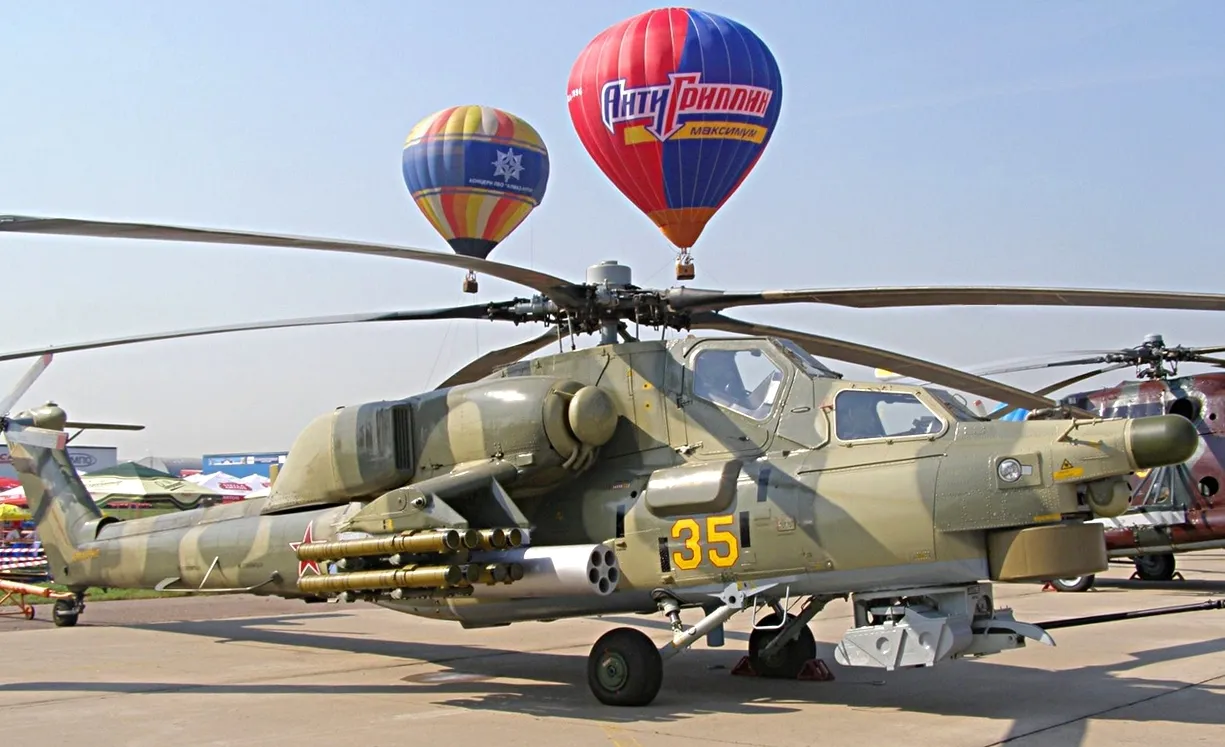
For the anti-tank role the Mi-28 carries a chin-mounted NPPU-28 turret with a 30 mm Shipunov 2A42 autocannon firing between 200 and 800 rounds per minute, plus up to 16 supersonic 9M120 Ataka-V anti-tank missiles, which use radio beam-riding guidance. It can also carry S-8 and S-13 unguided rockets, R-73 air-to-air missiles and up to 500 kg of bombs. Over 190 Mi-28s had been built as of May 2025, and the type remains in service2.
Variants
The most important variant is the Mi-28N, nicknamed Night Hunter, unveiled in 1995. It adds an all-weather radar in a round cover above the main rotor, similar in layout to the American AH-64D Apache Longbow’s mast-mounted radar, giving it night and poor-weather attack capability the original prototype lacked. The first serial Mi-28N reached the Russian Army on 5 June 2006, with the type formally accepted into service in October 20092.
A further upgrade, the Mi-28NM, first flew in October 2016. It fits more powerful VK-2500P engines with full-authority digital engine control (FADEC) and improved rotor blades, together raising maximum speed by about 13%. Russia also operates the Mi-28UB, a dedicated two-seat training-and-combat variant, procured alongside operational units at a rate of four to six Mi-28UBs for every unit flying the Mi-28N2.
Operators and service
Russia is the largest operator, with 94 Mi-28N/NM helicopters in service and a further 98 on order. Export customers fly the Mi-28NE, a version cleared for foreign sale: Algeria operates 42, Iraq 17, and Uganda 4, with 2 more on order. Iran has also taken delivery of between three and six Mi-28NEs as of February 20262.
Safety record
Russian Mi-28Ns saw their combat debut in Syria during the 2016 Battle of Palmyra, striking Islamic State positions with S-8 rockets and 9M120 Ataka anti-tank missiles. The type has suffered heavier losses in Russia’s invasion of Ukraine since 2022: as of November 2025, 14 Mi-28s had been visually confirmed destroyed and a further 4 damaged2 since the invasion began.
Similar aircraft
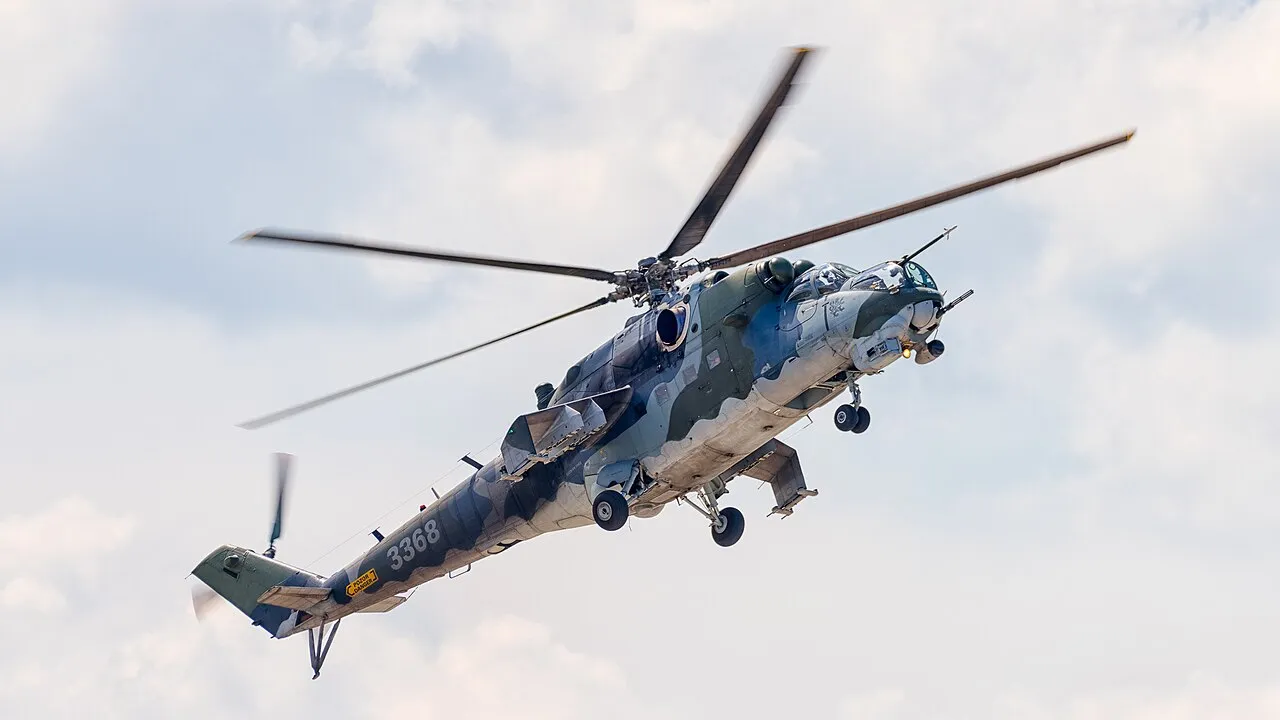
- Mil Mi-24: the earlier Mil gunship the Mi-28 program grew out of, though the Mi-24 also carries troops and the Mi-28 does not.
- Boeing AH-64 Apache: the American equivalent in concept and role, and the type whose mast-mounted radar the Mi-28N’s turret-top radar most closely resembles.
- Kamov Ka-52: the twin-seat, coaxial-rotor derivative of the Ka-50 that beat the original Mi-28 in Soviet trials before the Mi-28N later reversed Russia’s choice of primary attack helicopter.
_(522-03)_Z26QJ04.webp)