Contents
The Mil Mi-24 is a Soviet-designed attack helicopter built by the Mil Moscow Helicopter Plant, known to NATO by the reporting name Hind. It is unusual among gunships because it also carries a small infantry compartment, seating up to eight troops, making it in effect a flying infantry fighting vehicle as well as an attack platform. The type entered production in 1970 and remains in service today1, flown both as a gunship and as an armoured assault transport.
Design and development
The concept dates to the early 1960s, when Mil argued that rising battlefield mobility would call for a new kind of flying infantry fighting vehicle. A mock-up, designated V-24, was shown in 1966 with a central troop compartment that could seat eight soldiers back to back. Mil put forward a twin-engine design of about 10.5 tonnes, and the Soviet armed forces issued a formal request for a battlefield support helicopter; the directive to proceed with the twin-engine layout came on 6 May 1968. The prototype flew for the first time on 19 September 1969, four days after a tethered hover test. The production model, the Mi-24A, entered production in 1970, reached initial operating capability in 1971 and was formally accepted into Soviet service in 19721.
Specifications
At 17.5 metres long, the fuselage carries a main rotor 17.2 metres in diameter; its stub wings, which carry weapons and offload lift in forward flight, span only about 6.5 metres. It is powered by two Isotov TV3-117 turboshaft engines, giving it a maximum take-off weight of 12,000 kg and a cruise speed of about 270 km/h. On internal fuel its standard range is around 450 km. A typical crew is two pilots and a weapons systems officer, with an optional technician and room for eight troops in the cabin. Since its first flight the type has been built in large numbers: about 2,648 had been produced as of the most recent count, and production has continued since 19691.
Variants
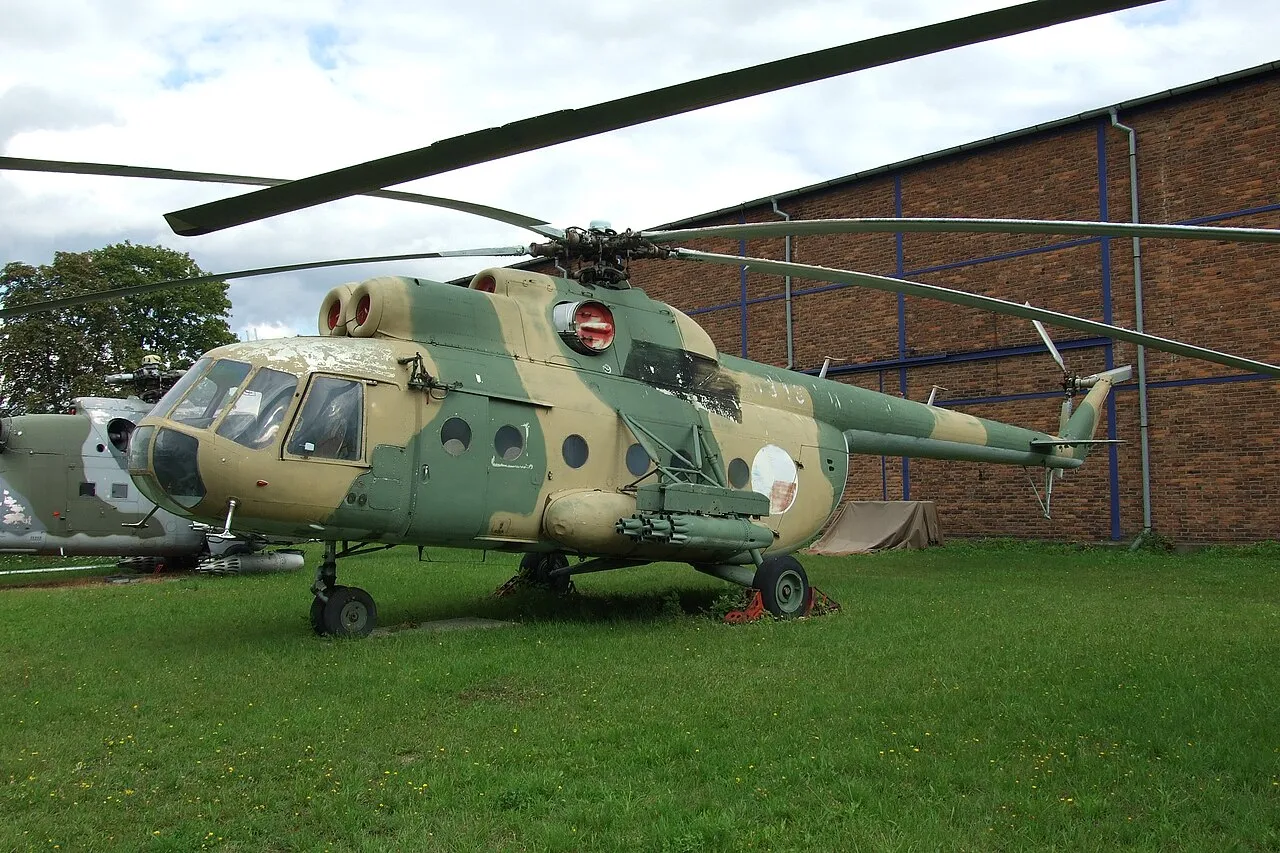
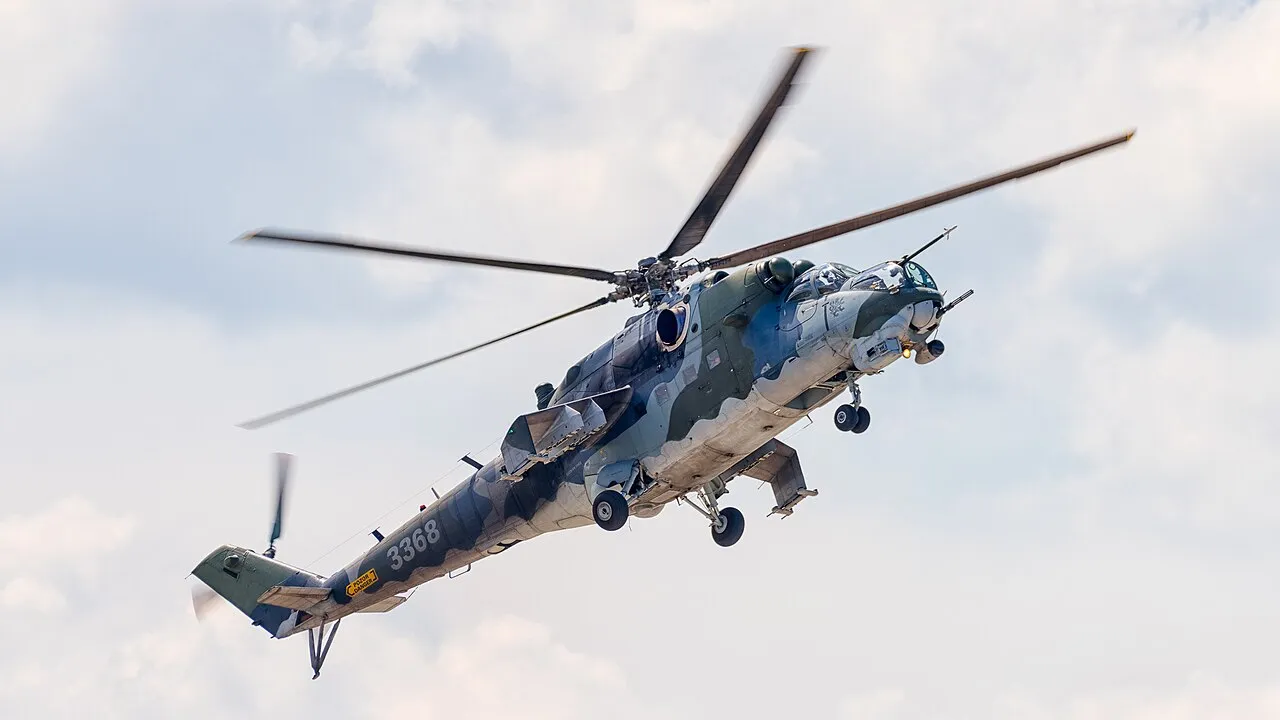
The original Mi-24A had an angular, greenhouse-style cockpit later judged to give poor visibility for the gunner. The Mi-24D, which NATO called Hind D, replaced it with the type’s now-characteristic tandem cockpit under a double-bubble canopy, stacking the pilot above and behind the gunner. The export version, known in the West as Hind E and in Soviet service as the Mi-24V, carried improved avionics and weapons systems and was later built for export as the Mi-35. The Mi-24P swapped the earlier flexible gun mount for a fixed twin-barrel 30 mm cannon built into the fuselage. The most recent production version, the Mi-35M, adds modern electronics, sights and night-vision capability1 to the same airframe.
Operators and service
Exports have taken the Mi-24 family worldwide: by the most recent count it is in use with 52 countries, with the Russian Aerospace Forces as its largest operator. Export and licensed customers span Eastern Europe, Africa, Latin America and Asia, among them Afghanistan, Algeria, Angola, Armenia, Azerbaijan, Belarus and Bulgaria. Brazil flew the type too, retiring its last Mi-35s in 20221. Its dual gunship-and-transport role has no direct NATO equivalent; Western air arms instead split the job between pure gunships like the AH-64 Apache and separate troop-carrying helicopters.
Safety record
Its heaviest losses came during the Soviet–Afghan War. From 1986 the United States supplied Afghan rebels with Stinger shoulder-launched, heat-seeking missiles, which could exploit a design weakness of the Mi-24: its two engines sit side by side in an inline configuration that creates two large, separate sources of heat and ultraviolet radiation for a heat-seeking missile to track. Soviet sources put total losses in the war at 74 helicopters, including 27 shot down by Stingers and two by older Redeye missiles. The last Soviet Mi-24 lost to a missile in that war was shot down on the night of 2 February 1989, killing both crew members1, shortly before the Soviet withdrawal.
Similar aircraft
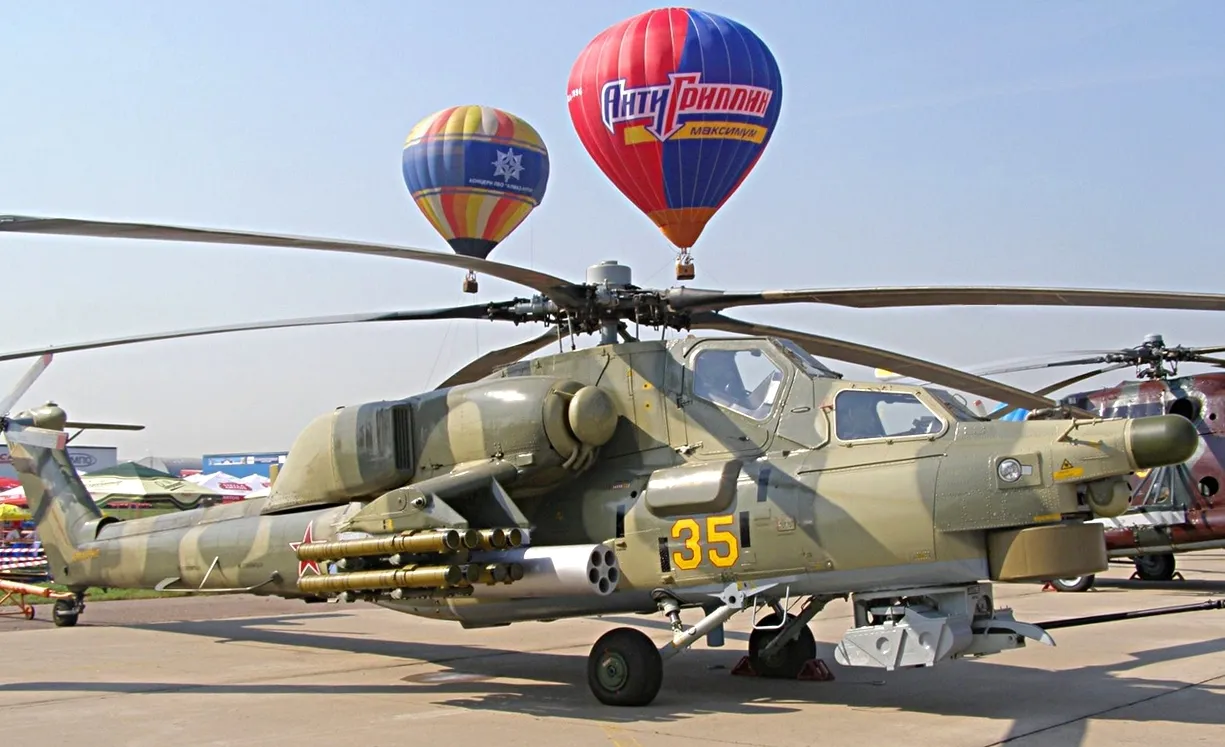
- Mil Mi-28: a later Soviet and Russian attack helicopter that drops the Mi-24’s troop cabin for a pure gunship role.
- Kamov Ka-50: a single-seat Soviet attack helicopter developed alongside the Mi-28 as a dedicated gunship, without troop-carrying capacity.
- Boeing AH-64 Apache: the main Western attack helicopter, built as a gunship without the Mi-24’s infantry compartment.
_(522-03)_Z26QJ04.webp)