Contents
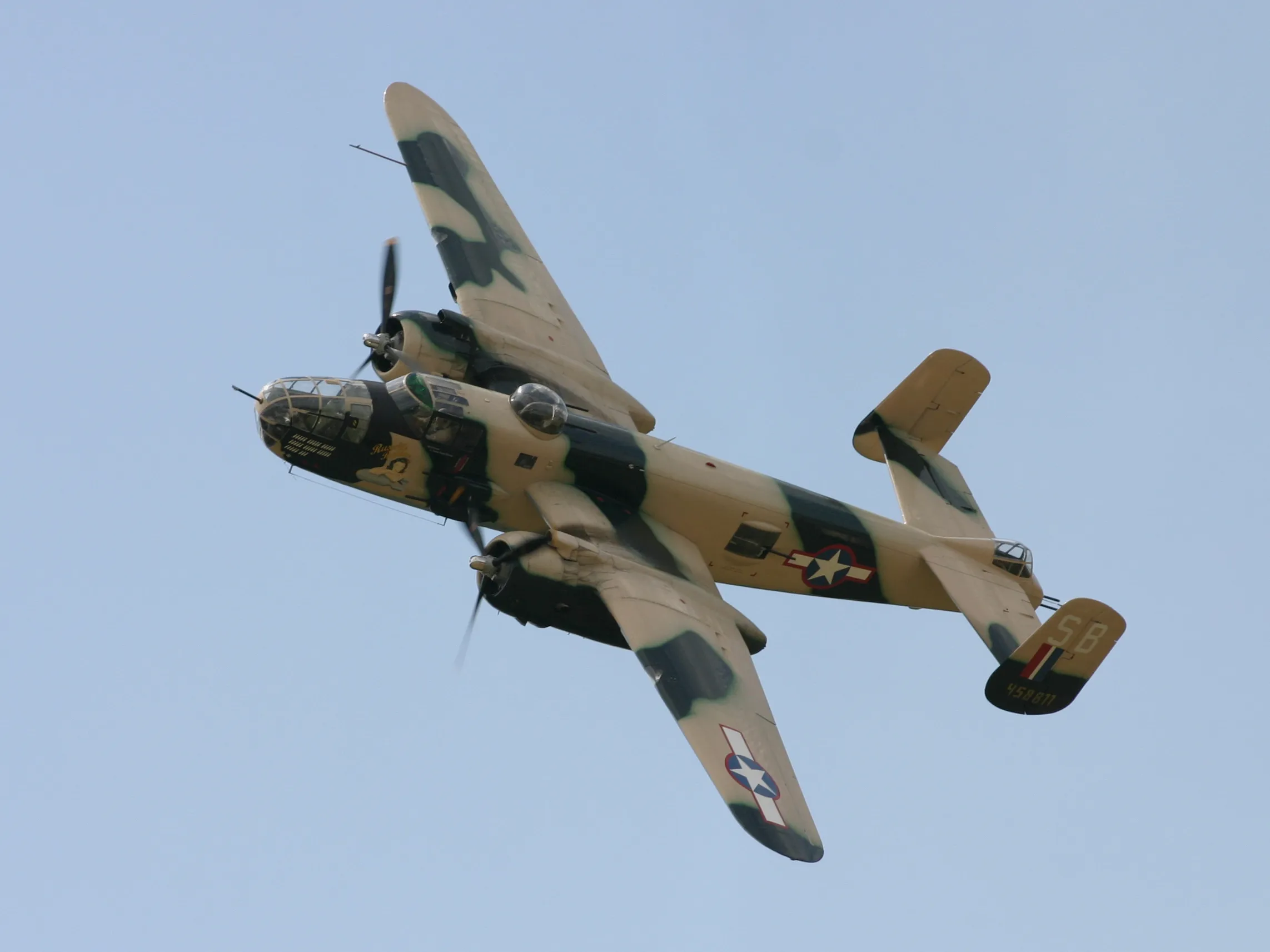
The North American B-25 Mitchell is a twin-engine medium bomber built by North American Aviation for the US Army Air Corps. On 18 April 19421 James Doolittle led sixteen B-25s from the carrier Hornet on the famous raid against Japan. The type was meant to bomb from moderate altitudes, but it found its true calling as a low-level attack bomber and strafer2.
Design and development
On 11 March 1939 the Army Air Corps asked for bids on a new medium bomber. It chose the Glenn L. Martin Company to build the B-26 Marauder and, to reduce the risk that technical problems could delay it, also selected a design that promised robust but not extraordinary performance: the North American B-25. Chief engineer Lee Atwood suggested the name Mitchell as a tribute to General William “Billy” Mitchell. The bomber drew heavily on the earlier NA-40 design, with the wing lowered and the cockpit revised to side-by-side seating1.
The prototype made its maiden flight on 19 August 19403. Test flights showed a tendency to Dutch roll, and North American fixed it by setting the outer wing panels just over a third of a degree down2 while keeping the four-degree dihedral of the inner panels, which gave the Mitchell its broken-wing look. The origin of the twin fins and rudders remains obscure, but they helped the pilot keep control when an engine failed. Air Corps planners had North American build the B-25 without first testing a pre-production prototype, a step that sped delivery of 130 Mitchells1 to front-line squadrons before Pearl Harbor.
Economy had a lot to do with its success: it took 25 percent fewer man-hours to build a B-25 than a B-26. North American built B-25s at Inglewood, California, and 6,608 at its Kansas plant3, while also producing the AT-6 Texan and the P-51 Mustang in huge numbers2.
Specifications
The Smithsonian’s B-25J measures 52 ft 11 in long, with a wingspan of 67 ft 7 in, and has a gross weight of 35,000 lb. Two Wright R-2600 radials of 1,700 horsepower1 each powered it. The Air Corps had required North American to stay with the well-developed though less powerful Wright R-2600 instead of the hot new Pratt & Whitney R-2800. The engines sat in nacelles entirely under the wings2, leaving the upper surface of the wing unobstructed.
The gunship B-25H cruised at 230 mph (370 km/h), had a range of 1,350 mi and carried 3,000 lb of bombs3. The airframe was all-aluminum with fabric-covered ailerons, elevators and rudders1, and it sat on tricycle landing gear. From the A model to the J the airframe remained unstretched2; the biggest change over the war was its armament.
Variants
The first 24 B-25s were followed by the B-25A, which had self-sealing fuel cells, and the B-25B with dorsal and ventral turrets. The B-25C was the first mass-produced version, with 1,625 built at Inglewood; the near-identical B-25D came from Kansas City. The B-25G replaced the glazed nose with a solid one carrying a 75 mm M4 cannon, and the B-25H added more guns and a lighter cannon; 405 Gs and 1,000 Hs3 left the factory. Units that found the cannon hard to operate, punishing to airframes and unpleasant to use2 stripped it out.
The B-25J, introduced in December 1943, returned to a glazed nose and was the most produced model, with 4,318 built. Its strafer-nose version could carry eighteen .50 in machine guns3. The Navy received 706 slightly navalized versions2, designated PBJs and flown mostly by the Marine Corps. After the Korean War, Hayes Aircraft modified 380 B-25J aircraft1 for advanced pilot training.
Operators and service
In the Doolittle Raid the B-25 was the only bomber able to take off from an aircraft carrier1 with a useful bombload and fly the distance needed. Most American B-25s fought in the Pacific, where, using mast-height tactics and skip bombing3, it proved capable at anti-ship attack. In the March 1943 Battle of the Bismarck Sea, twelve B-25 strafers of the 3rd Bomb Group sank four cargo vessels and two destroyers. In the Mediterranean and Europe, B-25s largely operated as strategic level bombers2.
Five Allied nations also operated the Mitchell during the war. Under Lend-Lease the United States delivered 870 to the USSR and 910 to Great Britain, and the Dutch operated more than 300. After the war, countries such as Brazil, Chile, China and Venezuela received B-25s through aid programmes. The last flight of a US Air Force B-25 came on 21 May 1960, and Indonesia retired its last B-25s in 1974. As of 2026, many B-25s are kept in airworthy condition3 by air museums and collectors; the Smithsonian’s B-25J “Carol Jean” entered its custody on 18 November 19851.
Safety record
The B-25 was considered a relatively forgiving aircraft to fly, though its extremely noisy engines left many pilots with some degree of hearing loss. On 28 July 19453 a USAAF B-25D crashed in thick fog into the north side of the Empire State Building between the 79th and 80th floors, and fourteen people died.
Similar aircraft
- Martin B-26 Marauder: chosen in the same 1939 competition as one of the most advanced and ambitious designs1 of its day, it had a reputation for being hard to handle2 due to its high wing loading, while thousands of newly trained pilots flew the B-25 with no problem.
- Douglas A-20 Havoc: a rival that was more expensive to manufacture than the B-25; the Fifth Air Force fitted A-20s with fixed nose guns before longer-range, more capable B-25s2 arrived.
- Boeing B-17 Flying Fortress: a high-altitude heavyweight, not a medium bomber, and among American aircraft the only one with a longer combat career2 than the B-25.