Contents
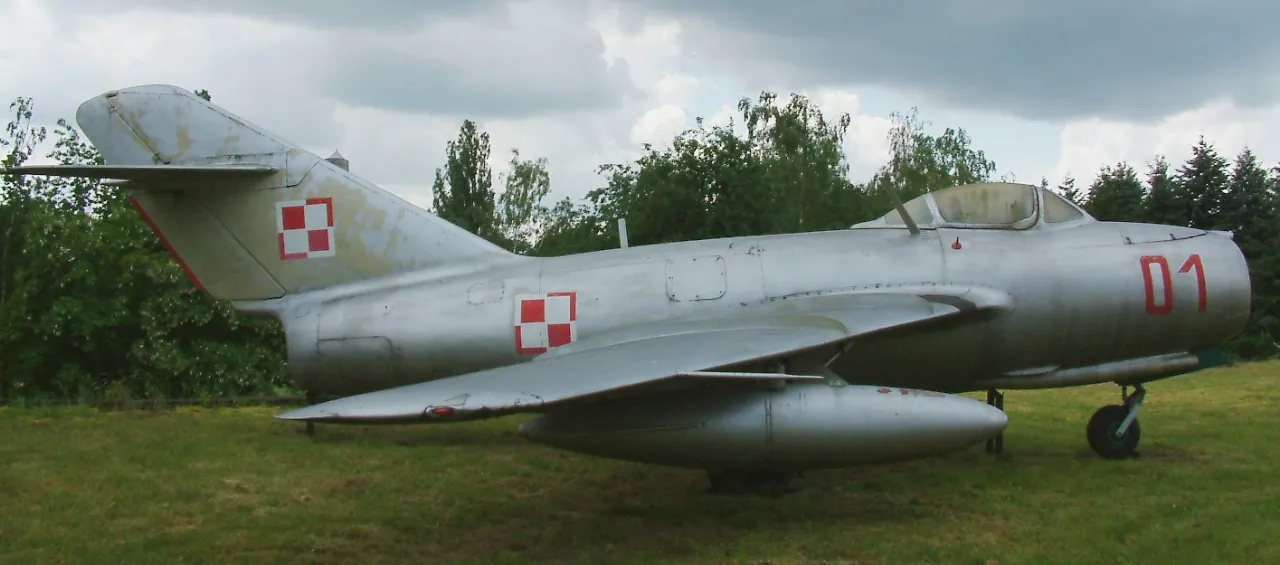
The Mikoyan-Gurevich MiG-15 is a single-engine, swept-wing jet fighter built for high-altitude interception. The Mikoyan-Gurevich Design Bureau developed it for the Soviet Union, and it became the first widely successful swept-wing jet fighter, best known for outperforming contemporary American jets during the Korean War. Known to NATO by the reporting name “Fagot,” it was built in enormous numbers and flown by dozens of air forces1 during the Cold War.
Design and development
Soviet engineers drew on captured German swept-wing research and a licensed British engine to leapfrog their earlier jet designs. The prototype, designated I-310, made its first flight on 30 December 1947, powered by a Klimov RD-45, a reverse-engineered version of the Rolls-Royce Nene turbojet that Britain had sold to the Soviet Union. The production MiG-15 followed with its first flight on 31 December 19481.
The aircraft’s 35-degree swept wing, copied in principle from wartime German research, let it fly closer to the speed of sound than earlier straight-wing jets such as the American F-80 and F-84 it would meet in combat. An improved variant, the MiG-15bis, introduced the more powerful Klimov VK-1 engine, a Soviet-developed evolution of the RD-451.
Specifications
The MiG-15bis variant is 10.102 m long with a wingspan of 10.085 m. Loaded with two 600-litre drop tanks, its maximum take-off weight reaches 6,106 kg, and with those tanks it has a ferry range of about 2,520 km at 12,000 m. Its cruise speed is about 850 km/h, roughly Mach 0.691.
Power comes from a single Klimov VK-1 centrifugal-flow turbojet in the MiG-15bis, while earlier aircraft used the Klimov RD-45, the licensed derivative of the Rolls-Royce Nene. The fighter normally carries a single pilot, except for the MiG-15UTI trainer variant, which seats two1.
Variants
Beyond the baseline MiG-15 and the more powerful MiG-15bis, the Soviet Union built the MiG-15UTI, a two-seat trainer version used to convert pilots onto the type. The design was also built under license in Czechoslovakia and Poland1, adding to Soviet output.
Operators and service
Production reached 13,130 aircraft in the USSR, plus at least 4,180 more built under license in Czechoslovakia and Poland, making it one of the most-produced jet fighters ever built. It flew with the air forces of the Soviet Union, China, North Korea and a long list of other Warsaw Pact and allied states through the 1950s and beyond. Today it is in limited service with the Korean People’s Army Air Force as an advanced trainer1, decades after most other operators retired it.
Safety record
No sourced record of a MiG-15-specific accident rate or fleet safety study was found; the type’s prominent record instead comes from air combat (see Design and development).
Similar aircraft
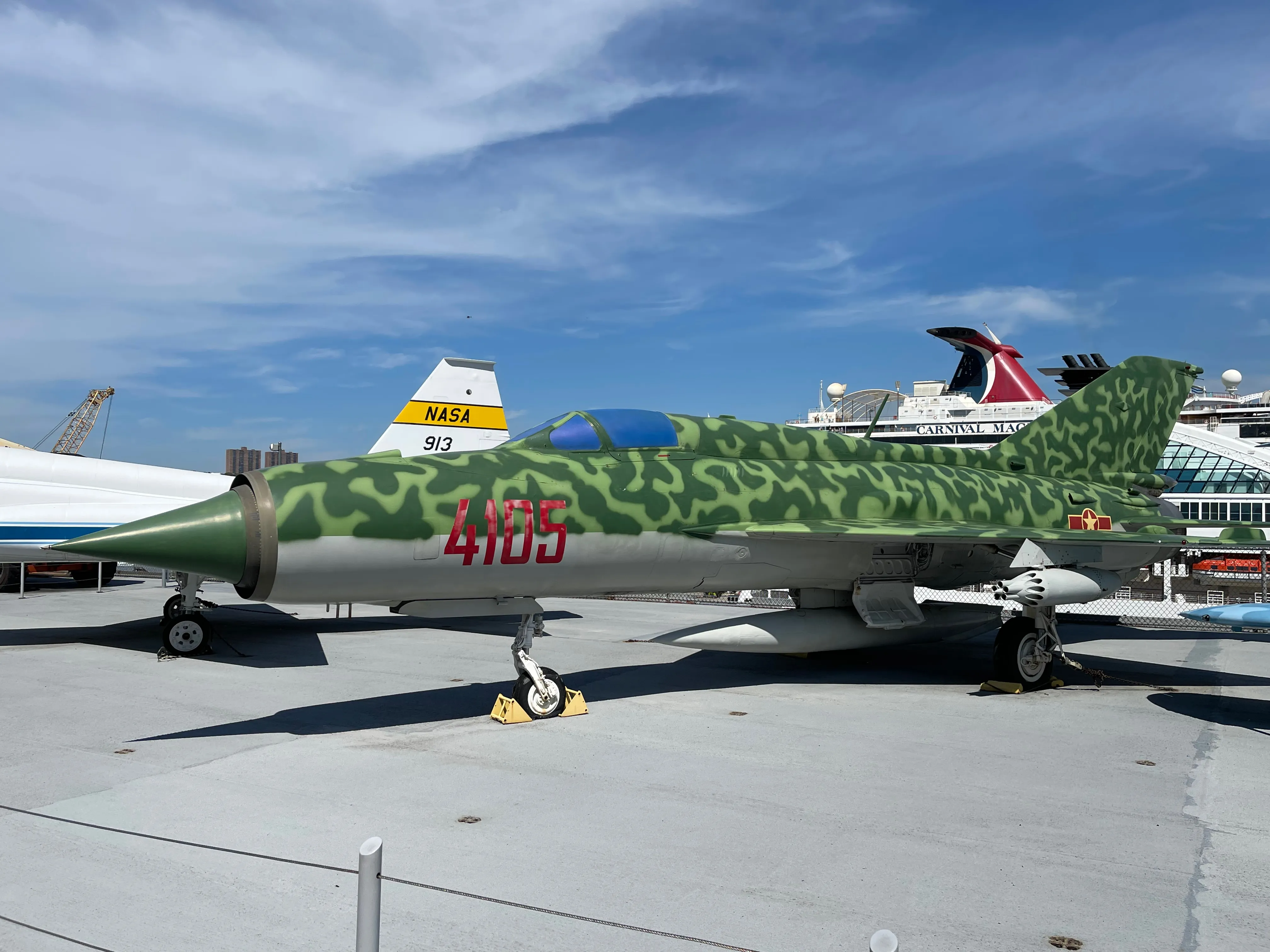
- Mikoyan-Gurevich MiG-21: the later Mikoyan-Gurevich delta-wing fighter that succeeded the MiG-15’s swept-wing generation in Soviet service.
- North American F-86 Sabre: the American swept-wing fighter that faced the MiG-15 in Korean War air combat.
_fA8XS.webp)
_2dTk34.webp)
_ZfgbMz.webp)