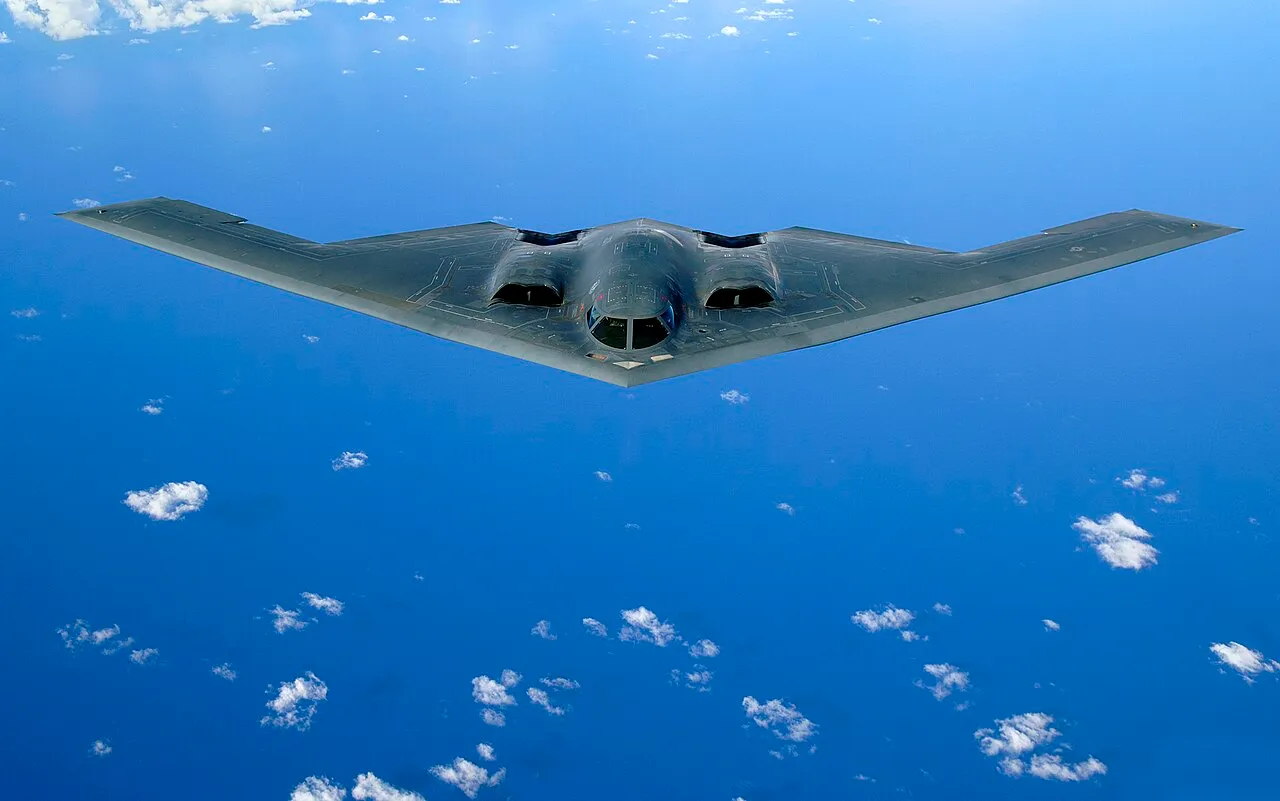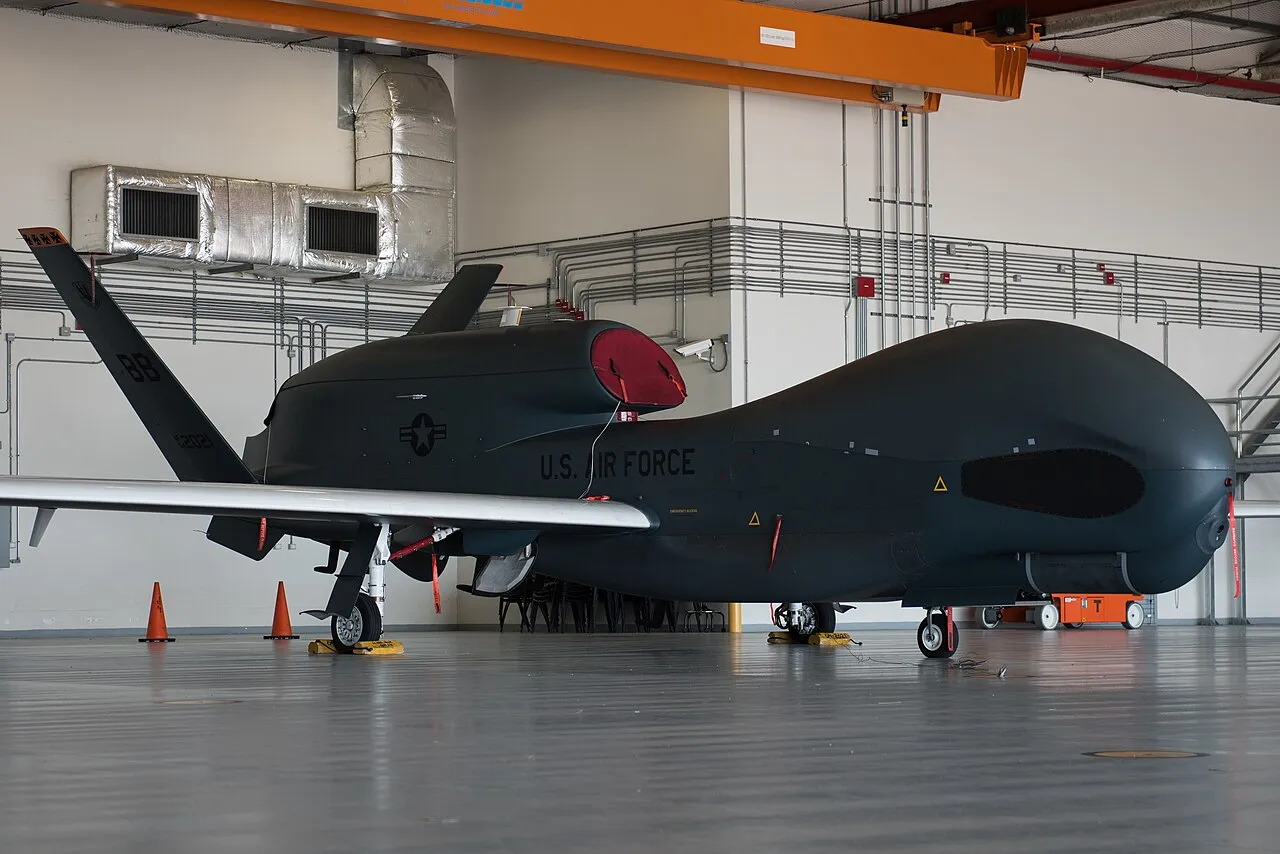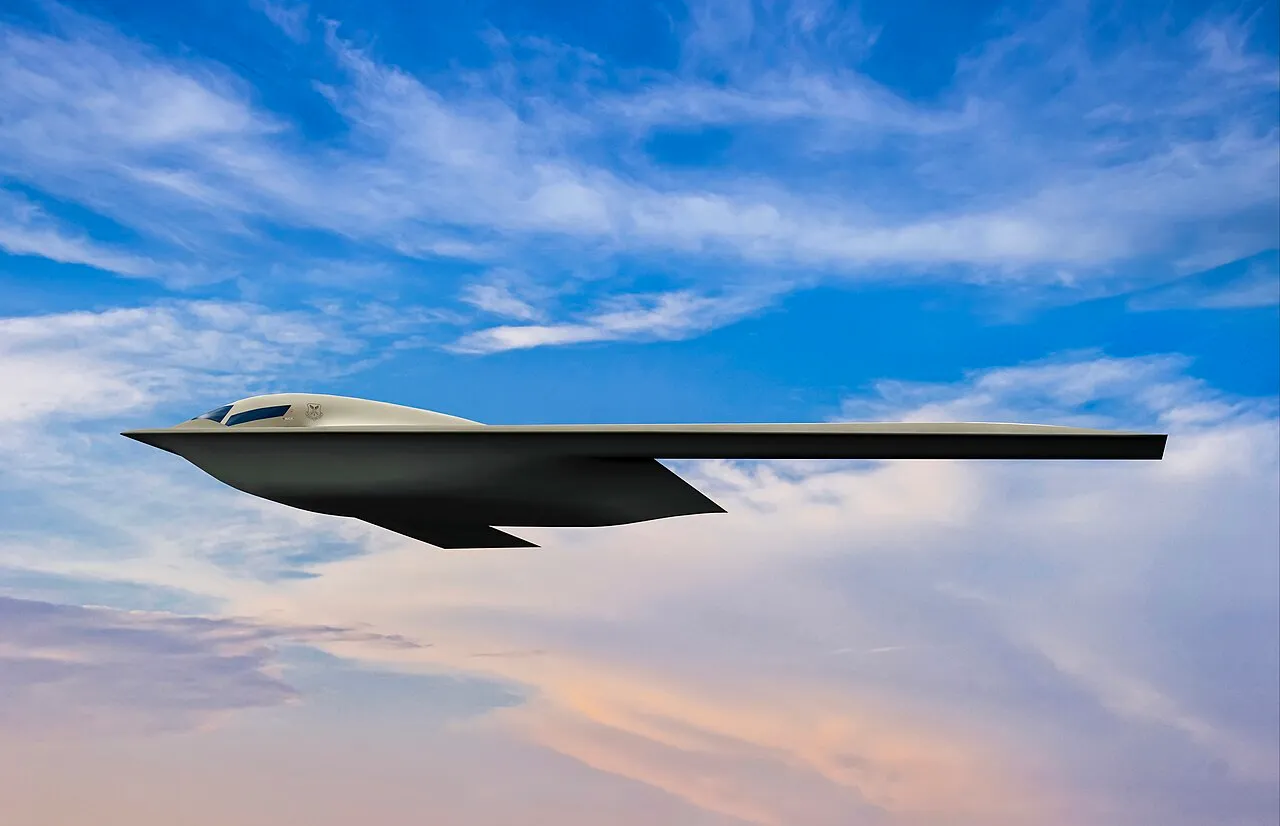
The Northrop Grumman B-21 Raider is an American nuclear-capable stealth strategic bomber that Northrop Grumman is developing for the United States Air Force. Its maker calls it the world’s first sixth-generation aircraft and says it is built to penetrate the toughest defences and deliver precision strikes anywhere in the world. The bomber is meant to complement the B-1 Lancer and B-2 Spirit and replace them by 20401. Northrop Grumman says the first B-21 is on track to arrive at Ellsworth Air Force Base in 20272.
Design and development
The Air Force launched the classified Long Range Strike Bomber programme in 2011 and awarded the development contract to Northrop Grumman in October 2015. Boeing and Lockheed Martin, which had bid together, protested the award, but the Government Accountability Office upheld the decision and its report showed that cost was the deciding factor. The programme is run by the Air Force Rapid Capabilities Office1 rather than through the usual procurement process.
In September 20161 the Air Force named the bomber “Raider” after the Doolittle Raiders. Northrop Grumman ties the name to the raid of 18 April 1942, when 80 men flew 16 B-25 Mitchell bombers2 off the carrier USS Hornet.
Northrop Grumman builds the bombers at Air Force Plant 42 in Palmdale, California. The first B-21 was unveiled there on 2 December 20222 and made its first flight from the plant in November 20233. A low-rate initial production contract followed on 23 January 20241.
Northrop Grumman describes the bomber as built with next-generation stealth, advanced networking and an open systems architecture2. Like the B-2, it is a flying wing and lambda wing design. Its cockpit windows are designed to eliminate joints and seams1 to keep its radar cross-section small.
Specifications
The War Zone measured the aircraft on a satellite image of Edwards Air Force Base and puts it at about 152 feet (46.3 m) wingspan and 61 feet (18.6 m) length, give or take a few feet. By that measurement it is about 12% smaller than the B-2 in both span and length. The same report notes that it is nearly the same length as an F-15 fighter4.
The bomber has two engines instead of the B-2’s four. Pratt & Whitney was named in March 2016 as one of seven tier-one suppliers, and in 2016 the F-35 programme manager said the B-21’s engines would be similar enough to the F-35’s Pratt & Whitney F135 to reduce their cost. The exhausts are deeply buried, with large planar exit ramps4. It has a crew of two. As of 2025 many aspects of the programme were still highly classified, and published figures for its weight and range are only estimates. At the unveiling, Northrop Grumman’s chief executive said the B-21 was slightly smaller than the B-2 but had a longer range1.
Images of the second test aircraft show a single large central weapons bay3. The bomber is to carry the AGM-181 LRSO nuclear cruise missile1 and the B61 Mod 12 and Mod 13 nuclear bombs, as well as conventional weapons such as the AGM-158 JASSM-ER.
When the B-21 was unveiled, the Air Force gave an expected average procurement cost of $692 million per aircraft. In April 2024 Air Force Secretary Frank Kendall told a Senate subcommittee that the unit cost had fallen5 after negotiations with Northrop Grumman; the current figure was not disclosed.
Variants
The first B-21s are test aircraft, not prototypes1, and the Air Force plans to convert them to operational configuration once testing ends.
Operators and service
The United States Air Force plans to buy at least 100 bombers, a figure that is increasingly expected to grow. Testing is run by the B-21 Combined Test Force at Edwards Air Force Base. By September 2024 the first aircraft was flying around two sorties a week from Edwards. The second B-21 first flew on 11 September 20253, and photographs released in April 20261 showed the bomber refuelling in flight from a KC-135.
Ellsworth Air Force Base, South Dakota, is the first base set to receive operational aircraft, and Northrop Grumman is developing simulators and training content for the Air Force’s Formal Training Unit at Ellsworth. The other planned bomber bases are Dyess in Texas and Whiteman in Missouri1, while Tinker Air Force Base in Oklahoma coordinates maintenance. An official release quoted by The War Zone said fiscal year 2026 would see military construction start at all three main operating bases3.
Similar aircraft
- Northrop B-2 Spirit: the B-21’s flying-wing predecessor; the B-21 is about 12% smaller in wingspan4 and has two engines instead of four.
- Rockwell B-1 Lancer: a bomber dating from the 1980s1 that the B-21 is meant to replace by 2040.
- Boeing B-52 Stratofortress: a bomber dating from the 1950s1 that the B-21 may eventually replace as well.