Contents
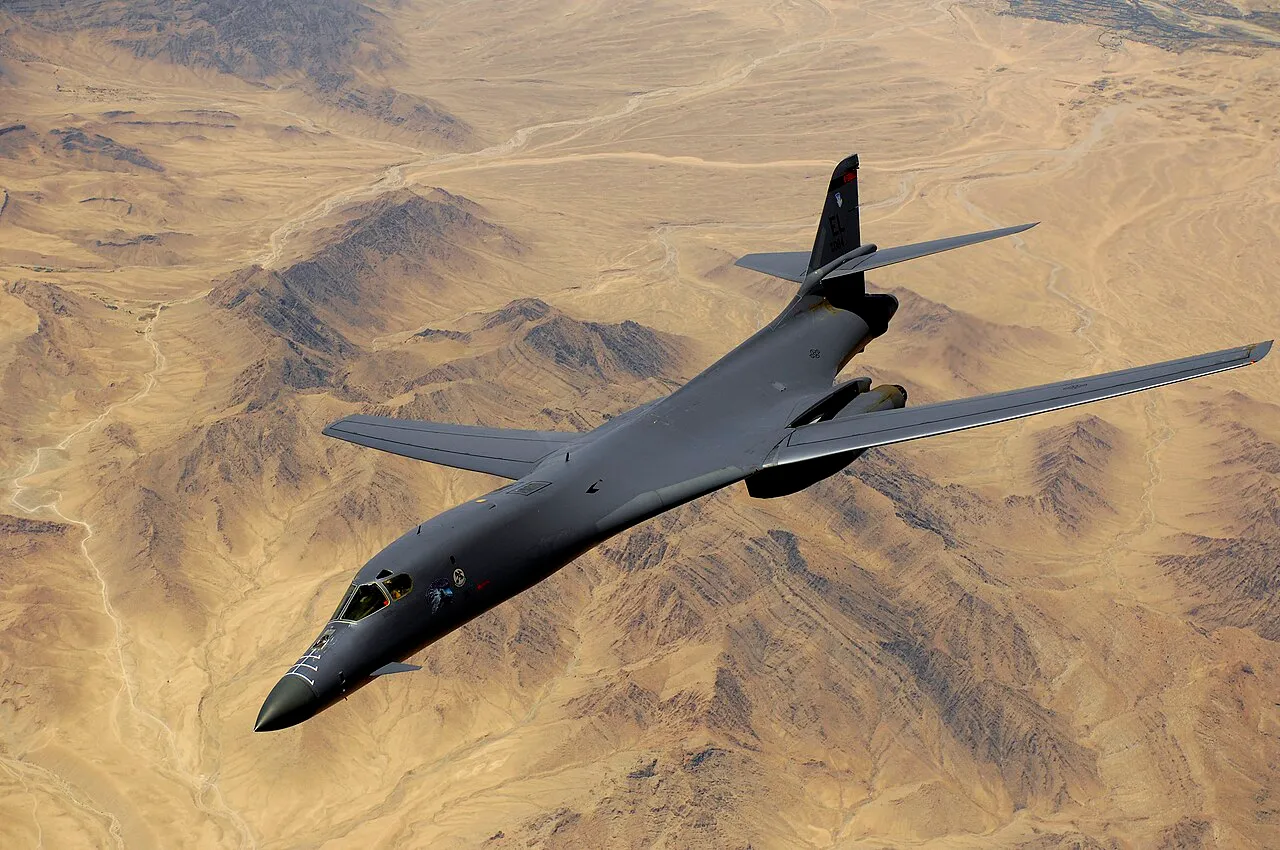
The Rockwell B-1 Lancer is a variable-sweep, supersonic-capable heavy bomber built for the United States Air Force. Rockwell International designed and built it, and after Boeing acquired Rockwell’s defense and space business in 19961 the aircraft passed into Boeing’s hands for support. Conceived as a nuclear-armed successor to the B-52, it was converted to conventional-only missions in the 1990s and has since flown long-range strike sorties over Iraq, Afghanistan, Libya and Syria.
Design and development
The B-1 traces back to a 1955 requirement for a bomber combining the B-52’s payload and range with the B-58’s Mach 2 speed, a search that ran through the cancelled B-70 Valkyrie before emerging in 1964 as the Advanced Manned Strategic Aircraft programme. President Nixon revived the effort as the B-1A in April 1969, and the first B-1A prototype made its first flight on 23 December 1974. President Carter cancelled the B-1A programme on 30 June 19771, judging cruise missiles and stealth aircraft better value for the cost.
Ronald Reagan reversed that decision: on 2 October 1981 he announced an order for 100 production aircraft as an interim bomber while the stealthy B-2 was developed. The redesigned B-1B traded top speed for survivability, with fixed engine intakes, a smaller radar cross-section and a maximum speed cut to about Mach 1.25 in place of the B-1A’s Mach 2.2. The first production B-1B flew on 18 October 1984, and the 100th and final aircraft was delivered on 2 May 19881.
Specifications
The B-1B is 44.5 m long with a variable-sweep wing spanning 41.8 m spread for take-off and landing and sweeping back to 24.1 m for high-speed flight. Maximum take-off weight is 216,364 kg, carried aloft by four General Electric F101-GE-102 afterburning turbofans. Unrefuelled ferry range is about 9,445 km, with a shorter combat radius once weapons and a strike profile are factored in. The bomber is optimised for low-level penetration, cruising at about 1,130 km/h (Mach 0.92) at low altitude and reaching roughly 1,335 km/h (Mach 1.25) at altitude. A crew of four1 flies it: an aircraft commander, a pilot and two systems officers who handle offensive and defensive systems.
Variants
The original B-1A used variable engine intakes for its Mach 2.2 top speed, and only four prototypes were built before Jimmy Carter’s 1977 cancellation. The B-1B, the only production version, fixed the intake geometry and accepted a lower top speed in exchange for a smaller radar signature and sturdier low-level handling; all 100 aircraft built belong to this standard. A 2004 proposal, the B-1R, would have fitted Pratt & Whitney F119 engines from the F-22 Raptor and modern radars and air-to-air missiles for a Mach 2.2 top speed at the cost of about 20 percent less range1, but it was never built.
Operators and service
The B-1B reached initial operational capability on 1 October 1986 and first saw combat over Iraq during Operation Desert Fox in December 1998. It later flew in Operation Allied Force over Kosovo in 1999, Operation Enduring Freedom in Afghanistan from 2001, the 2003 invasion of Iraq, Operation Odyssey Dawn over Libya in 2011 and the campaign against Islamic State from 2014. In the opening six months over Afghanistan alone, eight B-1s dropped almost 40 percent of the aerial ordnance used, including around 3,900 JDAMs1.
Of the 100 B-1Bs built, 45 remained in United States Air Force service as of 2025, flown from the 7th Bomb Wing at Dyess Air Force Base, Texas, and the 28th Bomb Wing at Ellsworth Air Force Base, South Dakota, with a USAF announcement in February 2021 that 17 of the remaining aircraft would be retired. The type is in service, though the incoming Northrop Grumman B-21 Raider is due to begin replacing it after 20251.
Safety record
In late 1990, engine fires traced to the first-stage fan forced a temporary grounding, and the fleet flew under limited alert until the problem was fixed by 6 February 1991. The type has also proven costly to keep flying: the Air Force has said a single flight hour requires 48.4 hours of repair work1.
Similar aircraft
- Boeing B-52 Stratofortress: the long-serving bomber the B-1 was meant to eventually succeed, though both still fly USAF missions side by side.
- Tupolev Tu-160: the Soviet/Russian variable-sweep supersonic bomber built to a broadly similar role and era.
- Northrop B-2 Spirit: the stealth bomber developed alongside the B-1B as part of the same strategic bomber modernisation effort.