Contents
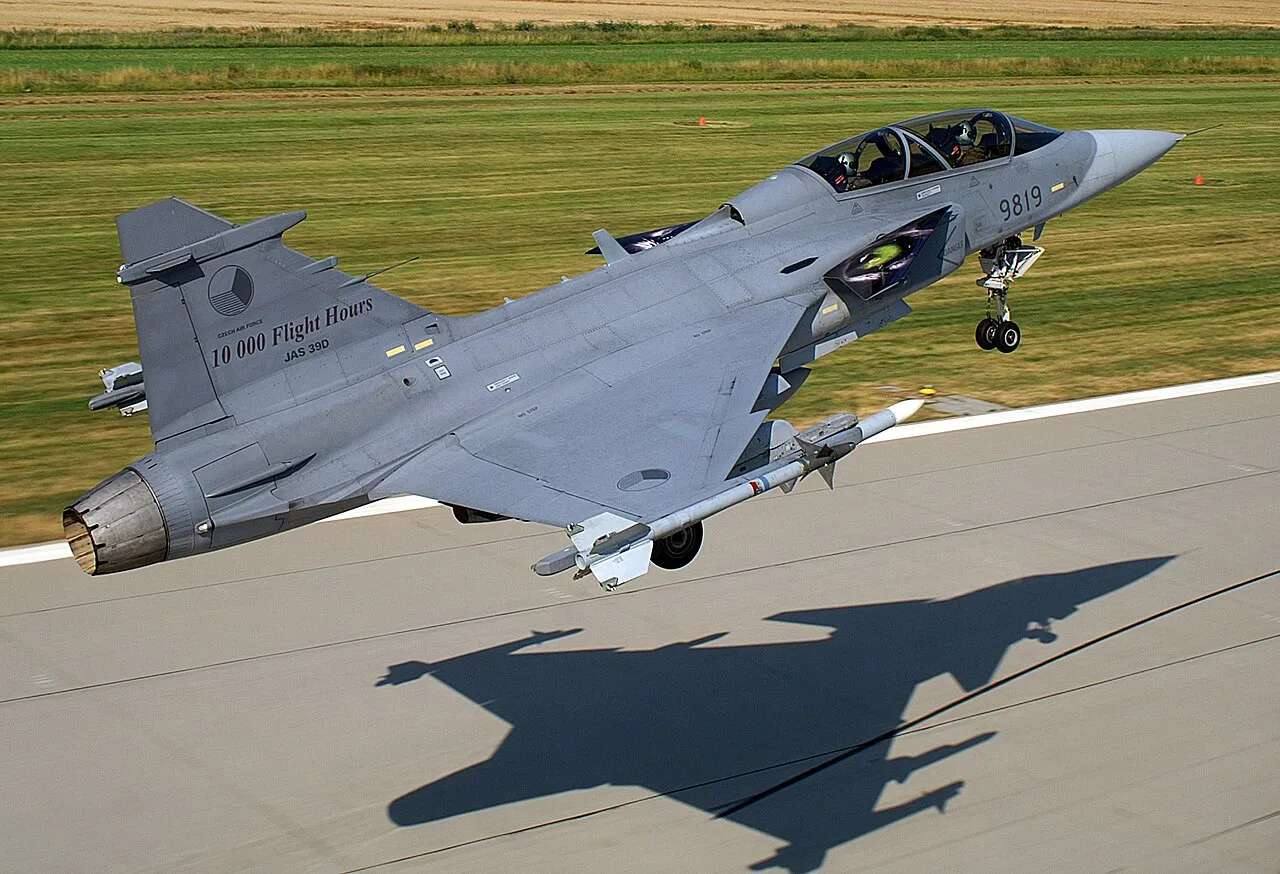
The Gripen is a single-engine, delta-wing, canard-equipped multirole fighter built by Saab for Sweden’s air force. The name JAS stands for Jakt, Attack, Spaning — fighter, attack and reconnaissance, the roles a single Gripen airframe is built to fly instead of the separate types it replaced. Saab designed it to be cheap to fly and to operate from short, dispersed roads and runways2, and it has since found export customers beyond Sweden in the Czech Republic, Hungary, Thailand, South Africa, Brazil and Colombia1.
Design and development
The Swedish government began studies in 1979 for a single aircraft type to replace the ageing Saab 35 Draken and 37 Viggen. The chosen design was a lightweight, single-engine, single-seat fighter using fly-by-wire controls and canards, deliberately built aerodynamically unstable to improve manoeuvrability. In 1980, Saab-Scania, LM Ericsson and Volvo Flygmotor formed the joint venture Industrigruppen JAS to build it, and on 30 June 1982 Sweden’s defence materiel administration signed contracts worth SEK 25.7 billion for five prototypes and 30 production aircraft1.
The first prototype was rolled out on 26 April 1987, Saab’s 50th anniversary, and made its maiden flight on 9 December 1988, a 51-minute flight flown by Stig Holmström. Flight testing was not without setbacks: the first prototype crashed on landing at Linköping on 2 February 1989 after pilot-induced oscillation in the flight control system, though the pilot survived with a broken elbow, and a production aircraft was destroyed during a display at the Stockholm Water Festival on 8 August 1993 after stalling in a low-altitude roll, with the pilot ejecting safely. The type entered service with the Swedish Air Force on 9 June 19961.
The design philosophy carried through later models. Saab says the Gripen E/F generation keeps the same emphasis on operating from dispersed and unprepared road bases in extreme climates, with a stated combat turnaround of 15 to 25 minutes2 between sorties.
Specifications
The Gripen’s single-seat C model is 14.9 m long with a wingspan of 8.4 m; the two-seat D is 15.6 m long. Maximum take-off weight on the C/D is 14,000 kg, and ferry range is about 3,200 km, with a combat radius of roughly 800 km on internal fuel. Power comes from one Volvo RM12 afterburning turbofan, a licence-built derivative of the General Electric F404 that had flown more than 143,000 hours without an engine-related failure by November 2010. The C/D carries a single 27 mm Mauser BK-27 cannon, omitted on the two-seat trainer variants, and can carry up to 6,500 kg of external stores1 including the RBS-15 anti-ship missile.
The newer Gripen E is a larger aircraft: Saab lists it at 15.2 m long (15.9 m for the two-seat F) with a maximum take-off weight of 16,500 kg, powered by one General Electric F414G afterburning turbofan rated at 98 kN of maximum thrust, about 20 percent more than the RM12. It has ten hardpoints, enough to carry up to seven Meteor beyond-visual-range missiles together with two IRIS-T short-range missiles2. All single-seat variants carry one pilot; the two-seat D and F trainer variants carry two. As of 2008, Saab’s own flyaway cost figure for the C model was under US$30 million; a 2012 study by Jane’s put its cost per flying hour at US$4,700, the lowest of the modern fighters it compared1.
Variants
The baseline JAS 39A and two-seat 39B were the initial production aircraft, with the B 66 cm longer than the A and built without the cannon to make room for a second seat. The JAS 39C and 39D, sometimes called the “Turbo Gripen,” added NATO-compatible systems and in-flight refuelling and became the export standard. The JAS 39E and two-seat 39F are a substantial redesign with a larger fuselage, the more powerful F414G engine and new radar and avionics; a related testbed, the two-seat Gripen Demonstrator, first flew on 27 May 2008 and was used to test supercruise above Mach 1.21.
Operators and service
Sweden is the largest operator, having ordered 204 Gripens across three production batches, with the Swedish Air Force approving 60 Gripen E aircraft on 17 January 2013 for delivery between 2018 and 2027; the first Gripen E was formally delivered to Sweden on 20 October 2025. Swedish Gripens have also flown in combat: eight Swedish Gripens flew more than 650 missions and around 2,000 flight hours over Libya in 20111.
Export sales followed Sweden’s own orders. The Czech Republic leased 14 ex-Swedish aircraft from June 2004, with the first six delivered in April 2005, a lease later extended to 2029 with a modernisation programme. Hungary signed a lease for 14 Gripens in February 2003, with the last deliveries completed in December 2007. Thailand operates 12 ex-Swedish Air Force Gripens, and South Africa also became an operator, though its purchase was later linked to corruption allegations against BAE Systems that drew criminal investigations in eight countries1.
Brazil is the largest Gripen E/F customer: it selected the type in December 2013 and signed a contract in October 2014 for 28 Gripen E and 8 Gripen F aircraft worth about SEK 39.3 billion, with the first Brazilian-built aircraft rolled out on 25 March 20261. Saab lists Gripen E/F orders at 117 aircraft in total: 60 for Sweden, 36 for Brazil, 17 for Colombia and 4 for Thailand2.
Safety record
Sweden’s Gripen fleet has lost four aircraft in accidents, including the two pre-production crashes during flight testing in 1989 and 19931 described above under Design and development; in both cases the pilot survived.
Similar aircraft
- Dassault Rafale: a heavier, twin-engine French multirole fighter that competes with the Gripen in export markets including Croatia and Colombia.
- General Dynamics F-16 Fighting Falcon: an older single-engine American fighter the Gripen was benchmarked against in a 2006 Red Flag–Alaska exercise, where a Swedish Gripen recorded multiple simulated kills against F-16s without a loss.
- Eurofighter Typhoon: a larger, twin-engine European canard-delta fighter from the same design era, also built for NATO interoperability.