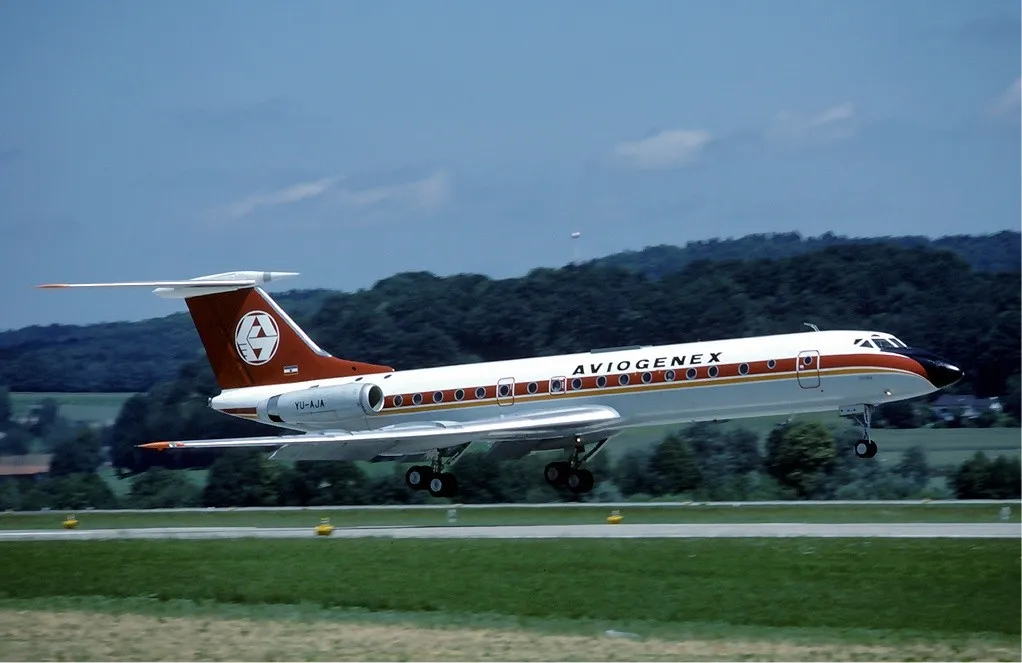
The Tupolev Tu-134 is a twin-engined, rear-engined short-haul airliner developed in the Soviet Union and built by the Kharkiv State Aircraft Manufacturing Company. It became one of Aeroflot’s main short- and medium-haul types for decades, also flying for export customers across the Soviet bloc, and it was the first Soviet airliner to receive international certification from the International Civil Aviation Organization1. Most passenger examples of the Tu-134 have since been retired, though a handful remain in military, government and limited civil use.
Design and development
Tupolev developed the Tu-134 as a modification of the earlier Tu-124, moving its engines from the wing roots to the rear fuselage in a layout pioneered by the French Sud Aviation Caravelle, which gave a cleaner wing airflow and a quieter cabin; the rearward engines also shifted the aircraft’s centre of gravity toward the tail, pushing the horizontal stabilisers up onto the fin. The prototype, initially designated Tu-124A, first flew on 29 July 19631; the type entered scheduled service in 1967, four years after its first flight, initially on the Moscow–Adler route, powered by two Soloviev D-30-II turbofans producing 66.68 kN of thrust each. Production ran from 1966 to 1989, with 854 aircraft built, 852 production examples plus two prototypes. The airframe kept a glazed nose for the navigator and 35-degree wing sweep with low-pressure landing-gear tyres for unprepared runways2, features carried over from earlier Tupolev military designs.
Variants
The original Tu-134 had a glazed nose and seated 64 to 72 passengers. The Tu-134A, the main production version, kept the glazed nose and chin-mounted radar dome, with upgraded engines, improved avionics and up to 84 seats1; other accounts put typical capacity more broadly, at 70 to 100 passengers depending on configuration2. The Tu-134B moved the radar into a solid nose radome, dropping the glazed nose, and seated 80. Military derivatives included the Tu-134UBL crew trainer for Tu-160 bomber pilots, built with a modified nose, the Tu-134LK cosmonaut trainer, and the Tu-134Sh bomber-crew trainers with specialised radar fits.
Operators and service
Aeroflot was the largest operator, carrying some 360 million passengers on the type by 19951 on domestic routes that from 1972 included Baku, Kyiv, Leningrad and Sochi, alongside the Moscow–Adler service it opened with; at its peak Aeroflot flew roughly 600 Tu-134s2 on domestic routes, earning the type an informal “Russian 737” nickname for its role as the airline’s short-haul workhorse. Export sales began in 1968 to Interflug of East Germany, LOT Polish Airlines and Malév of Hungary, and the type also flew for Czechoslovak, Bulgarian and other Comecon carriers. The Soviet Air Force and Soviet Naval Aviation operated military variants for transport and crew training.
Tightening ICAO noise rules pushed the Tu-134 out of most Western European airports after 20021, though Russian operators kept flying it longer, and a fatal accident in March 2007 led Russia’s transport minister to press Aeroflot into retiring its fleet by 1 January 2008. Russian passenger flying nonetheless continued for over a decade more: Siberian carrier Alrosa Airlines flew Russia’s last Tu-134 passenger service on 22 May 2019, after which the aircraft went straight to a museum in Novosibirsk2. A small number of Tu-134s remain active outside passenger service, including with North Korea’s Air Koryo, Ukraine’s air force and air guard, Russia’s space agency and air force, and Syria’s air force, in government, military or limited commercial roles.
Safety record
The Tu-134’s retirement from Russian passenger service followed two fatal accidents in particular: a March 2007 crash that prompted Aeroflot’s withdrawal announcement, and the June 2011 crash of RusAir’s Flight 9605, a 31-year-old Tu-134 on approach to Petrozavodsk Airport, which led President Dmitry Medvedev to order the type off passenger routes1 within a year. Early reports put the toll at 44 killed and eight survivors; it rose to a final 47 killed and five survivors4 of the 52 aboard in the following days, after the crew continued its approach in thick fog beyond the point for a go-around and struck power lines that cut the runway lights; Russia’s 13 largest airlines had flown accident-free for the three prior years3. A further Tu-134, operated by Kyrgyzstan’s Air Company, crashed in December 2011.
Similar aircraft
- Tupolev Tu-154: Tupolev’s larger trijet counterpart from the same era, seating up to 164 against the Tu-134’s 845 and using three rear-mounted engines instead of two.
- McDonnell Douglas DC-9: a Western twin rear-engined short-haul jet of similar layout, seating up to 139 in its stretched Series 50, against the Tu-134’s 846.
- BAC One-Eleven: a British short-haul twinjet that, like the Tu-134, placed its engines on the rear fuselage, but seated fewer passengers, up to 119 in its stretched 500 series7.
_Special_Flight_Squadron_Rossiya_(Russian_Government)_VKO_UUWW_(32966735944)_ZM3Jey.webp)