Contents
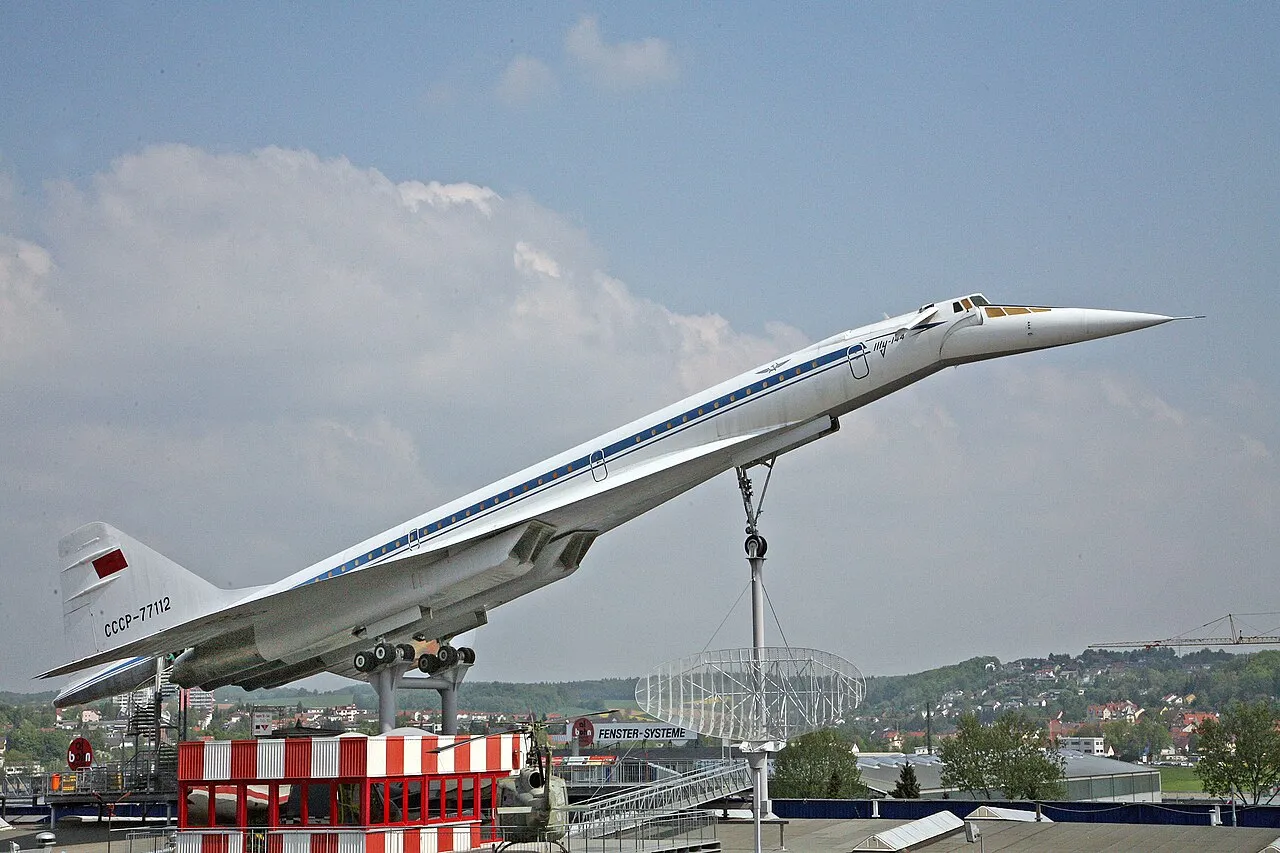
The Tupolev Tu-144 is a supersonic airliner designed by the Tupolev bureau and built by the Voronezh Aircraft Production Association for the Soviet Union. It was developed to carry passengers at supersonic speed across the country’s long domestic distances, and it made its first flight on 31 December 1968, two months before Concorde’s own first flight1, making it the first supersonic airliner to fly. Its visual similarity to Concorde earned it the nickname “Concordski”, though the two aircraft differ in several technical respects.
Design and development
The Soviet government approved the Tu-144 concept in 1963, with development formally starting on 26 July that year. The programme answered a practical need: the Soviet Union’s vast geography made supersonic travel look economically attractive, especially for government employees travelling between Moscow and cities in Siberia. It was also a Cold War race: the original government decree demanded a first flight in 1968, a target the Tu-144 met exactly, on 31 December that year1, beating Concorde’s first flight by two months.
Despite the “Concordski” nickname, the two designs diverge. The Tu-144 was bigger and faster than Concorde, cruising at Mach 2.15 against Concorde’s Mach 2.04. Tupolev’s engineers lacked access to the Western electronic engine controls used on Concorde, because of military export restrictions, and used fuel/hydraulic heat exchangers together with cooling turbines for cabin air instead. The prototype flew with an ogival delta wing without Concorde’s conical camber; production aircraft switched to a double delta wing with spanwise and chordwise camber and added small retractable “moustache” canards behind the cockpit to improve low-speed lift1.
Tupolev’s resources were stretched thin: the bureau was developing the Tu-154 and Tu-204 airliners alongside the Tu-22M and Tu-160 bombers at the same time, and Soviet leaders increasingly favoured the rival Ilyushin bureau’s Il-86 jumbo jet, which offered a much lower cost per seat than the Tu-1441.
Specifications
The production Tu-144D is 65.7 m long with a wingspan of 28.8 m and a maximum take-off weight of 207,000 kg. It cruised at Mach 2.0, about 2,125 km/h, and carried a flight crew of three. Cabin layout was for 150 passengers, 11 in first class and 139 in tourist class. The Tu-144D’s four Kolesov RD-36-51 turbojets, with a fuel capacity of 93,000 kg, extended range to about 6,500 km — Wikipedia gives a somewhat lower figure of about 5,330 km against Concorde’s roughly 6,470 km, reflecting different test conditions. The earlier Tu-144S, powered by four Kuznetsov NK-144A turbofans, had a much shorter range of about 2,500 km1.
Cabin noise was a persistent problem: inside the Tu-144S passenger cabin it reached at least 90–95 dB, making conversation between passengers difficult1.
Variants
The Tu-144S was the first production version, nine aircraft built with Kuznetsov NK-144A turbofans, a redesign of the prototype with more take-off thrust. The Tu-144D (“D” for Dal’nyaya, long-range) followed, five production aircraft plus one incomplete airframe with Kolesov RD-36-51 turbojets for better fuel efficiency and range. The Tu-144LL (“Flying Laboratory”) was a single Tu-144D, registration 77114, rebuilt from 1995 at a cost of US$350 million for NASA’s High Speed Civil Transport research programme; it flew 27 research flights between 1996 and 1999 before the programme was cancelled for lack of funding. In all, 16 Tu-144s were built, plus one unfinished airframe, between 1967 and 19831.
Operators and service
All commercial Tu-144s flew for Aeroflot and the Soviet Ministry of Aviation Industry; NASA later acquired the Tu-144LL for its own research flights. The Tu-144S entered service on 26 December 1975, flying cargo and mail between Moscow and Alma-Ata; scheduled passenger flights on the same route began on 1 November 1977. The service was short and troubled: over about 102 flights and 181 flight hours, the Tu-144S suffered more than 226 failures, 80 of them in flight and 80 severe enough to disrupt the schedule. Passenger flights ended on 1 June 1978, after an accident involving a Tu-144D; Aeroflot resumed cargo flights with the Tu-144D from 23 June 1979 until the whole programme was cancelled on 1 July 1983. The type’s last flight of any kind came on 26 June 1999, a NASA/Tu-144LL research sortie1, and it has not flown since.
Safety record
Two accidents mark the Tu-144’s short career. At the Paris Air Show on 3 June 1973, the first production Tu-144S (registration 77102) broke apart during its display flight and crashed, destroying 15 houses and killing all six people on board as well as eight people on the ground. The most-cited theory is that the pilot made an evasive manoeuvre to avoid a French Mirage reconnaissance jet that was photographing the Tu-144’s canards1, though the cause remains officially disputed.
A second accident occurred on 23 May 1978 near Yegoryevsk, when a Tu-144D on a pre-delivery test flight suffered a fuel leak that let about eight tonnes of fuel escape into the wing compartments some 27 minutes before it ignited, causing a fire in the port wing at 3,000 m altitude. The crew belly-landed the aircraft in a field six minutes after the fire started, but two flight engineers died when the nose cone collapsed under the fuselage and crushed their compartment1. This accident led Aeroflot to end passenger service a few days later.
Similar aircraft
- Concorde: the only other supersonic airliner to enter service, developed in parallel in Britain and France and first flown two months after the Tu-144, giving rise to the “Concordski” nickname.
- Boeing 2707: the cancelled American supersonic airliner project of the same era, abandoned before a prototype flew.
_Special_Flight_Squadron_Rossiya_(Russian_Government)_VKO_UUWW_(32966735944)_ZM3Jey.webp)