Contents
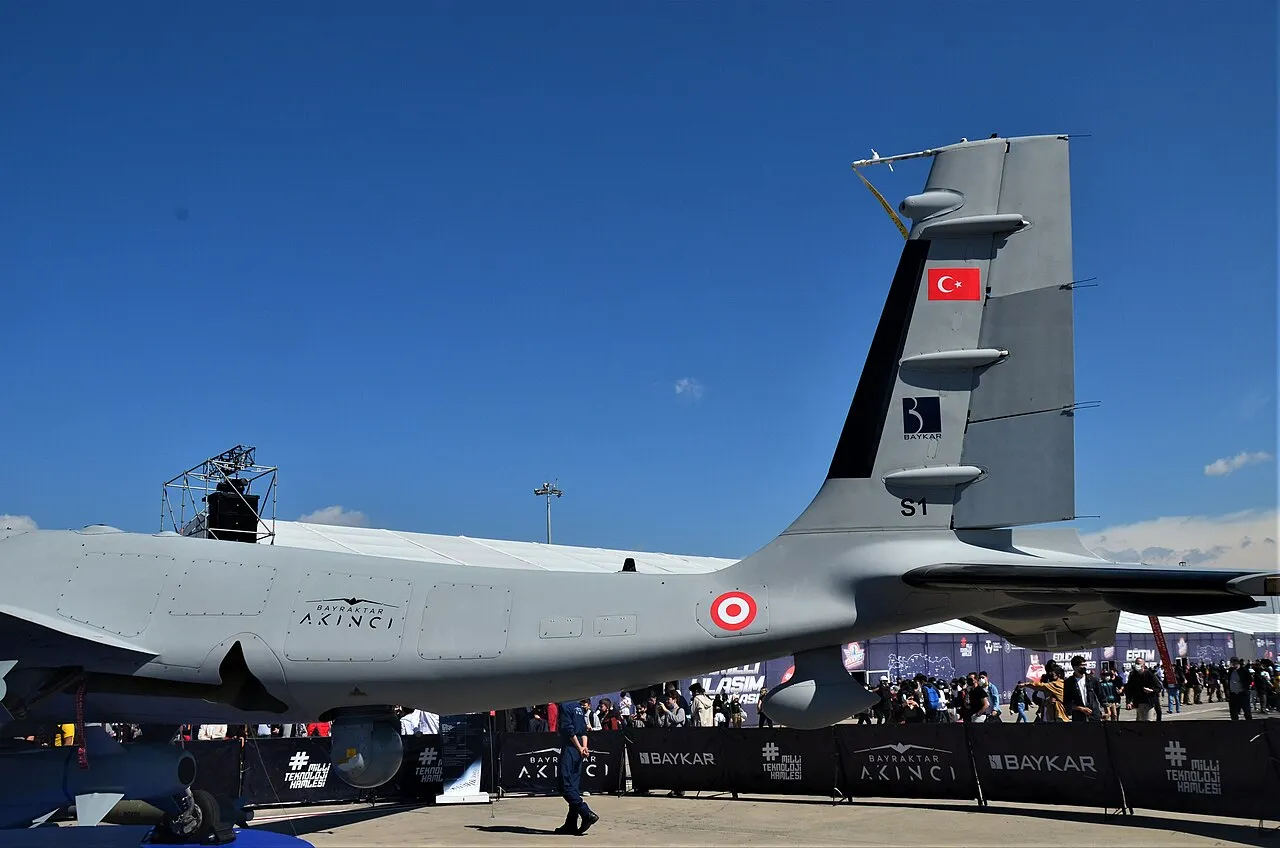
The Bayraktar Akinci is a multirole high-altitude long-endurance unmanned combat aerial vehicle manufactured by the Turkish defence company Baykar. Baykar describes it as a twin-engine aircraft for ISTAR missions, short for intelligence, surveillance, target acquisition and reconnaissance. The maker also calls it a strike platform for precision air-to-ground and air-to-air missions2, with maritime roles that include anti-submarine warfare and coastal patrol. The first three units entered service with the Turkish Armed Forces on 29 August 20211.
Design and development
The first images of the drone appeared in media reports in June 2018, and it was unveiled to the public at the Teknofest aviation festival in September 2019. After the preliminary design phase was completed in June 2019, engine ground runs began in August 2019 with a Ukrainian Ivchenko-Progress AI-450C turboprop. The Akinci made its maiden flight on 6 December 20191, with automatic taxiing, take-off, a 16-minute flight and landing.
Anadolu Agency reported in August 2020 that the second prototype had flown for 2 hours and 26 minutes at 20,000 feet3 in a medium-altitude verification test. The drone carried out its first firing tests on 22 April 2021, fitted with three variants of the MAM-L smart munition. On 7 July 20211 it set a Turkish national flight altitude record, cruising at 38,039 feet for 25 hours and 46 minutes over a distance of 7,507 km.
According to the same 2020 Anadolu Agency report, six artificial intelligence computers3 collect and save data from the drone’s sensors and cameras. Baykar lists fully autonomous take-off and landing2 independent of ground control systems, and a triple-redundant autopilot.
Specifications
Baykar gives the Akinci a length of 12.2 m, a wingspan of 20 m and a height of 4.1 m. Its maximum take-off weight is 6,000 kg, and the maker states a payload capacity of 1,500 kg. Depending on the version, it is powered by two turboprops of 450, 750 or 850 hp2 each.
Baykar quotes a cruise speed of 150 KTAS and a maximum of 240 KTAS, an endurance of more than 20 hours and an operational range of 6,000 km. The drone’s service ceiling is 40,000 feet and its operational altitude 30,000 feet, while the maximum altitude Baykar lists is 45,118 feet2.
Control and video run over three line-of-sight bands2, and over SATCOM for beyond-line-of-sight operations.
Sensors and weapons
Baykar lists its reconnaissance payload as simultaneous EO/IR and laser designation2, a multi-mode AESA radar, signals intelligence and electronic warfare support systems. The drone also carries electronic support and ECM systems, dual satellite communications, an air-to-air radar, a collision avoidance radar and a synthetic-aperture radar. An Akinci fitted with Aselsan’s MURAD AESA radar made its first flight on 1 March 20251.
The airframe has 8 hardpoints. Baykar names the MAM-L and MAM-C2 as its national munitions. In 2020 Anadolu Agency reported that the drone was equipped with the Gokdogan and Bozdogan air-to-air missiles3, and could launch SOM stand-off cruise missiles. On 10 July 20211 it flew for 13 hours and 24 minutes with a 1,360 kg payload that included the NEB bunker-buster bomb developed by TUBITAK SAGE.
Operators and combat use
The Akinci flew its first combat mission on 13 February 2022. After the 2023 Turkey-Syria earthquake, nine Akincis flew over 1,551 hours in the earthquake zone, supplying data for damage detection and search and rescue. In May 20241, an Akinci helped find the crash site of the helicopter that killed Iranian president Ebrahim Raisi.
Export customers listed as of 2026 include the Pakistan Air Force, which received 6 to 7 Akincis in the first half of 2023, and Mali, which received two Akinci-A drones in November 2024. Indonesia signed an agreement in February 20251 to acquire 9 Akincis with joint production.
On 16 March 2025 the People’s Defense Forces (HPG) announced that they had shot down a Turkish Akinci in the Qandil region of Iraq. A Malian Air Force Akinci was reported shot down by Algerian air defences on 31 March 2025 at Tinzaouaten. During Sudan’s civil war, a Sudanese Air Force Akinci reportedly shot down another Akinci over North Kordofan on 17 March 2026 with a Roketsan EREN missile. On 26 July 20261 the Houthis announced that they had shot down a Saudi Akinci in Al-Jawf governorate.
Variants
Baykar offers the drone in three versions, AKINCI-A, AKINCI-B and AKINCI-C2.
- Akinci A: powered by two Ivchenko-Progress Motor Sich AI-450T turboprops1 of 450 hp each.
- Akinci B: powered by two PT6A-135A turboprops of 750 hp each. Baykar announced its maiden flight on 2 March 20221, and on 21 June 2022 it reached 45,118 feet during a flight of 20 hours and 23 minutes.
- Akinci C: powered by two Pratt & Whitney Canada PT6 turboprops of 850 hp each. It made its first flight test on 24 February 20241.
Similar drones
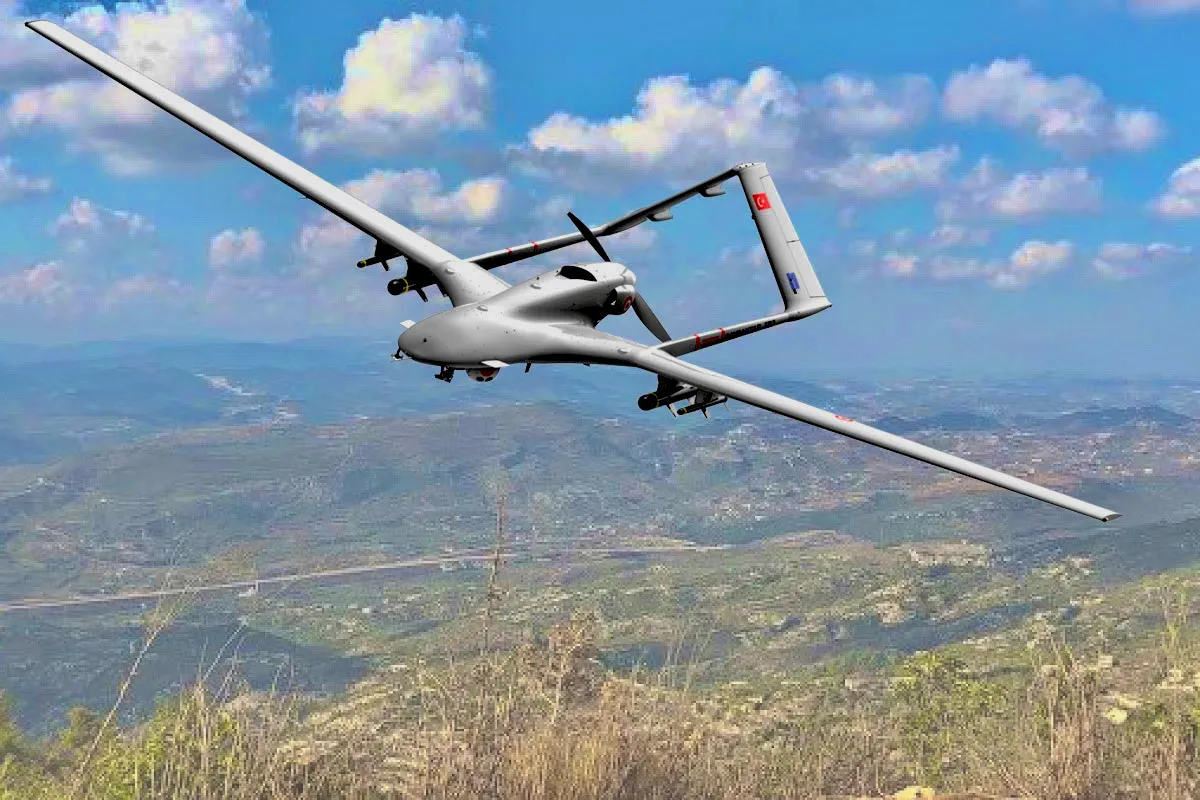
- Baykar Bayraktar TB2: Baykar’s smaller medium-altitude long-endurance drone, with a maximum take-off weight of 700 kg and a service ceiling of 20,000 feet4.
- General Atomics MQ-9 Reaper: has a similar 66 ft (20 m) wingspan but a single Honeywell TPE331-10 turboprop, and an endurance of over 27 hours5.