Contents
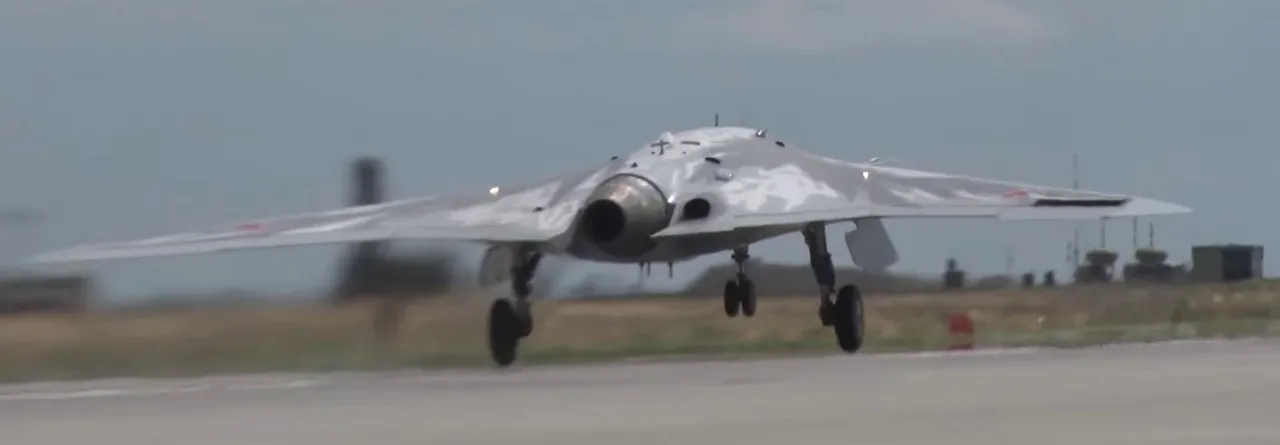
The Sukhoi S-70 Okhotnik-B, or Hunter-B, is a Russian stealth heavy unmanned combat aerial vehicle1 being developed by Sukhoi and Russian Aircraft Corporation MiG. Russia’s TASS news agency describes the S-70 as a heavy strike drone with stealth technology and the flying wing design, and the United Aircraft Corporation told TASS that it would be able to operate with the Sukhoi Su-57 fighter. It made its debut flight on 3 August 20192. On 5 October 20243 one was shot down over Ukraine by a Russian fighter.
Design and development
The Okhotnik has been under development since at least 2011, when Sukhoi was selected by the Russian Defense Ministry to lead a programme for a new heavy unmanned reconnaissance and attack drone. It is being developed jointly by MiG and Sukhoi, based on data of the earlier Mikoyan Skat1 programme. MiG produced the Skat prototype in 20074; work on it stopped in 2012 due to a lack of interest from the Defence Ministry and resumed in 2018.
The first mock-up intended for ground tests was created in 2014, and a prototype was first revealed in July 2017. In November 2018 the drone made its first taxiing tests in fully autonomous mode, reaching 200 km/h1 on the runway of the Novosibirsk plant.
On its first flight the drone, according to the Defense Ministry, flew around the aerodrome at about 600 m5 under an operator’s control, and the flight lasted over 20 minutes. On 27 September 20192 it flew together with a Su-57 for over 30 minutes, manoeuvring in automated mode at around 1,600 m. The ministry said the pair tested expanding the fighter’s radar field and issuing target acquisition data for air-launched weapons.
Deputy Defence Minister Alexey Krivoruchko said in December 2021 that the first flight prototype2 of the upgraded drone had been rolled out at the Novosibirsk Aviation Enterprise. Rostec’s chief executive said its flat thrust nozzle was its major feature and reduced its radar signature.
The service date has moved several times. In August 2019 Deputy Prime Minister Yuri Borisov’s office told TASS that serial deliveries to the Aerospace Force were planned from 20255. In December 2021 Krivoruchko said that, if testing was successful, the drone would enter service in 20244. In January 2024 the vice-governor of Novosibirsk oblast said serial production would begin in the second half of 20241.
Specifications
Defense News reported in 2021 that the drone has a take-off weight of 20 tons4, measures 14 metres long and has a wingspan of 19 metres. Other published specifications give a wingspan of 20 m and a maximum take-off weight of 25,000 kg1. TASS says that, according to open sources, it can reach around 1,000 km/h2.
Ruslan Pukhov, head of the Center for Analysis of Strategies and Technologies, told Defense News that it uses the Russian-made AL-41F1 engine4, also used on the Su-57 and the Checkmate, giving it a range of up to 6,000 kilometres. Published specifications list a combat range of 3,000 km1.
Sensors and weapons
According to Russia’s Defense Ministry, the drone has an anti-radar coating and carries equipment for electro-optical, radar and other types of reconnaissance. Borisov’s office called it a “universal baseline platform” for air-launched weapons and onboard reconnaissance systems5. The United Aircraft Corporation told TASS that it would be able to strike aerial and ground targets2 in network-centric interaction with the fighter.
Published specifications list two internal weapons bays for up to 2,000 kg of guided and unguided munitions. The Okhotnik reportedly tested unguided weapons such as free-fall bombs in 20211, and carried out tests with precision-guided munitions in 2022. Portions of a Russian glide bomb3 were found in the wreckage of the drone lost in October 2024.
Operators and combat use
The drone is meant for the Russian Aerospace Forces: Borisov’s office spoke of serial deliveries to units of the Aerospace Force5. A source in the aircraft industry told TASS that a Su-57 pilot would coordinate four Okhotnik drones2 at once. In February 2021 it was reported that Project 23900 amphibious assault ships would be able to carry 4 Okhotnik drones1 for reconnaissance and strike missions.
Videos posted to social media show a Russian fighter, likely a Su-57, shooting down the S-70 north of Donetsk with a short-range air-to-air missile on 5 October 2024, and the wreckage was claimed by Ukrainian forces. The engagement happened near Konstantynivka, supposedly around 10 miles behind Ukrainian lines. Air & Space Forces Magazine wrote that it isn’t clear why Russia shot down the drone, and that operators may have lost control of it. The War Zone judged that the best answer is that operators lost command6 and it strayed over hostile territory. A former Pentagon official said the wreckage doesn’t “obviously show”3 any advanced low-observable technology, and the magazine noted that the S-70 is believed not to have entered series production as of October 2024.
Variants
The first prototype has a conventional exhaust nozzle, with no reduction of infrared signature or radar cross section; the second has low-observable apertures. In December 2021 a second prototype with a new flat jet nozzle and no afterburner was shown. According to The War Zone, only around four first-generation examples6 were said to have been built. A report in February 2021 said three more prototypes were being built, with the 3rd and 4th identical to the serial production unit1. The engine maker told TASS that the flat nozzle, made by a 3D printer, would reduce the drone’s signature for heat-seeking missiles2.
Similar drones
- Lockheed Martin RQ-170 Sentinel: an American tailless flying wing7 operated by the US Air Force for the CIA, where the S-70 is being developed for Russia’s Aerospace Forces.
- Dassault nEUROn: a European stealth demonstrator of which only one vehicle will be produced8, while Russian officials plan serial production of the S-70.
- Bayraktar Kızılelma: a Turkish unmanned fighter with canards and two vertical stabilizers9, where the S-70 is a flying wing that lacks the tail5.