Contents
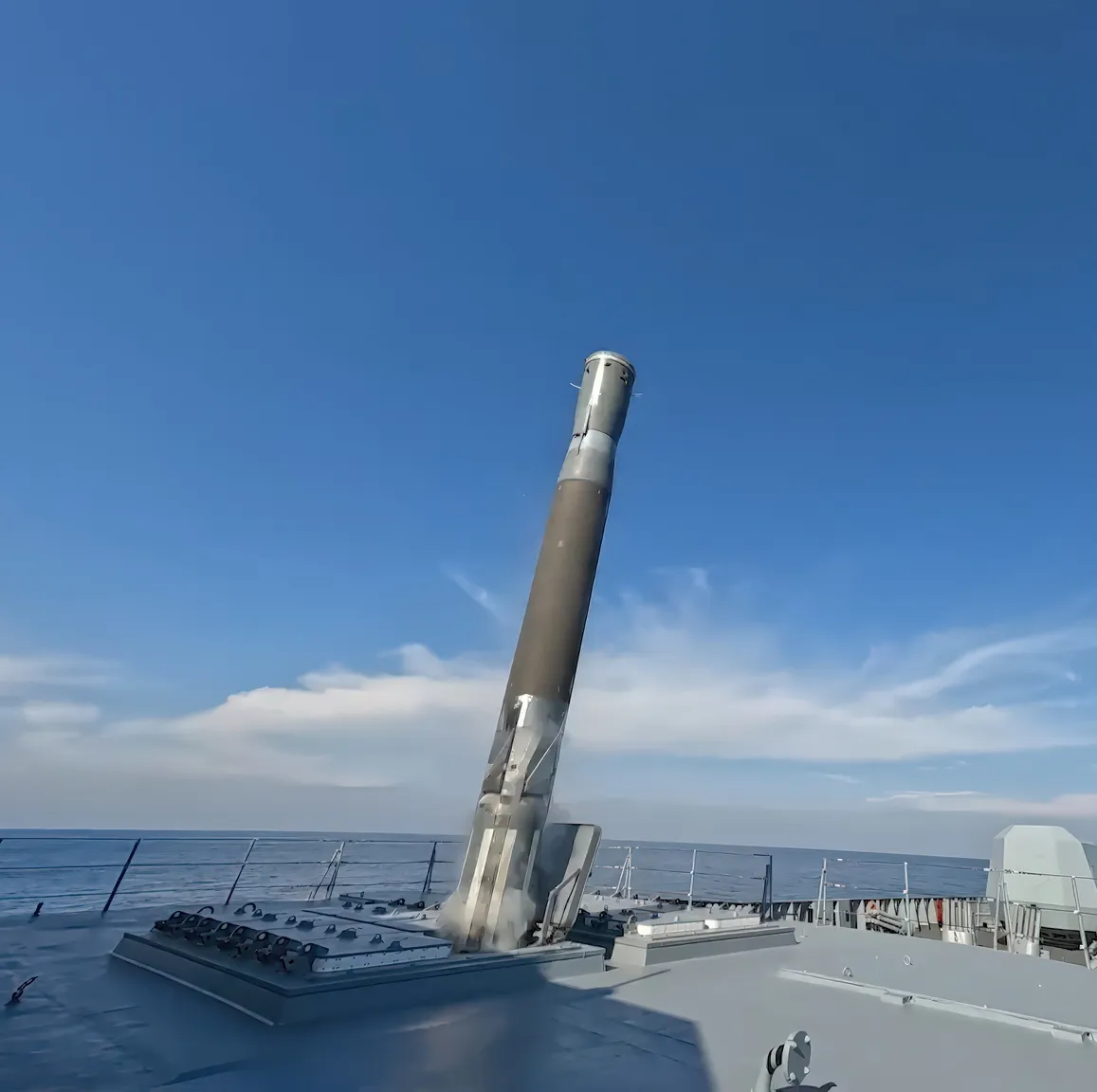
The 3M22 Zircon, also spelled Tsirkon and called SS-N-33 by NATO, is a Russian nuclear-capable missile1 made by NPO Mashinostroyeniya for the Russian Navy and fired from the 3S-14 launch system of frigates and submarines. Russia presents it as a hypersonic weapon, but in August 2026 Ukraine’s Defence Intelligence (HUR) described it as a ballistic missile2 whose recorded top speed does not exceed Mach 6.8. Russia has used it against Ukraine since February 20243, understood to be fired from launchers on land.
Design and development
The Zircon is reported to be a further development of the GELA, an experimental hypersonic vehicle of the same maker. It was test-fired on 3 June 2017, and in February 2019 President Vladimir Putin claimed it could reach Mach 9 and hit targets within 1,000 km. In early January 2020 it was first test-launched from the frigate Admiral Gorshkov. On 7 October 2020 Russia’s chief of the General Staff said a Zircon fired from that frigate in the White Sea had hit a sea target 450 km away in the Barents Sea. The Defence Ministry announced the first launch from a submarine, the Severodvinsk, on 4 October 2021, and in December 2022 Defence Minister Sergei Shoigu said the Admiral Gorshkov had received a batch of Zircon missiles1.
Russian and other sources long described the weapon as a hypersonic cruise missile with an air-breathing engine. In August 2026 TWZ reported that debris examined by Ukraine’s Scientific Research Institute of Forensic Expertise included part of a solid-propellant rocket motor that appeared to belong to the second stage, which TWZ said suggests two rocket stages; it added that this does not conclusively prove the missile lacks an air-breathing engine. HUR stated that both the booster and the sustainer2 burn solid propellant. TWZ names NPO Mashinostroyeniya as the main designer and manufacturer3, with the motor from NPO Iskra and the radar seeker from NPP Radar MMS.
Specifications
Published figures differ widely. HUR lists the missile at approximately 26 feet long3, about 7.9 m, with a body diameter of 2.2 ft (0.67 m) and a warhead of about 265 lb. Militarnyi gave that warhead as about 120 kg2, less than the 150 kg of Russia’s compact Banderol cruise missile. Other listings give a length of 9 m1 and a diameter of 60 cm.
Russian officials claim a speed of approximately Mach 9. HUR gave a maximum of Mach 8 to 9 and a maximum fixed speed of Mach 6.83, while other Ukrainian assessments, which TWZ says cannot be independently confirmed, describe a flight at around Mach 5.5 that accelerates to approximately Mach 7.5 near the target and then slows before impact. In February 2024 the director of the Kyiv forensic institute, Oleksandr Ruvin, citing the relevant services, said the missile had reached only 2,500 kilometres per hour4 in the final stage of its flight. HUR describes an inertial navigation system2 for the cruise phase and an active radar seeker for the terminal phase. Russian specifications claim a range of around 1,000 kilometers5, while other estimates run from 250 to 500 km at low level1 to 740 km on a semi-ballistic trajectory.
In October 2025 Militarnyi reported, from Russian procurement documents, a contract with annual deliveries of 80 units6 from 2024 to 2026, at an estimated $5.2 to 5.6 million per missile.
Launch platforms
The Zircon was first deployed on the Admiral Gorshkov-class frigates in January 2023. Its 3S-14 vertical launch system also takes the P-800 Oniks and Kalibr missiles; in 2023 the battlecruiser Admiral Nakhimov was being refitted with it, and Gremyashchiy-class corvettes, Yasen-class submarines and modernised Udaloy-class destroyers are named as further carriers. A ground-launched version on a wheeled carrier was developed after the naval version1.
HUR says Russia adapted the missile for Bastion-M coastal systems2 because of difficulties in operating its fleet in the Black Sea. TWZ considers modified K-300P Bastion launchers the most likely candidate3 for the ground launches against Ukraine.
Operators and combat use
The Russian Navy is the only listed operator. On 12 February 2024 the Kyiv Scientific Research Institute of Forensic Expertise reported that Russia had used a Zircon in its attack of 7 February, and its director later said at least two were used4, one falling in Kyiv’s Dniprovskyi district and one in a field in Vyshneve. On 25 March 2024 two Zircons were launched at Kyiv from Crimea1; Russian state media said both hit their targets, while Ukrainian sources said both were intercepted. Militarnyi wrote that in 2024 Russia used the missile to a limited extent6 against Zaporizhzhia and Kyiv, in groups of two to four fired from occupied Crimea. In August 2024 Ukraine’s commander-in-chief Oleksandr Syrskyi counted 6 Zircon missiles, 2 of them downed7.
Ukrainian authorities reported a Zircon fired from occupied Crimea during a major strike in January 20263. Ukraine’s General Staff reported hitting a Bastion launcher in Crimea on 24 March 2026, and on 16 August Ukrainian forces struck Bastion positions that Russia uses to fire Oniks and Zircon missiles5. In November 2026 HUR put the Russian stockpile at more than 120 units8, with more than 30 made in the first seven months of the year.
Ukraine’s Air Force, which lists the Zircon as an anti-ship missile, reported one Zircon destroyed9 in October 2026. In the night to 7 November it named the Zircon among the missiles launched from Bryansk and Voronezh regions10, together with the Iskander-M11 and the North Korean KN-23.
Variants
The naval missile is the 3M22 itself. In December 2019 Putin said a land-based version was in development, and the ground-launched version uses a wheeled carrier similar to the SS-C-5, the NATO name of the Bastion system. India’s future BrahMos-II missile will likely have similar characteristics to the Zircon1, the head of the joint BrahMos programme said in 2022.
Similar weapons
- P-800 Oniks: a supersonic missile, two of which a standard Bastion launcher carries; it travels at more than twice the speed of sound5.
- Kh-47M2 Kinzhal: an air-launched Russian quasi-ballistic missile, with the high speed and unpredictable path TWZ describes as shared with the Zircon3.
- Kalibr: a cruise missile that uses the same 3S-14 launch system1 on Russian ships.