Contents
The Kalibr is a family of Russian cruise missiles1 developed by NPO Novator (OKB-8), with ship-, submarine- and air-launched versions for anti-ship and land-attack use; NATO calls them SS-N-27 Sizzler and SS-N-30A. In media the name usually means the 3M-14 land-attack missile, which CSIS describes as one part of the larger Kalibr family2, next to the 3M-54 anti-ship missile and the 91R anti-submarine missile. Russia first fired it in combat at Syria in 2015 and has used it against Ukraine since the first day of the full-scale invasion in February 2022.
Design and development
Novator began work on the family in 1985, and NATO designated the anti-ship missile SS-N-27 after it was first displayed in 19933; it was offered for export from 1997. The system is modular, with common parts1 for the surface and submarine versions but different boosters: a thrust-vectoring booster for launch from a ship’s vertical launch system, a conventional one for a submarine’s torpedo tube. The air-launched version is carried in a container that drops away at launch.
The three Kalibr missile types share common vertical launch tubes2. CSIS quotes a Russian defence industry official who said in 2011 that Russia planned to fit the capability to all newly designed submarines, corvettes, frigates and larger surface ships, adding that it gives even modest platforms such as corvettes a significant offensive capability. After experience in Syria, Defence Minister Sergei Shoigu said in September 2019 that the targeting system had been improved1 for time-sensitive attacks.
Specifications
CSIS gives the 3M-14 a length of 6.2 m2, a 450 kg high-explosive warhead, possibly nuclear-capable, and turbojet propulsion, with an estimated range of 1,500 to 2,500 km. Other estimates are lower: the US Department of Defense puts the range at 1,400 km, and Shoigu said almost 1,500 km. The family is listed with a speed of about Mach 0.81 and a diameter of 0.533 m.
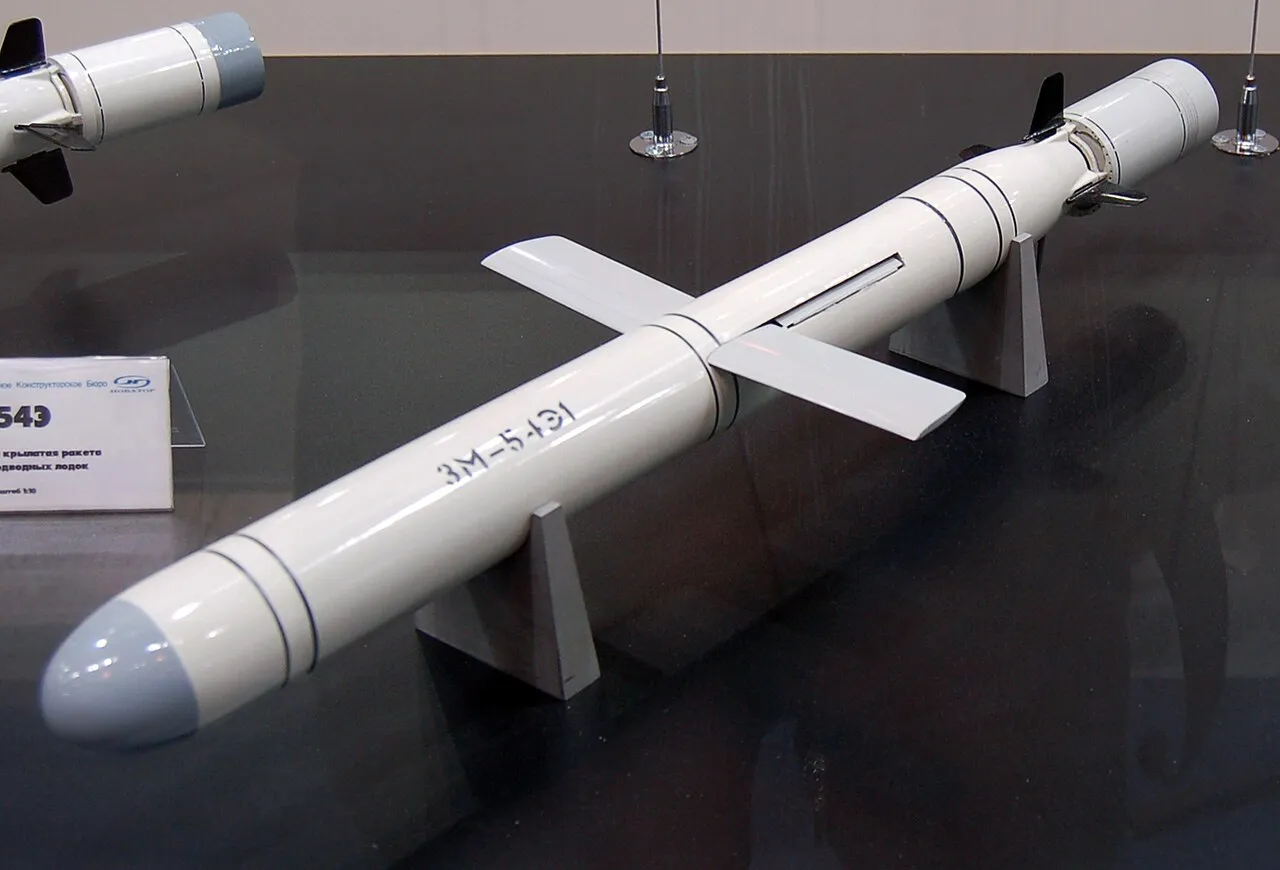
The anti-ship 3M54 is a three-stage missile 8.22 m long3 with a launch weight of 1,930 kg, while the two-stage 3M54M1 is 6.2 m long, weighs 1,570 kg and carries a 450 kg warhead up to 300 km. The export 3M-54E reaches 220 km with a 200 kg warhead.
UNITED24 Media, citing Militarnyi, reported Russian procurement papers with two contracts for 240 missiles for 2022–20244 and another 450 for 2025–2026, each at just over $2 million, plus 56 3M-14S versions with nuclear warheads. A September 2026 opinion piece in the Kyiv Independent put Kalibr output at 29 against a target of 265 and the stock at more than 450 missiles; according to Ukraine’s deputy intelligence chief Vadym Skibitsky, a significant share of the new missiles is going to arm Russian ships and submarines.
Launch platforms
Surface ships carry the Kalibr-NK system and submarines the Kalibr-PL1, exported as Club-N and Club-S. In the Russian Navy the submarine versions arm Kilo, Lada, Akula, Oscar II and Yasen-class boats, and the ship versions the Gremyashchiy, Karakurt and Buyan-M corvettes and the Gepard, Admiral Gorshkov and Admiral Grigorovich frigates. According to Militarnyi, the family is fired from frigates, corvettes, and submarines4. The Club-K variant fits a standard 20- or 40-foot shipping container and was shown at the MAKS 2011 air show.
Ukraine’s General Staff said its forces struck the frigates Admiral Makarov and Admiral Essen and a Buyan-M corvette in Novorossiysk on 12 August 20266; the OSINT account Absolutely Reliable Source assessed that direct hits had destroyed the Admiral Essen’s eight-cell 3S14 launch system. In October 2026 Ukrainian Navy spokesman Dmytro Pletenchuk said the Black Sea Fleet had stayed out of open waters for five months, launching Kalibr cruise missiles7 from its base in Novorossiysk.
Operators and combat use
On 7 October 2015 a Gepard-class frigate and three Buyan-M corvettes in the Caspian Sea fired 26 SS-N-30A missiles2 at targets in Syria, which reportedly flew about 1,800 km. On 9 December 2015 the Improved Kilo-class submarine Rostov-on-Don fired 3M14K cruise missiles1 at targets in Syria from the Mediterranean. Besides Russia, CSIS lists Algeria, China, India, Iran and Vietnam3 as possessors of the anti-ship versions.
The opening assault on Ukraine on 24 February 2022 is said to have included at least 30 cruise missiles, likely fired by Buyan-class corvettes, Admiral Grigorovich-class frigates and Kilo-class submarines of the Black Sea Fleet. On 14 July 2022 a strike on central Vinnytsia killed 22 people, including three children, by the evening count; Kyrylo Tymoshenko, deputy head of the President’s Office, said the missiles were Kalibr cruise missiles launched from a Russian submarine8 in the Black Sea. On 10 October 2022 three Kalibrs crossed the airspace of Moldova1.
In August 2024 Ukraine’s commander-in-chief Oleksandr Syrskyi gave a 67% rate of downing9 for Kalibr, Kh-555/101 and R-500 cruise missiles combined. Ukraine’s Air Force reported 12 Kalibr cruise missiles10 destroyed in October 2026.
Variants
The domestic versions are the 3M54 anti-ship model1, the 3M14 land-attack model and the 91R anti-submarine model of the Otvet complex; the export family is called Club, formerly Klub. CSIS names the submarine-launched land-attack missile 3M-14K and splits the anti-ship missile into the SS-N-27A (3M54) and the two-stage SS-N-27B3 (3M54M1). The air-launched Club-A has no first-stage booster and is carried in a canister, 6.2 m long and 1,400 kg in weight. The 3M-14S is a version with a nuclear warhead4.
Similar weapons
- Kh-101: the air-launched Russian cruise missile, whose latest 504AP version has a range of about 2,500 km4, carried by Tu-95 and Tu-160 bombers.
- 9K720 Iskander11: the ground-launched system whose cruise missiles RUSI describes as derived from the 3M-14 family12.
- P-800 Oniks: a supersonic ramjet anti-ship missile13 that, like the 3M22 Zircon, uses the same 3S-14 launch system14 on Russian ships.