Contents
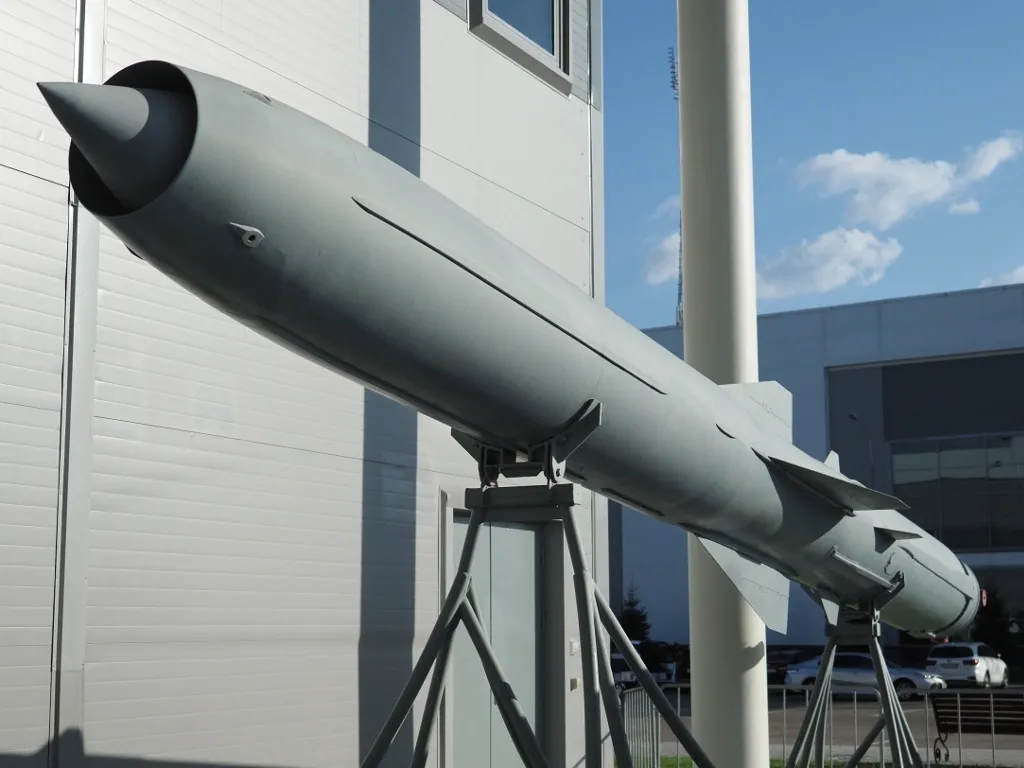
The P-800 Oniks, exported as the Yakhont and called SS-N-26 Strobile by NATO, is a Soviet and Russian supersonic anti-ship cruise missile1 developed by NPO Mashinostroyeniya as a ramjet version of the P-80 Zubr. Besides ships and submarines, it can be ground-launched from two Bastion systems2, the stationary Bastion-S and the transportable Bastion-P, according to CSIS. Russia has fired it at land targets in Ukraine since 2022, including the Odesa region, where Ukraine’s Air Force reported 2 Oniks missiles from occupied Crimea3 in the night of 23 to 24 August 2026.
Design and development
Development commenced in 19831, and in the 1990s the missile was tested on the Project 1234.7 ship before it passed its trials and was commissioned in 2002. It is reported to replace the P-270 Moskit and possibly the P-700 Granit. In 1999 NPO Mashinostroyeniya developed a ground-launched export version, the Yakhont, and an air-launched Yakhont-M; Russia fielded its first Oniks in 2002 on Nakat-class missile ships and began deploying the Bastion coastal systems in 2015. The Oniks design also became the basis2 for the Russian-Indian BrahMos.
After a rocket booster accelerates it, the missile is driven by a kerosene-powered ramjet motor2. It flies most of the way at high altitude and descends to 10 to 15 m as it approaches its target.
Specifications
CSIS gives a range of 300 km2 on the default trajectory and 120 km on a low-altitude trajectory, an altitude of up to 14 km and a speed of up to 750 m/s, falling to 680 m/s at low altitude. It lists the surface-to-surface missile at 8.6 m long and the air-launched version at 8.3 m, with a diameter of 670 mm, a launch weight of 3,000 kg and either a 200 kg high-explosive or a 250 kg semi-armour-piercing warhead. The Oniks version for Russia, unlike the export Yakhont, is credited with a range of 600 km1 and a 300 kg semi-armour-piercing warhead.
The Kyiv Post wrote in 2023 that the upgraded Onyx-M, presented in 2019, can reach up to 800 kilometers4. Guidance is inertial in mid-course with an active-passive radar seeker1 for the terminal phase. In November 2026 Ukraine’s Defence Intelligence (HUR) said Russian Oniks missiles had been given more powerful warheads and an increased range5 for use against land targets.
Launch platforms
A standard K-300P Bastion-P launcher carries two P-800 Oniks missiles6 and is road-mobile. A standard battery has four self-propelled launchers with command, security and reload vehicles. At sea the missile arms the Admiral Gorshkov- and Admiral Grigorovich-class frigates, the Buyan-M, Karakurt and Gremyashchiy corvettes and Yasen-class submarines, among other ships. For an air-launched version the record is mixed: CSIS describes the Yakhont-M of 1999, while the planned Kh-61 is said to have been never built1.
Operators and combat use
CSIS lists Russia, Indonesia, Syria and Vietnam as operators. Syria received two Bastion systems with 36 missiles each1, and an Israeli airstrike on 5 July 2013 destroyed a warehouse in Latakia holding the missiles, although US intelligence analysts believed some had been removed before the attack. On 15 November 2016 Oniks missiles were fired at Syrian rebels from a Bastion launcher, the first known land-attack use2 of the missile.
Russia’s Defence Ministry said it had used the missile on 1 May 20221 around Odesa, and on 9 May 2022 four Oniks were launched at Odesa from Crimea. After the grain deal ended on 17 July 2023, the Kyiv Post reported strikes on Odesa’s ports with Kh-22, Kh-59, Kalibr and Onyx missiles4. In August 2024 Ukraine’s commander-in-chief Oleksandr Syrskyi said Russia had used 211 Onyx missiles7, 12 of them shot down.
In the night to 16 August 2026, Ukraine’s Air Force said, Russia used Oniks missiles against Kyiv, Kremenchuk and Kryvyi Rih6; hours later the Ukrainian Navy struck Bastion positions in Crimea. In the night to 22 October the Air Force named the Oniks among missiles launched from Kursk, Bryansk and Rostov regions8, together with the Iskander-M9, the S-40010 and the Zircon. HUR put the combined Oniks stockpile, including upgraded versions, at more than 600 units5 in November 2026, with more than 55 made in the previous seven months.
Variants
The 3M55 Oniks is the base version for Russia1 and the P-800 Yakhont its export version; the P-800 Yashma is a submarine-launched Yakhont. The Bastion-P mobile coastal system officially entered service in 2015, and the Oniks-M improves range, accuracy and resistance to countermeasures. BrahMos, co-developed with India through BrahMos Aerospace since 1998, is derived from it.
Similar weapons
- 3M22 Zircon: HUR says Russia adapted it for Bastion-M coastal systems11.
- BrahMos: the Russian-Indian missile built on the Oniks design2.
- P-270 Moskit: a Soviet supersonic ramjet anti-ship missile12 with four ramjets, which the Oniks is reported to replace1.