Contents
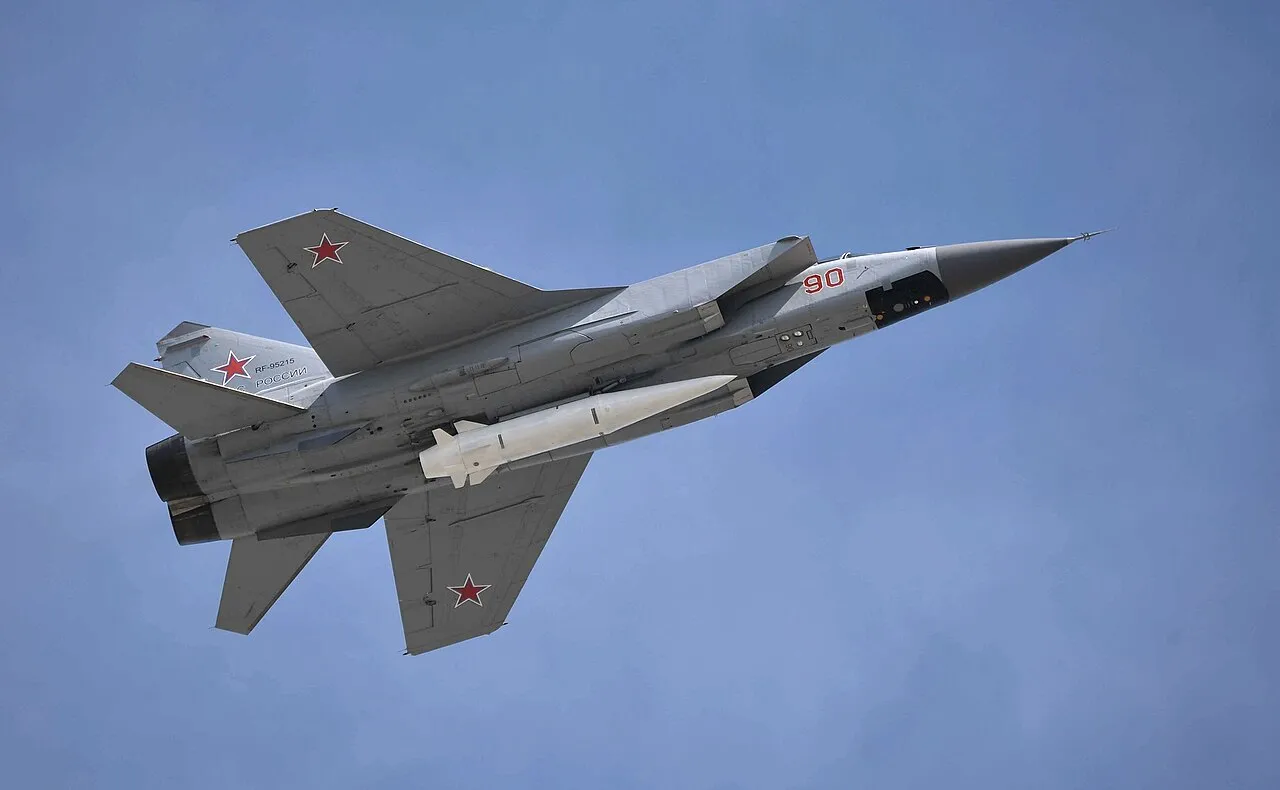
The Kh-47M2 Kinzhal (Russian Х-47М2 “Кинжал”, “dagger”; Ukrainian “Кинджал”) is a Russian air-launched ballistic missile1, known to NATO as the AS-24 Killjoy, that can carry a conventional or a nuclear warhead. CSIS considers it likely derived from the 9K720 Iskander-M2, the ground-launched short-range ballistic missile, adapted for launch from a modified MiG-31. Russia presents it as hypersonic and has fired it at Ukraine since March 2022; Ukraine’s Air Force reports it as the “Kh-47 Kinzhal”, as for the three aeroballistic missiles3 it said were launched from the Lipetsk region in the night to 14 May.
Design and development
When development began is unclear: CSIS notes that concept drawings of Iskander missiles on the MiG-31 circulated online around 2010. The missile reportedly entered a trial period at airfields in southern Russia in December 2017, and President Vladimir Putin unveiled it among Russia’s new strategic weapons on 1 March 2018. Russian media released footage of a test launch2 on 11 March.
Compared with the Iskander, CSIS points to a redesigned tail section2, smaller rudders and a stub that shields the engine nozzle at high speed. Defense Express describes the Kinzhal as an upgrade of the Iskander that needs the MiG-31K as a high-speed “booster”, and gives its launch weight as about 4.2 tonnes against about 3.8 tonnes for the 9M7234, a difference that points to a different configuration. Piotr Butowski wrote in TWZ that the MiG-31K and the 9-S-7760 missile together form the 9-A-7760 Kinzhal5 system, and that the first Kinzhal regiment was set up in December 2021 at Savasleyka.
The “hypersonic” label is disputed. CSIS calls Russia’s use of the term somewhat misleading2, because nearly all ballistic missiles reach hypersonic speed at some point, and the UK Parliamentary Office of Science and Technology described a quasi-ballistic trajectory1 with limited manoeuvres.
Specifications
CSIS lists a length of 8.0 m, a diameter of 1.0 m, a launch weight of approximately 4,300 kg and a payload of 480 kg, nuclear or conventional; other published estimates give 7.2 m and 1.2 m. According to CSIS it reaches about Mach 42 after launch and may reach Mach 10. The Ukrainian Patriot crew that downed one in May 2023 said it was travelling at approximately 1,240 m/s1, around a third of the speed Russia claims.
Range figures depend on how they are counted. CSIS gives 1,500 to 2,000 km2 and cites a 2018 TASS report suggesting more than 3,000 km from a Tu-22M3. These Russian figures add the carrier’s combat radius to the missile’s own flight, which has been estimated at 460 to 480 km1, close to that of the Iskander.
Procurement documents obtained by Militarnyi put the price of one 9-S-7760 Kinzhal under a 2024 order at RUB 366 million, or $4.5 million6. In May 2023 Ukrainska Pravda wrote that a Kinzhal can cost $10 million and above7, without naming a source for the figure.
Launch platforms
The main carrier is the MiG-31K, a modified MiG-31 interceptor that carries a single missile5. Defense Express wrote in 2023 that only about 10 to 12 MiG-31K jets4 were in Russian service, and that Russian media plans from 2018 to arm the Tu-22M3 with up to four Kinzhals and the Tu-160 with up to eight remained talk; the Tu-22M3 received the Kh-32 instead. An unnamed Russian defence official told TASS that a Su-34 had used the Kinzhal8 in what Russia calls its special military operation.
Operators and combat use
The Russian Aerospace Forces are the only operator1. On 19 March 2022 Russia’s Ministry of Defence claimed a Kinzhal strike on a munitions depot around Deliatyn in western Ukraine, which CSIS describes as the first known combat use2. By September 2022 Russia had claimed three uses5, Butowski wrote, and Ukrainian intelligence put the pre-war stock at no more than 35 to 40 missiles.
On 6 May 2023 Air Force commander Mykola Oleshchuk announced that a Kh-47 launched by a MiG-31K from Russian territory had been downed over Kyiv Oblast with a Patriot system9 in the night of 3 to 4 May. CNN reported, citing a person familiar with the matter, that the United States was confident in that claim10. On 16 May 2023 Ukraine said it had intercepted six Kinzhals7 fired at Kyiv overnight, while Russia’s defence minister said fewer than six had been launched1. In July 2024 Colonel Serhii Yaremenko said that more than 20 Kinzhals had been fired at Kyiv since May 2023 and all were intercepted11.
Militarnyi reported in October 2025 that the Kolomna Machine Building Design Bureau received an order for 44 missiles in 20246, with 144 more to follow. Ukraine’s Air Force said its defences destroyed 2 Kh-47M2 Kinzhal missiles12 during May 2026.
Variants
The missile itself is designated 9-S-7760 and its carrier, the MiG-31K, is also known as the MiG-31I5. The animation in Putin’s speech showed the Kinzhal striking ships, and CSIS wrote that it may have, or be given, an anti-ship capability2.
Similar weapons
- 9K720 Iskander13: the ground-launched system whose 9M723 missile has similar dimensions2, with a different tail section and smaller rudders on the Kinzhal.
- Kh-22: the older supersonic missile of the Tu-22M3; Butowski judged the Kinzhal’s capabilities not significantly different5 from the bomber’s Kh-22/Kh-32, though the Kinzhal is faster.
- 3M22 Zircon: an anti-ship missile that Ukraine’s Air Force reports as a type of its own, as for the anti-ship Zircon missiles14 it said were launched alongside Iskander-M ballistic missiles in the night to 3 November.