Contents
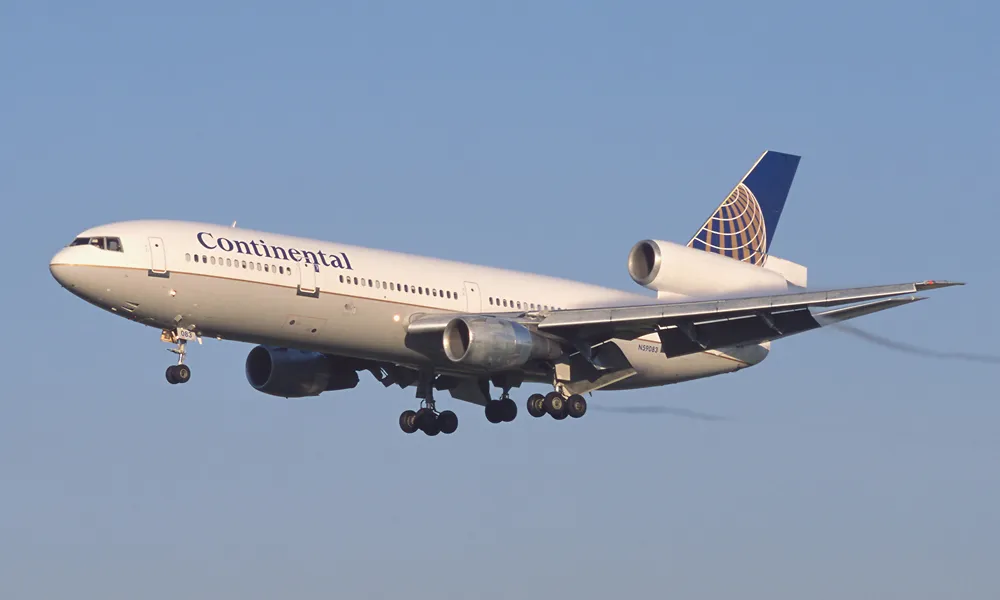
The McDonnell Douglas DC-10 is a three-engine, wide-body airliner1 built by McDonnell Douglas from the late 1960s through the 1980s, with typical seating for 250 to 360 passengers. The Smithsonian’s National Air and Space Museum describes it as answering the need for an airplane smaller than the 7472; a tanker version, the KC-10 Extender, went on to serve with the United States Air Force. The type’s early career was marked by a string of serious accidents, several traced to a flawed cargo door design, but it went on to log decades of service in passenger and cargo roles before passenger operators retired it.
At a glance
The DC-10 is a trijet, with two engines slung under the wings and a third in the tail1. The Smithsonian puts its typical layout at 250 to 360 passengers depending on configuration2, and GE Aerospace, which built its engines, says the type entered airline service in 19713. McDonnell Douglas built hundreds of commercial examples before production ended, plus a further run of KC-10 military tankers. Passenger service ended in the 2010s; the type still earns its keep today as a freighter and tanker.
Design and development
The programme grew out of American Airlines’ call for a wide-body smaller than the 747, able to fly long routes from shorter runways. After Douglas Aircraft merged with McDonnell Aircraft, the new company settled on a three-engine layout rather than a twin, a choice shaped by customer surveys and hot-and-high climb performance at Stapleton, United’s busy Denver hub. The prototype first flew on 29 August 19701. GE Aerospace says United and American chose its CF6-6 engine in spring 1968, ahead of the aircraft’s own first flight; the uprated CF6-50 later powered the long-range DC-10-30, which GE Aerospace rates at 46,000 to 54,000 lb of thrust3, and both GE Aerospace and the Smithsonian date American and United’s first DC-10 flights to 19712.
Specifications
The long-range DC-10-30, the main production version, measures 55.35m long, 50.39m wingspan, 251,700kg MTOW, 9,600km range, 876km/h cruise1, heavier and longer-ranged than the shorter-bodied DC-10-10. Early cabins were flown by a crew of three, two pilots and a flight engineer, since the DC-10 predated glass-cockpit, two-pilot designs, and the Smithsonian again gives a typical layout of 250 to 360 passengers2. The original DC-10-10 flew on the CF6-6, which GE Aerospace rates at 40,000 lb of thrust3, well below the later CF6-50.
Variants
McDonnell Douglas built the DC-10-10 as its initial domestic version, the long-range DC-10-30 that became the most common version and was powered by the CF6-503, the Pratt & Whitney-powered DC-10-40 built for Northwest Orient and Japan Airlines, and the hot-and-high DC-10-15. DC-10-15: 1979, Mexicana/Aeroméxico; 386 built 1969-1989, $20M, 19721.
The US Air Force bought a dedicated tanker derivative, the KC-10 Extender. Later, some surviving DC-10s were converted into MD-10 freighters, starting with the first MD-10 flight in April 19991, with a glass cockpit that removed the need for a flight engineer.
Operators and service
Early operators included Northwest Airlines, Swissair and KLM alongside the Smithsonian’s American and United as the DC-10’s launch airlines2. As fleets aged, passenger DC-10s moved to smaller and charter carriers, with the last scheduled passenger flights operated by Biman Bangladesh; passenger service ended February 2014; two MD-10-30Fs remained by September 20241, flown by TAB Airlines and Cargo Three. The type lives on mainly as a freighter in its MD-10 form, plus a handful of DC-10-30s flying on as aerial firefighting tankers. The KC-10 fleet, meanwhile, flew as a US Air Force tanker for decades after entering service in the early 1980s.
Safety record
The DC-10’s early years were marred by a design flaw in its outward-opening cargo door. On 12 June 1972, a cargo door blew out on an American Airlines DC-10 near Windsor, Ontario, collapsing part of the cabin floor, but the crew landed safely. The same failure proved catastrophic less than two years later: on 3 March 1974, a cargo door blowout on a Turkish Airlines DC-10 near Paris1 killed all 346 aboard, at the time the deadliest accident in aviation history. The FAA responded with an airworthiness directive ordering cargo door modifications across the fleet.
A different failure caused the type’s deadliest crash in the United States. On 25 May 1979, an engine and pylon separated from an American Airlines DC-10 on takeoff from Chicago O’Hare, severing control lines and causing the aircraft to crash, killing all 271 aboard and 2 people on the ground. The FAA grounded all DC-10s for several weeks that summer, after slat system modifications. A decade on, on 19 July 1989, an uncontained tail-engine failure knocked out all three hydraulic systems on a United Airlines DC-10; the crew used engine thrust alone to reach Sioux City, where 112 of the 296 aboard died but 184 survived, a crash many pilots consider a feat of airmanship. Across its service life, the type was involved in 55 accidents and incidents, with 32 hull losses, as of February 20251; most of that toll came in its first decade, and later study placed its long-term safety record in line with other airliners of its era.
Similar aircraft
- Lockheed L-1011 TriStar: also a trijet of the same generation, but the TriStar fed its tail engine through an S-duct air inlet above the fuselage4, where the DC-10 ran its tail engine straight through for simplicity.
- Airbus A300: a twin-engine widebody from the same era; a shortened, two-engine DC-10 variant was proposed in 1971 to compete with it1, but McDonnell Douglas never built it.
- Boeing 747: the larger four-engine widebody; the Smithsonian frames the DC-10 as answering the need for a jet smaller than the 7472.
_10Vvmy.webp)