Contents
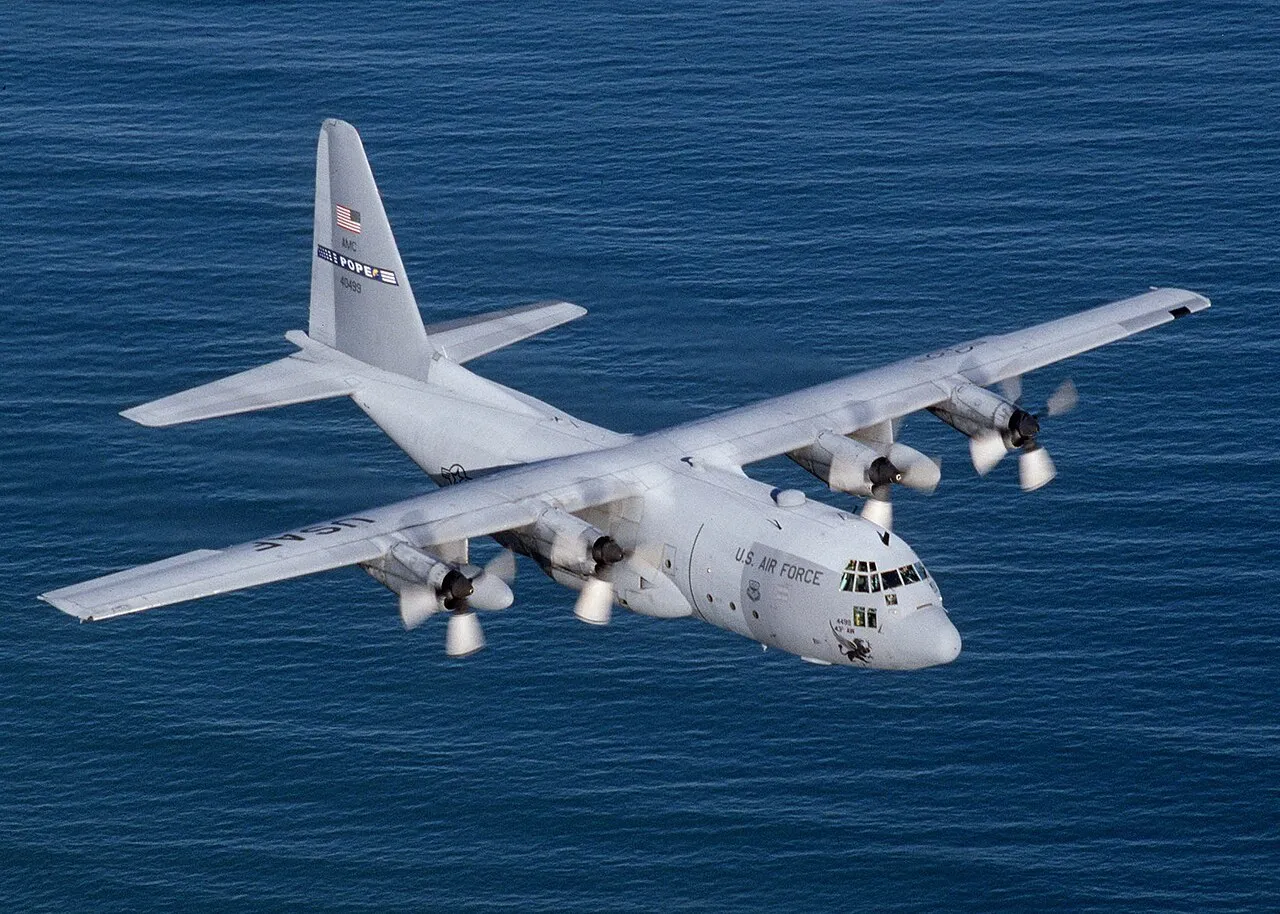
The Lockheed C-130 Hercules is a four-engine turboprop military transport built by Lockheed Corporation, now Lockheed Martin. It carries troops, cargo and casualties, refuels other aircraft, fights fires, flies special operations and search-and-rescue missions, and has served more than 60 nations’ air forces. First flown in 1954, it remains in production today, making it the longest continuously produced military aircraft1.
Design and development
The requirement came out of the Korean War, where piston-engined transports left over from the Second World War were judged no longer adequate, and the US Air Force issued its specification to manufacturers on 2 February 1951. Lockheed’s team, led by Willis Hawkins, won the competition, and the company assigned it the Model 82 designation on 2 July 1951. Lockheed’s chief engineer Kelly Johnson is said to have opposed the project at first before signing off on it1.
Designated YC-130, the prototype made its first flight on 23 August 19542, a 61-minute flight to Edwards Air Force Base flown by Stanley Beltz and Roy Wimmer. Production began at Lockheed’s plant in Marietta, Georgia, and the first production model, the C-130A, entered US Air Force service in December 1956. The design’s defining choice was its engine: the Allison T56 turboprop gave better fuel efficiency than contemporary turbojets, at the cost of needing safety systems to stop a stopped propeller windmilling and adding drag1.
Specifications
These figures describe the widely built C-130H variant. The aircraft is 29.79 m long with a wingspan of 40.41 m and a maximum take-off weight of 70,307 kg. It is powered by four Allison T56-A-15 turboprops, giving a cruise speed of about 541 km/h and a range of about 3,797 km with maximum payload, extending to roughly 7,400 km ferry range with no cargo. A standard crew is five: two pilots, a navigator, a flight engineer and a loadmaster, though crew composition varies by variant and mission. In the transport role it can carry up to 92 passengers, or 64 paratroops, or 74 litter patients with five medical attendants. More than 2,700 Hercules had been built by June 2024, out of an eventual production run that began with 219 C-130As, followed by 134 C-130Bs and 389 C-130Es1.
Variants
Lockheed kept refining the design: the C-130B added stronger hydraulics and four-bladed propellers and entered service in May 1959, and the C-130E, an extended-range version with external fuel tanks, followed in August 1962. The C-130H, with more powerful T56-A-15 engines, arrived in June 1964 and became the most widely used version. The current production model, the C-130J Super Hercules, uses new turboprop engines, six-bladed propellers and digital avionics, and is the only version Lockheed Martin still builds1.
Many specialised versions share the same airframe: the AC-130 gunship, first built during the Vietnam War for close air support; the HC-130 search-and-rescue aircraft equipped to deploy pararescue teams; the MC-130 Combat Talon for special operations; the KC-130 aerial refuelling tanker used by the US Marine Corps; and the ski-equipped LC-130 for Antarctic operations1.
Operators and service
More than 60 nations’ air forces fly the type, alongside the US Air Force, Navy, Coast Guard and Marine Corps. Australia was the first operator outside the United States, taking delivery of 12 aircraft from 1958, and the type later entered service with air forces including Canada, the United Kingdom, France and Germany. The ski-equipped LC-130H is the largest aircraft in the world able to land on snow and ice using skis1, and the type is the mainstay of US logistics flights to Antarctica.
The Hercules has flown in combat from Vietnam through the 1991 Gulf War to the Afghanistan and Iraq campaigns of the 2000s, and carried Israeli commandos in the 1976 Entebbe raid. Outside combat it has flown humanitarian missions, including dispersing oil dispersants after the 2010 Deepwater Horizon spill. A US Marine Corps KC-130F also set a record that still stands: 21 unarrested full-stop landings aboard the carrier USS Forrestal in 1963, the largest and heaviest aircraft ever to land on a carrier. The type remains in service and in production1, 70 years after its first flight.
Safety record
Given its size and long service, most of the C-130’s losses have come in combat or during demanding low-level and special-operations flying rather than from a single systemic fault. One documented loss involved an experimental variant: the High Technology Test Bed C-130 crashed on 3 February 1993 at Dobbins Air Reserve Base, Georgia, killing its crew after a rudder control system failure during minimum-speed testing1.
Similar aircraft
- Antonov An-12: a Soviet four-engine turboprop military transport of the same generation, broadly comparable in role and size.
- Airbus A400M: a newer four-engine turboprop transport built to a similar tactical airlift and air-to-air refuelling brief.
- Kawasaki C-2: a Japanese twin-jet military transport developed as a successor role aircraft for forces that also fly the Hercules.