Contents
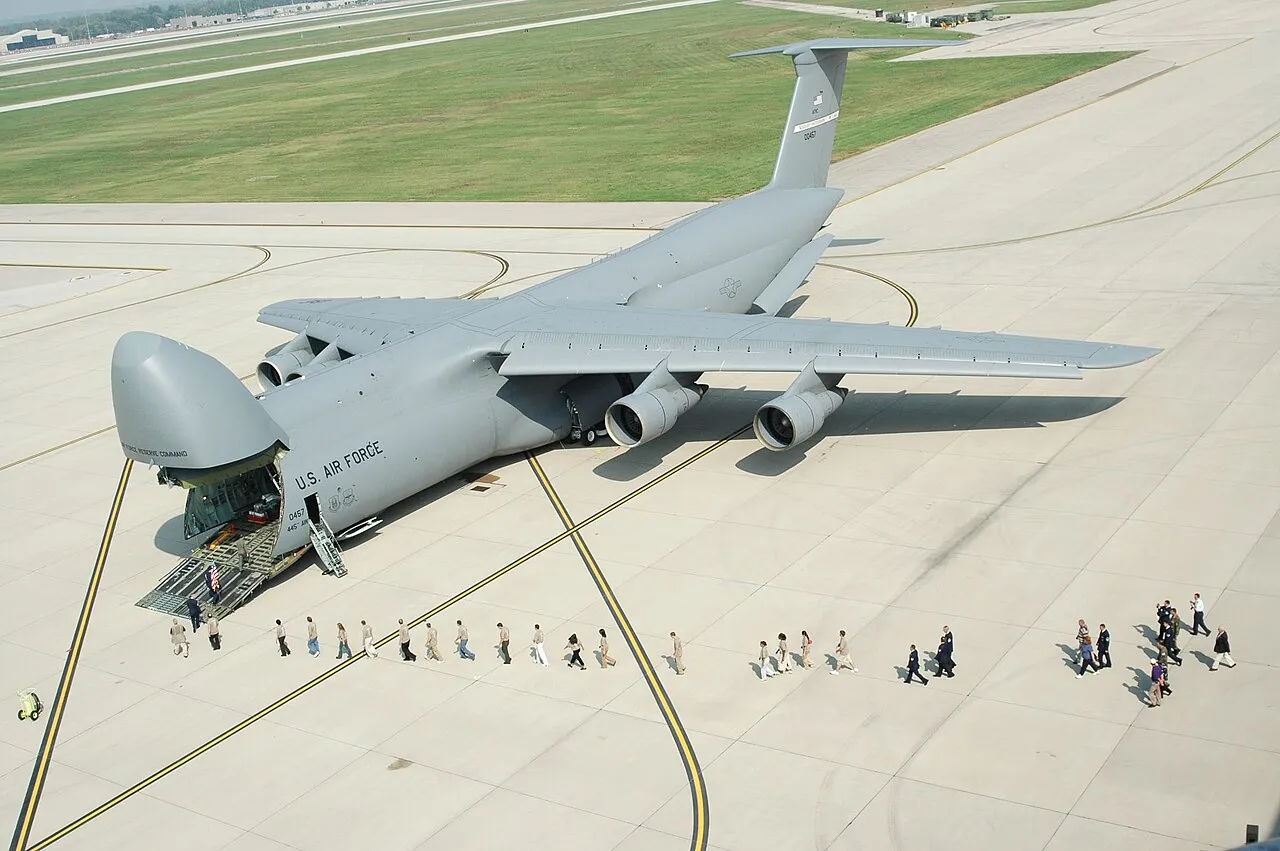
The Lockheed C-5 Galaxy is a strategic military transport aircraft built by Lockheed (now Lockheed Martin) for the United States Air Force. It was designed to carry outsized and oversized cargo, including fully assembled helicopters, armoured vehicles and tanks, over intercontinental distances. More than half a century after its first flight, upgraded C-5Ms still fly strategic airlift missions for the US Air Force1.
Design and development
The Galaxy grew out of a US Air Force requirement for an aircraft with a cargo bay larger than the Lockheed C-141 Starlifter’s, to replace the ageing Douglas C-133 Cargomaster. The Air Force issued the “Heavy Logistics System” request for proposals in April 1964, and Lockheed won the competition in September 1965, submitting the lowest total-cost bid even though Boeing’s design was considered technically superior. General Electric’s new TF39 turbofan, the first high-bypass-ratio jet engine built for a production aircraft1, was chosen to power it that same year.
The first aircraft rolled out on 2 March 1968 and made its first flight on 30 June 1968. The programme ran heavily over budget, with costs reaching about $1 billion and triggering congressional investigations in 1968 and 1969, and the type entered service in June 1970 at Charleston Air Force Base. Fatigue testing in the mid-1970s then uncovered wing cracks that forced the Air Force to cap peacetime payloads at 50,000 lb, a problem Lockheed fixed with a $1.5 billion re-winging programme, carried out between 1976 and 1987, that fitted 76 C-5As with a new aluminium alloy wing1.
Specifications
The production C-5 is 75.31 metres long with a wingspan of 67.89 metres, and it has a maximum take-off weight of 381,018 kg. Its ferry range without cargo is about 13,000 km, though with a 120,000 lb payload that falls to roughly 8,900 km, and it cruises at about 830 km/h. The original C-5A and C-5B are powered by four General Electric TF39 turbofans, while the upgraded C-5M Super Galaxy uses four General Electric F138-GE-100 turbofans rated at 51,000 lbf (230 kN) of thrust each. A typical crew is seven: an aircraft commander, a pilot, two flight engineers and three loadmasters, with a minimum crew of four1.
The cargo bay is the aircraft’s defining feature. Front and rear doors and a “kneeling” landing gear that lowers the fuselage to truck-bed height let it drive-through load vehicles from both ends at once. It can carry 36 standard 463L pallets, or outsized loads such as six Boeing AH-64 Apache helicopters, five Bradley fighting vehicles or M1 Abrams tanks1.
Variants
Lockheed built 131 C-5s in total: 81 C-5As between 1968 and 1973, and 50 C-5Bs between 1985 and 1989; the C-5B carried over the C-5A’s fixes and added simplified landing gear and upgraded avionics. Two C-5As were converted to the C-5C configuration, with a movable aft bulkhead for outsized payloads such as satellites. From 2006 to 2018, 52 survivors were remanufactured to C-5M Super Galaxy standard, with new engines and a glass cockpit, extending their planned service life beyond 2040. A proposed C-5D update in the 1990s was rejected, and its specifications were later folded into the C-5M programme; a civilian derivative, the L-500, was proposed but never built1.
Operators and service
The C-5 has flown only with the United States Air Force, which operated 52 C-5M Super Galaxy aircraft as of April 2025, based with the 60th Air Mobility Wing at Travis Air Force Base in California and the 436th Airlift Wing at Dover Air Force Base in Delaware, with Air Force Reserve units at Travis, Kelly Field in Texas and Westover in Massachusetts. The type has also supported allies: during the Yom Kippur War in 1973, C-5s flew resupply missions to Israel as part of Operation Nickel Grass. It remains the largest aircraft to operate in Antarctica, landing at Williams Field near McMurdo Station, and in September 2009 a C-5M set 41 world records, including carrying a 176,610 lb payload to 41,100 ft in under 24 minutes1.
Safety record
Three C-5s have been lost in crashes, with 169 fatalities in total. The first was in September 1974, when a C-5A overran the runway at Clinton, Oklahoma, Municipal Airport after a landing-gear fire. The deadliest came in April 1975, when a rear pressure door failed on a C-5A flying an Operation Babylift evacuation mission, crashing near Saigon and killing 144 of the 313 people aboard, including 78 children. A third aircraft was lost in August 1990 after a thrust reverser deployed during takeoff at Ramstein Air Base in Germany, killing 13 of the 17 aboard1.
Similar aircraft
- Boeing C-17 Globemaster III: a smaller, more agile US military strategic and tactical airlifter that now flies alongside the C-5 in Air Force service.
- Antonov An-124 Ruslan: a Soviet-designed strategic airlifter of similar size and era, built as the Eastern Bloc’s counterpart to the C-5.