Contents
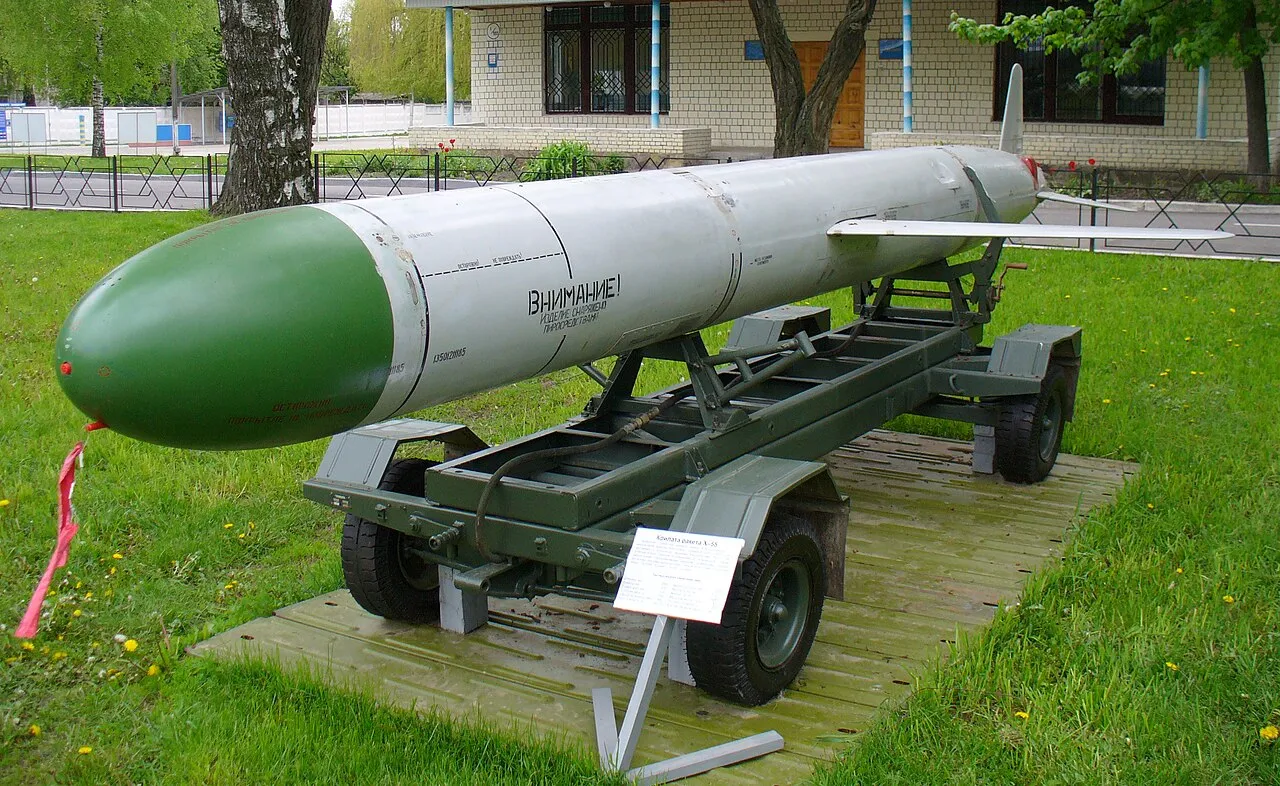
The Kh-55 (Russian Х-55) is a Soviet and Russian subsonic air-launched cruise missile1, known to NATO as the AS-15 Kent, designed by MKB Raduga in the 1970s to carry a nuclear warhead from long-range bombers. The family includes the longer-ranged Kh-55SM and the conventionally armed Kh-555 (Х-555), which CSIS credits with a 400 kg high-explosive warhead2 and improved accuracy. Ukraine’s Air Force names the Kh-555 together with its successor in its reports, as in the 10 “Kh-101/Kh-555” cruise missiles3 it said Tu-95MS bombers launched in the night to 22 June 2024.
Design and development
A late-1960s study by the GosNIIAS institute concluded that many small subsonic cruise missiles would be more effective than fewer, costlier supersonic ones. Work on an air-launched cruise missile started at Raduga in 19712. The first test flight came in 1976, the year the US AGM-86 appeared, and the Soviet Air Force issued its formal requirement in December that year. The original Kh-55 entered service on 31 December 19831, and the Kh-55SM followed in 1987.
After launch the folded wings, tail surfaces and engine deploy, the turbofan dropping below the body, and the missile flies low at subsonic speed. CSIS describes its guidance as inertial navigation and TERCOM2, terrain contour matching against stored data. After the Cold War Russia worked on conventional versions, among them the 600 km Kh-65SE1 announced in 1992, the Kh-SD and the Kh-555. Piotr Butowski wrote in TWZ that the Kh-555 is a conventional conversion of the nuclear Kh-55 and estimated that around 40 were converted4 in the mid-2000s.
Specifications
CSIS gives the basic Kh-55 a length of 6.04 m2, a diameter of 0.514 m and a launch weight of 1,210 kg, with a single 200 to 250 kT nuclear warhead and a maximum range of 2,500 km. Its wings span 3.1 m1, and the original R95-300 turbofan gave about 400 kgf of thrust.
The Kh-55SM adds conformal fuel tanks and a more powerful engine of 450 kg thrust, which raise its launch weight to 1,500 kg and its range to 3,000 km. For the conventional Kh-555, CSIS lists a 400 kg unitary high-explosive, penetrating or submunition warhead, a reduced radar cross-section and a range of 3,500 km. The export Kh-65SE was to carry a 410 kg warhead over 600 km2, but no exports are documented.
Launch platforms
The Kh-55 family is a bomber weapon. CSIS lists the Tu-95MS, the Tu-142M and the Tu-160 as carriers, and estimates that a Tu-160 carries 12 Kh-55SM or Kh-555 missiles2, a Tu-95MS6 six and a Tu-95MS16 sixteen. Defense Express wrote in 2022 that a Tu-95MS can take up to 6 Kh-555 missiles5 on internal mounts, and the missile was also tested1 on the Tu-22M.
Operators and combat use
The end of the Soviet Union left Ukraine with 1,612 Kh-55s at its bomber bases. Under a 1999 agreement signed in Yalta, Ukraine handed Russia 575 Kh-55 cruise missiles6 together with eight Tu-160 and three Tu-95MS bombers, against gas debt. In 2005 Ukraine acknowledged that 12 Kh-55s without nuclear warheads2 had been illegally sold to Iran in 2001, and CSIS also reports six sent to China. Russia, Iran and China are the listed operators1.
In November 2015 Russian bombers launched 35 Kh-555s4 in Syria, which Butowski believed exhausted the stock; in September 2022 he wrote that Ukrainian imagery showed only Kh-101s. In November 2022 the UK Ministry of Defence said that a Kh-55, designed in the 1980s purely as a nuclear delivery system, had been fired at Ukraine with its warhead probably substituted for ballast7, likely as a decoy for air defences.
The Radio Liberty project Skhemy compared serial numbers on wreckage with the list of missiles transferred in 1999 and found more than ten matches6, including three missiles shot down over Kyiv and its region in January, April and May 2023. One Kh-55 that hit an apartment building in Kyiv at the end of 2022 killed a woman. In Poland, the remains of a missile found in a forest near Bydgoszcz on 24 April 2023 were preliminarily identified as a Russian Kh-55 without a warhead8. Ukraine’s Air Force reported Kh-101/Kh-555 launches from Tu-95MS bombers over the Saratov region in June 2024 and said 7 of the 10 were shot down3.
Variants
- Kh-55 (Kent-A, RKV-500A): the original nuclear missile, with a 2,500 km range2.
- Kh-55SM (Kent-B, RKV-500B): conformal fuel tanks and a 3,000 km range2.
- Kh-55-OK: a version with optical guidance1.
- Kh-65SE: the conventional export version announced in 19921, with a 600 km range.
- Kh-SD: a tactical version reported in 1995 with a 300 km range2, later 600 km; its status is unknown.
- Kh-555: the conventional conversion with a 400 kg warhead2, carried by the Tu-95MS and Tu-160.
Similar weapons
- Kh-101: its stealthier successor, which TWZ calls a substantially revised derivative9 of the Kh-55/Kh-555 family with some stealthy features.
- AGM-86 ALCM: the US bomber-launched cruise missile whose appearance in 1976 gave the Soviet programme impetus1.
- Soumar: an Iranian ground-launched cruise missile unveiled in 2015 that CSIS says appears to originate from the Kh-552.