Contents
The Kh-101 (Russian Х-101) is a Russian air-launched cruise missile1, known to NATO as the AS-23 Kodiak, and the Kh-102 is its nuclear-armed version. The Raduga bureau designed it as a stealthier replacement for the Kh-55, and CSIS lists it in service since 20122 with Russia’s long-range bombers. Russia fires it at Ukraine from Tu-95MS and Tu-160 bombers, and Ukraine’s Air Force reported 35 Kh-101 cruise missiles3 launched in the single night to 14 May.
Design and development
Work on a successor to the Kh-55 began in the late 1980s, with a conventional warhead for the Kh-101 and a nuclear one for the Kh-102; the missile was designed by Igor Seleznyev of Raduga. CSIS writes that full-scale development likely began in 19952, and the missile’s first flight is dated to 19981, with evaluation trials from 2000 and acceptance into service in 2012.
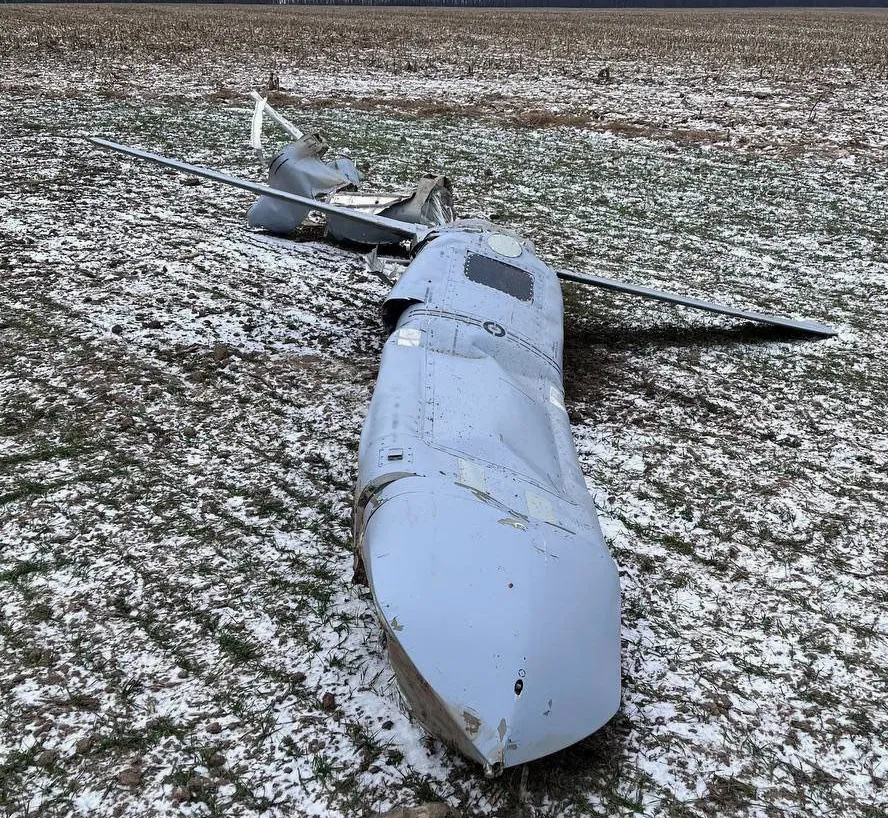
The airframe drops the round cross-section of the Kh-55 for a nose and forward body shaped to produce lift1. TWZ describes it as a substantially revised derivative4 of the Kh-55/Kh-555 family with some stealthy features, and points to its low-observable design5, meant to reduce its radar cross-section. Navigation combines inertial and satellite navigation6 with terrain-contour and scene matching. Defense Express, citing a Ukrainian General Staff briefing, reported an upgraded version in use since late 20227, with a camera of three fixed lenses in place of one swivelling lens and an L-504 unit that releases radar-reflecting chaff.
Specifications
CSIS gives the Kh-101 a length of 7.45 m2, a diameter of 0.51 m and a launch weight of 2,300 to 2,400 kg, with a 450 kg high-explosive, penetrating or cluster warhead; the Kh-102 reportedly carries a 250 kt nuclear charge. The missile is fired without a booster and is powered by a TRDD-50A turbofan. CSIS puts its cruising speed at Mach 0.58 and its top speed at Mach 0.78, while other listings give a top speed of 970 km/h1 and a cruising height of 30 to 70 m above the ground.
Range figures differ widely. CSIS lists 2,500 to 2,800 km2, with an unconfirmed Russian claim of 4,500 km, while Piotr Butowski wrote in TWZ in 2022 of roughly 2,175 miles6, about 3,500 km. In January 2024 a Raduga representative told Russia’s defence minister that the warhead had grown from 450 kg to 800 kg8, and wreckage from a missile downed in a later night attack showed a second warhead fitted in place of part of the fuel tank. The UK Ministry of Defence assessed that this twin-warhead version had likely halved its range5.
Procurement documents obtained by Militarnyi put the price of a Kh-101 under 2024 contracts at RUB 164 million, about $2 million9, and at RUB 171 to 194 million for 2025.
Launch platforms
The Kh-101 is carried by the Tu-95MS and the Tu-160 of Russia’s Long-Range Aviation, and Butowski called it in 2022 the only conventional cruise missile6 then available to those bombers. According to Defense Express, a Tu-95MS can carry up to 8 Kh-101s10 on external mounts and a Tu-160 up to 12 Kh-101 or Kh-555 missiles. CSIS also lists the Tu-22M3 and the Su-27IB among its launch platforms2.
Operators and combat use
The Russian Aerospace Forces are the only listed user1. The missile’s combat debut came in Syria: CSIS records that Tu-95 and Tu-160 bombers launched 32 Kh-101s2 against Islamic State targets on 19 and 20 November 2015, followed by further strikes in 2016 and 2017.
Against Ukraine the Kh-101 has been used from the first weeks of the full-scale invasion. On 6 March 2022 the Air Force command said eight missiles, presumably Kh-101s11, fired by Tu-95MS and Tu-160 bombers from the Black Sea area, struck the Vinnytsia airfield. On 8 July 2024 the Okhmatdyt children’s hospital in Kyiv was hit; the UN Human Rights Monitoring Mission said there was a high likelihood of a direct hit12, assessed as a Russian Kh-101, and Ukraine’s Security Service reported Kh-101 fragments at the scene. Two people were killed and 32 wounded.
Militarnyi reported in October 2025 that Raduga received contracts for 525 missiles for 20249, that 700 had been contracted for 2025 and 30 more for 2026. Ukraine’s Air Force said that in the night to 14 May, 35 Kh-101s were launched from the Vologda region and 29 were shot down or suppressed3, and that Ukraine’s defence forces destroyed 14 Kh-101 cruise missiles13 in October 2026.
Variants
- Kh-101 (AS-23A1): the conventional missile, with a 450 kg warhead2 of high-explosive, penetrating or cluster type.
- Kh-102 (AS-23B1): the nuclear version, reportedly with a 250 kt warhead2, though some sources give up to 450 kt.
- Izdeliye 504AP: a subvariant with a countermeasures dispenser, first reported in late 20224 and shown by Ukraine’s armed forces at a press conference in February 2023.
- Twin-warhead Kh-101: the 2024 version with a second fragmentation warhead and a smaller fuel tank, described by Defense Express8 and TWZ.
Similar weapons
- Kh-55: the older bomber-launched cruise missile it replaces, which TWZ treats as the family it was derived from4; its conventional Kh-555 version flies from the same bombers.
- Kh-59: an air-launched cruise missile for tactical aviation, 4.2 m long against 7.45 m14 for the Kh-101.
- 3M-54 Kalibr: a cruise missile family with ship-, submarine- and air-launched versions15 and a 3M-14 land-attack version, whose engine comes from the same TRDD-50 line14.