Contents
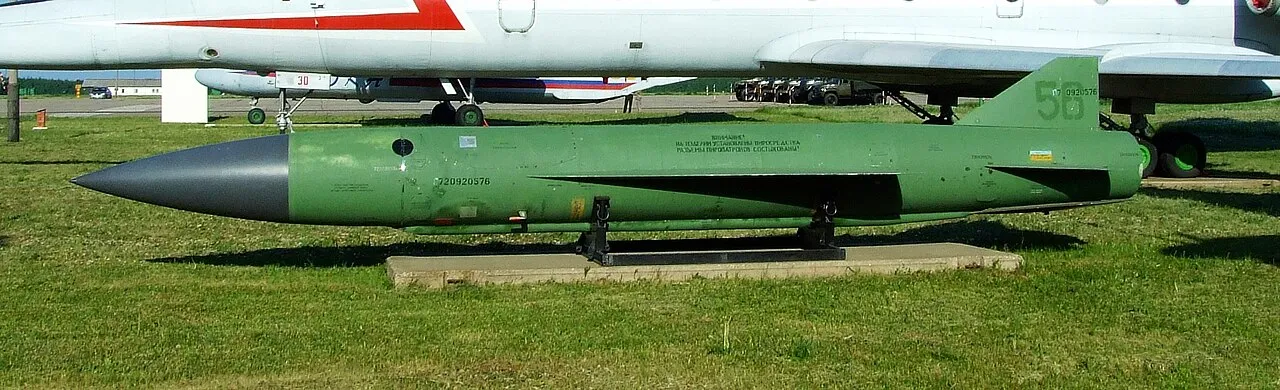
The Kh-22 Burya (Russian Х-22 “Буря”) is a large, long-range anti-ship cruise missile1 developed by MKB Raduga in the Soviet Union, known to NATO as the AS-4 Kitchen. It was designed to strike aircraft carriers and their battle groups with a conventional or nuclear warhead, and its updated conventional successor, the Kh-32, was first shown in public in 20162. Since 2022 Russia has fired both types from Tu-22M3 bombers at targets on land in Ukraine, and Ukraine’s Air Force reports them together as “Kh-22/32”, as for the Kh-22/32 cruise missiles3 it said were launched from the airspace over occupied Crimea in the night to 17 October.
Design and development
The Kh-22 was built to arm the Tu-22 bomber. The Kyiv Post dates its development to the 1960s, with flight and firing tests completed in 19674; the first Kh-22PG was fired in 1963 and the missile entered service in 19681 together with the Tu-22K missile carrier. In the 1970s it was upgraded to the Kh-22M and Kh-22MA standard with new attack profiles, somewhat longer range and a datalink for mid-course updates.
The missile burns liquid propellants1 and climbs high before diving onto its target. Its radar seekers were made to find ships, which Piotr Butowski noted in TWZ in 2022 makes it inaccurate against land targets5. Defense Express put the Kh-22’s delivery errors at about 500 m to a few kilometres6 from the aiming point.
Work on the Kh-32 began at Raduga in the late 1980s2, was halted after the Soviet collapse, resumed in the mid-1990s with early tests in 1998 and restarted in 2008 once a Tu-22M3 had been modified for the programme. Militarnyi writes that the work began after the old missile was found to have low resistance to electronic countermeasures7. Russia’s pre-war plan called for 30 Kh-32 missiles6, made by remodelling older Kh-22s.
Specifications
The commonly quoted figures give the Kh-22 a launch weight of 5,820 kg, a length of 11.65 m, a body diameter of 92 cm and a wingspan of 3 m, with a 1,000 kg RDX warhead or a nuclear charge of 350 to 1,000 kilotons. The Kyiv Post, describing the missile after its 1970s upgrades, gives a speed of 4,000 km/h4, a 1,000 kg warhead and a range of 500 km, and says approximately 3,000 were produced in the Soviet Union. Other figures are a top speed of Mach 4.6 and a range of up to 600 km1, while Butowski gave the Kh-22 a range of up to 217 miles5, about 350 km, and a cruise speed of Mach 3.
The Kh-32 also needs liquid fuel. Its range is reported at up to 1,000 km2 thanks to enlarged fuel tanks, and Defense Express estimates its speed at Mach 4 to 5 depending on the flight profile. Militarnyi gives Mach 3.5 to 4.67 and a lightweight 9A22 warhead of up to 700 kg. Russian sources themselves put the Kh-32’s radar homing range at only up to 300 km6, Defense Express wrote in 2022, and it concluded that the missile’s real range is much less than declared.
Launch platforms
In Soviet service the Kh-22 armed the Tu-22K1 and the Tu-95K-22 version of the Tu-95, and its main launch platform became the Tu-22M3. Butowski wrote in 2022 that a Tu-22M3 normally carries a single Kh-225, and two or even three only at the expense of fuel. Sources differ on the Kh-32: Defense Express wrote in 2022 that only the modernised Tu-22M3M can carry it6, while the Kyiv Independent in 2026 said it is launched from the Tu-22M32. Russian plans to arm the Tu-22M3 with the Kinzhal remained just an idea8, and the bomber received the Kh-32 instead.
Operators and combat use
The Soviet Union passed its missiles to Russia and to Belarus, Kazakhstan and Ukraine; Ukraine scrapped 4231 after it retired its Tu-22M fleet. In 2000 Ukraine transferred 386 Kh-22 missiles to Russia4 as an instalment against its gas debt.
The first combat use1 came in the 2022 invasion of Ukraine. Butowski reported launches from the 52nd Heavy Bomber Aviation Regiment5 at Shaykovka, with several dozen missiles fired from April 2022 and, by Ukrainian accounts, 200 in the second half of June. British intelligence suggested a Kh-32 hit the Amstor shopping mall in Kremenchuk on 27 June 20226, a strike that killed at least 21 people2. On 14 January 2023 a Kh-22 hit a nine-storey apartment building in Dnipro, where 46 people died4, and Ukraine’s Prosecutor General’s Office said the weapon caused the heaviest civilian casualties because of its very low precision.
In December 2023 Air Force spokesperson Yurii Ihnat said Russia had fired around 300 Kh-22 missiles4 since the full-scale invasion and that none had been intercepted. Overnight on 19 April 2024, the Air Force said, Russia attacked with 22 missiles including six Kh-22s9. On 24 January 2026 the Air Force reported intercepting nine Kh-32 missiles2, and in October 2026 Militarnyi noted the first Kh-22/32 use since July7 of that year.
Variants
- Kh-22: the original missile with a large conventional warhead1.
- Kh-22N: the nuclear version, with a 350 to 1,000 kiloton warhead1.
- Kh-22P: an anti-radiation version1 from the mid-1970s, made to destroy radar sites.
- Kh-22M and Kh-22MA: 1970s upgrades1 with new attack profiles, longer range and a datalink.
- Kh-22NA: a version that, according to the Kyiv Post, does not use a radar4 to lock on and flies on autopilot to set coordinates.
- Kh-32: the modernised conventional missile with a new radar seeker and a modernised liquid rocket engine6; Russia declared it operational in 20162.
Similar weapons
- Kh-47M2 Kinzhal: a faster air-launched ballistic missile carried by the MiG-31K, which Butowski judged not significantly different5 in capability from the Tu-22M3 with the Kh-22/Kh-32.
- Kh-101: a subsonic, low-flying cruise missile for the Tu-95MS and Tu-160, weighing about 4,850 to 5,290 lb5 against some 13,000 lb for the Kh-22.
- Kalibr: the ship-launched cruise missile, whose cruise speed the Kyiv Post put at three times slower4 than the Kh-22’s.