Contents
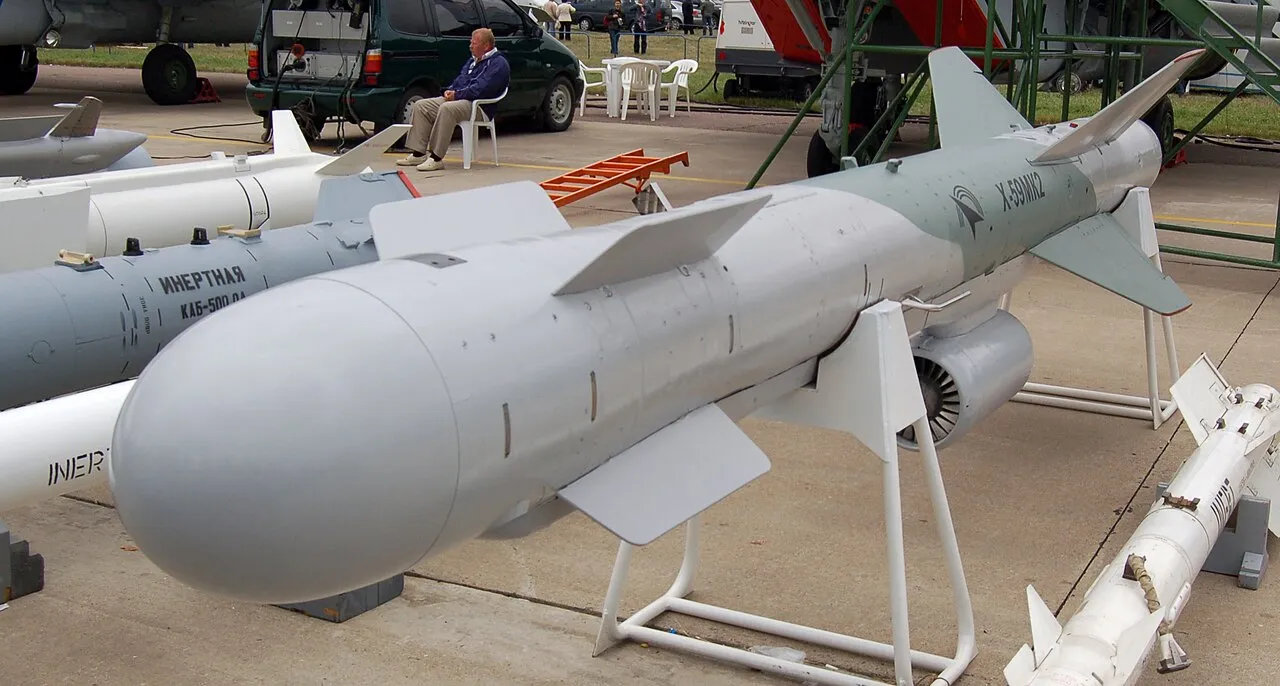
The Kh-59 Ovod is a Russian air-launched cruise missile with a two-stage solid-fuel propulsion system, known to NATO as the AS-13 Kingbolt. It was designed by the Raduga bureau, and its Kh-59M Ovod-M variant (AS-18 Kazoo) has a bigger warhead and a turbojet engine1 and serves mainly against land targets, while the Kh-59MK is aimed at ships. Defense Express describes the family as a cruise missile for tactical aviation that Russia has fired at Ukrainian infrastructure since the first weeks of the full-scale invasion2 in 2022.
Design and development
Raduga developed the missile in the 1970s as a longer-ranged version of the Kh-25, a precision stand-off weapon for the Su-24M and late-model MiG-27. Its electro-optical sensors came from the S. A. Zverev works in Krasnogorsk. Work on the Kh-59M is believed to have started in the 1980s1, with details first revealed in the early 1990s.
After release, a solid-fuel booster in the tail fires first, then the forward fins unfold and the cruise engine takes over. The missile cruises about 7 m above water1, or 100 to 1,000 m above ground, measured by a radar altimeter. The Kh-59ME is steered by inertial guidance towards the target area and by television guidance for the final approach. In 2023 Defense Express named the Smolensk Aircraft Plant as a key subcontractor for aviation missiles2, the Kh-59 among them.
Specifications
Published figures differ by version. The commonly quoted set gives a launch mass of 930 kg1, a length of 5.7 m, a body diameter of 38 cm and a wingspan of 1.3 m, with a 320 kg cluster or shaped-charge fragmentation warhead and a speed of Mach 0.72 to 0.88, 882 to 1,080 km/h. For the Kh-59MK2, Defense Express gave in 2023 a length of 4.2 m and a launch weight of 770 kg2, a 310 kg penetrating or cassette warhead, and a TRDD-50B engine related to the one in the Kh-101 and the Kalibr.
Range depends on the version as well. Defense Express gives launch ranges from 45 km and up to 285 km2, and in 2022 it wrote of a 300 km range3. Other listings give 285 km for the anti-ship Kh-59MK1 and 290 km for the Kh-59MK2, while the Institute for the Study of War cited a 200 km range for the Kh-59MK24 in April 2024. In July 2026 Defense Express valued one Kh-59 at approximately $300,0005.
Launch platforms
In Russian service the original Kh-59 was fielded only on the Su-24M, although other aircraft could carry it with a datalink pod. Defense Express listed five Russian carriers2 in 2023: the Su-24M, Su-30, Su-34, Su-35 and Su-57. Launch aircraft listed for the family also include1 the MiG-27, the Su-17M3, the Su-22M4, the Su-25 and India’s Su-30MKI.
A video published in May 2018 showed a Su-57 launching a Kh-59MK26, CSIS reported. Defense Express reported that Su-57s fired Kh-59s on 8 April 20223 at targets in Kirovohrad region and the port of Odesa, the fighter’s first combat use, and that in March 2022 Su-35s armed with Kh-59s struck oil depots2 in Rivne region.
Operators and combat use
Listed operators are Russia, Algeria, China, India, Indonesia, Malaysia, Syria, Venezuela and Vietnam, and the missile was used in both Chechen wars. Russia delivered some 200 Kh-59s to China1 between 2008 and 2015 for its Su-30MK2 fighters. CSIS wrote in 2018 that Russia may have used the Kh-59MK2 in Syria6, which remained unconfirmed.
In Ukraine, photographs published on Telegram channels showed a Kh-59M launched at a grain silo near Mykolaiv on 4 April 2022, caught on CCTV on its way to the target area, and on 16 August 2022 Ukraine’s Air Force confirmed that Kh-59s had struck an airbase1 in Zhytomyr Oblast. Defense Express reported that five Kh-59 cruise missiles were detected2 in the night attack of 16 October 2023, an unusual number for one salvo. On 15 January 2024 Ukraine’s Air Command East said it had destroyed a Kh-59 near Dnipro7. Ukraine’s Air Force reports the type together with its successor as “Kh-59/69”, and in July 2026 Defense Express counted the Kh-59 and its Kh-69 development among the primary precision-guided munitions5 of Russia’s tactical aviation. In the night to 8 November that year, the Air Force said, Russia launched three Kh-59/69 guided air-launched missiles8 from the Sea of Azov area.
Variants
The original Kh-59 (AS-13) used two solid-fuel rocket stages and was exported as the Kh-59E. The Kh-59M (AS-18) added the turbojet and the larger warhead, and its export Kh-59ME was offered in 1999 with a 200 km range. The Kh-59MK is the anti-ship model with a turbofan and an active radar seeker. Laser-guided Kh-59L and television-guided Kh-59T versions were also developed, and the Kh-59MKM is a penetrator with a 360 kg warhead1 and no seeker.
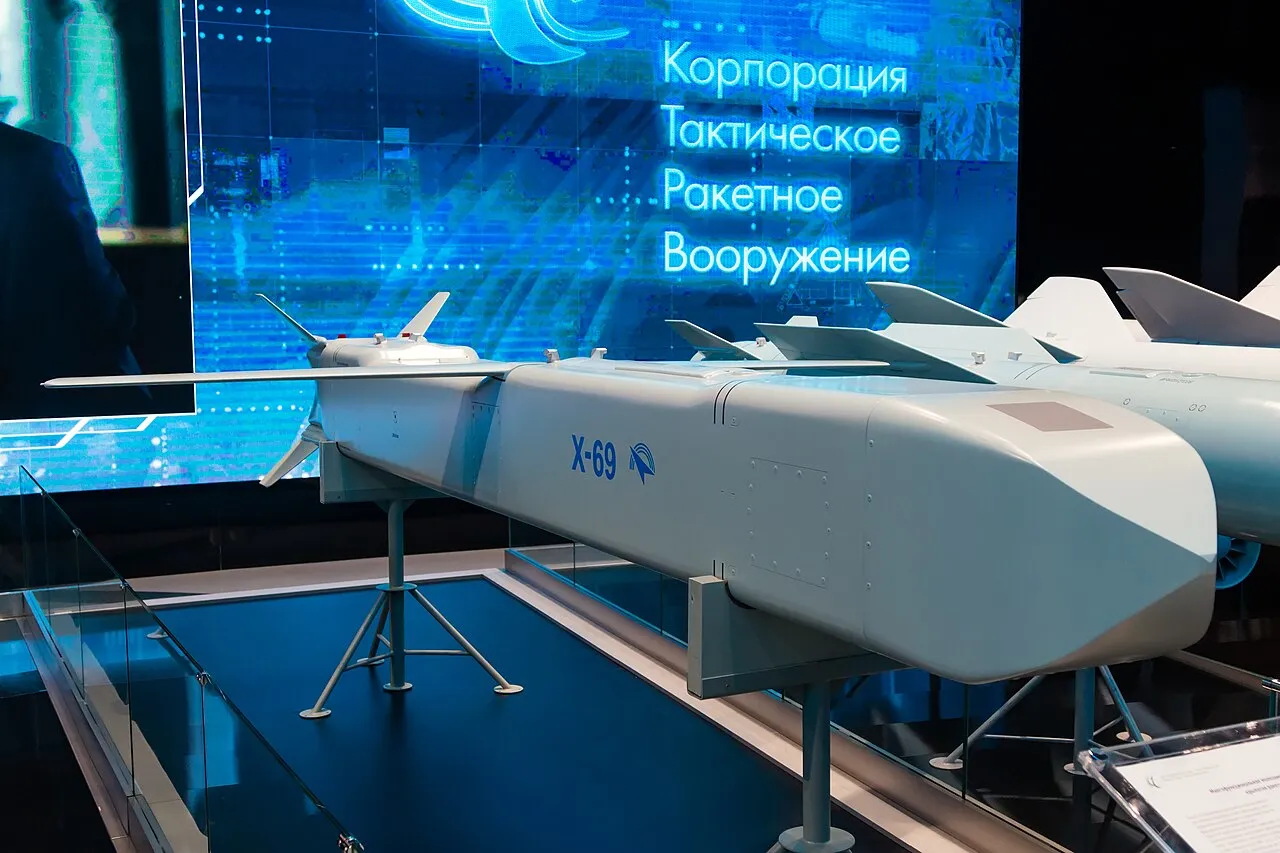
The Kh-59MK2 first appeared in 20099, looking like the Kh-59MK but with inertial navigation updated by GPS and GLONASS and an electro-optical terminal seeker. In 2015 it was reworked with low-observable features and an internal turbofan, and Raduga turned that design into the domestic Kh-69.
Similar weapons
- Kh-69: the successor developed from the reworked Kh-59MK2, with a boxy, trapezoidal-section body9 shaped for the Su-57’s internal bay.
- Kh-25: the earlier missile of which the Kh-59 was conceived as a longer-ranged version1.
- Kh-101: a much larger Russian air-launched cruise missile, 7.45 m long2 against 4.2 m for the Kh-59MK2.