Contents
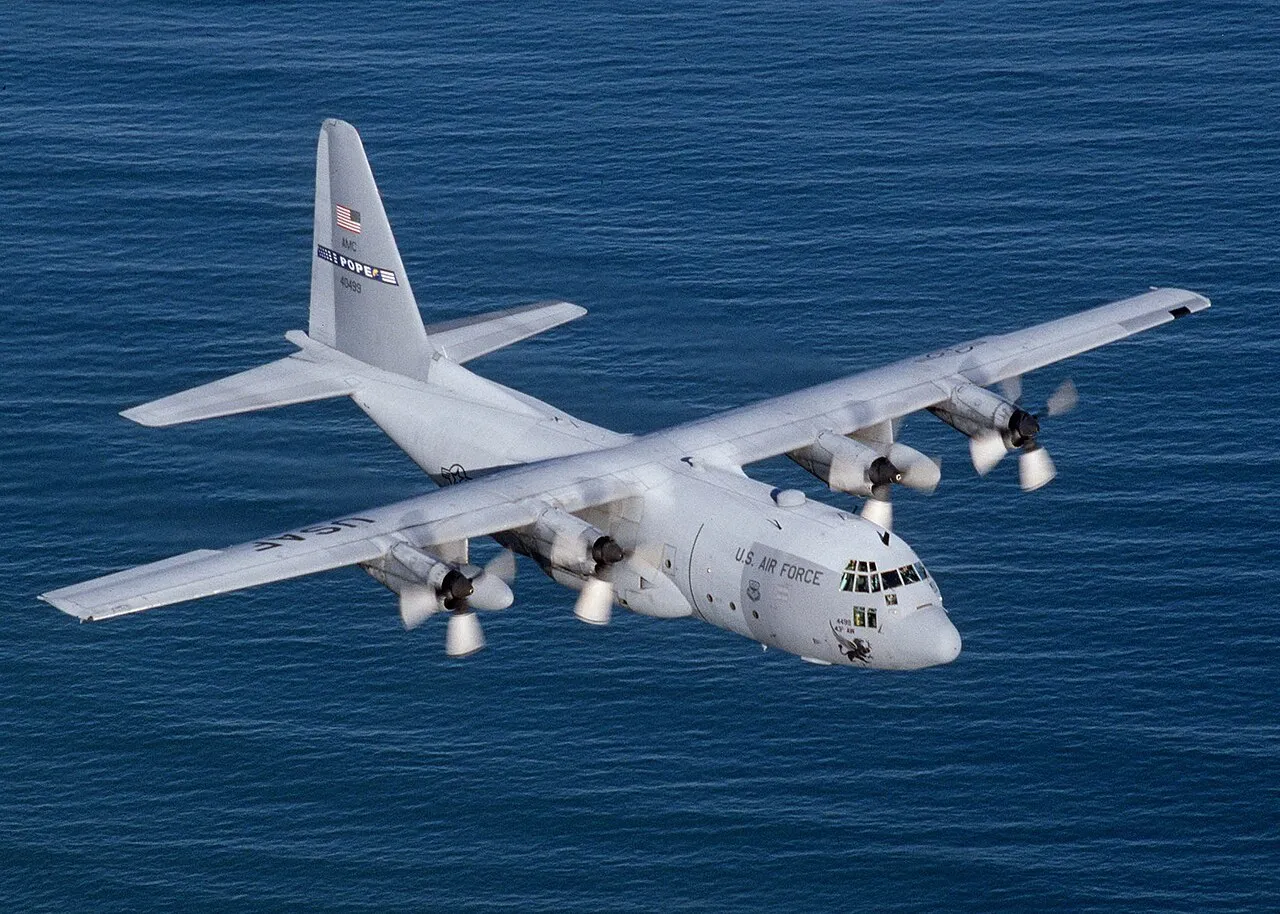
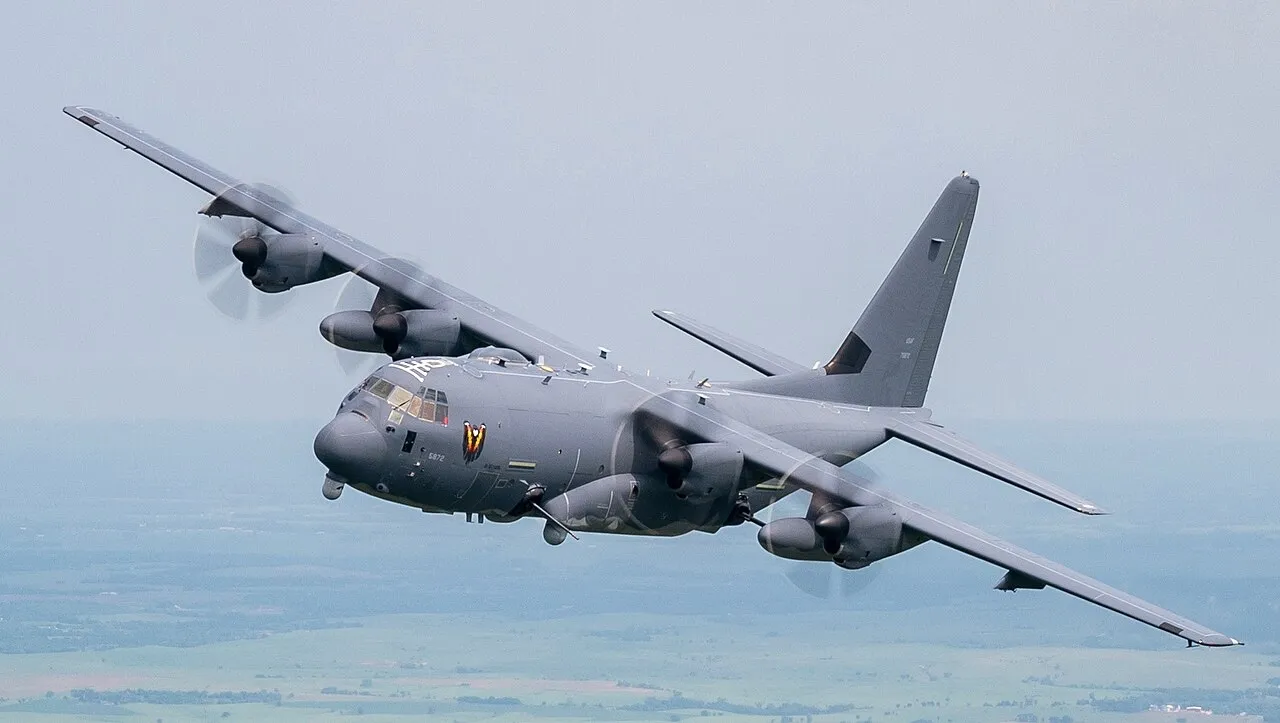
The Lockheed AC-130 is a heavily armed, long-endurance aircraft that carries weapons against ground targets, tied to sensors, navigation and fire-control systems. It is based on Lockheed’s four-engine turboprop transport and weaponized by Boeing, a conversion of the Lockheed C-130 Hercules. Since the Vietnam War the gunship has flown close air support, air interdiction and force protection2 for US ground troops. Its sole operator has been the United States Air Force, and as of 2026 it uses the AC-130J Ghostrider1.
Design and development
The gunship idea started in 1964, when US Special Forces in Vietnam needed night firepower. Its first form was a Douglas C-47 transport with side-firing guns: the FC-47 was introduced on December 11, 1964, later renamed the AC-47 Spooky. To decrease vulnerability and increase munitions capability, the AC-47 concept was then applied to a Lockheed C-130 Hercules transport. In 1967 JC-130A serial no. 54-1626 was converted to prototype AC-130A2 under Project Gunship II, with a night-vision telescope, an early forward-looking infrared device and a prototype analog fire-control computer.
In September 1967 the AC-130, call sign Spectre, flew to Nha Trang Air Base in South Vietnam for a 90-day test programme. HistoryNet calls it an immediate success2, and seven more aircraft were converted to the same configuration in 1968. In 1970, 10 more AC-130As were acquired under the “Pave Pronto” project1, and C-130Es were then converted into AC-130Es under the “PAVE Spectre” project.
The current model came from a 2011 initiative to acquire 16 new gunships1 based on newly built MC-130J Commando II special-operations tankers fitted with a “precision strike package”. Lockheed Martin delivered the final AC-130J Ghostrider to Air Force Special Operations Command as its 31st delivery3, paving the way for a full transition from the command’s legacy gunship fleet.
Specifications
Four 4,700-hp Rolls-Royce turboprops power the AC-130J Block 20, giving it a speed of 362 knots at 22,000 feet. Its precision strike package includes standoff precision-guided munitions, electro-optical/infrared sensors3, a communications suite and a fire control system. HistoryNet lists its armament as an internal 30mm MK44 cannon and a trainable M102 105mm howitzer2, with the ability to carry GBU-39 guided bombs and wing-mounted AGM-114 Hellfire missiles.
The electronic fit described by HistoryNet includes a laser range finder, low-light TV camera, crew night-vision capability, night-vision radar and a moving-target indicator. Like the MC-130J on which it is based, the Ghostrider has inflight refueling capability2. Because its large profile and low operating altitudes around 7,000 feet1 make it an easy target, its close air support missions are usually flown at night.
Variants
- AC-130A Spectre: conversions of C-130As, 19 completed1; transferred to the Air Force Reserve in 1975 and retired in 1995. Early examples carried four 20mm rotary cannons and four 7.62mm miniguns2 along the left side.
- AC-130E Spectre: conversions of C-130Es, 11 completed1, 10 of them upgraded to AC-130H configuration.
- AC-130H Spectre: armed with two 20 mm M61 Vulcan cannons, one Bofors 40 mm cannon and an M137 105 mm cannon; the last aircraft was retired in 20151.
- AC-130U Spooky: had a 25 mm GAU-12 Equalizer cannon in place of the two 20 mm guns, an improved fire-control system and more ammunition; the variant was retired in June 20201.
- AC-130W Stinger II: a modified C-130H with a precision strike package, formerly the MC-130W Dragon Spear; retired in July 20221.
- AC-130J Ghostrider: the heavy ground-attack variant of the C-130J Super Hercules3, fitted with a precision strike package.
Operators and service
In Vietnam the gunship proved so effective as a truck-killer2 along the Ho Chi Minh trail that the Air Force had difficulty keeping up with demand for an airplane also needed for troop and cargo transport. AC-130s reportedly destroyed more than 10,000 trucks during the war. The type has since seen combat in Grenada, Panama, the Persian Gulf, Somalia, Bosnia, Kosovo, Afghanistan, Iraq and Libya. In the 1989 invasion of Panama1 AC-130s destroyed Panama Defense Force headquarters and provided close air support for US ground troops.
On 3 October 2015, an AC-130 mistakenly attacked the Doctors Without Borders hospital in Kunduz, Afghanistan, killing 42 people. The last AC-130H Spectre, tail number 69-6569 “Excalibur”1, was retired on 26 May 2015 at Cannon Air Force Base, New Mexico.
The Air Force reported that the first six AC-130Js achieved initial operational capability on September 30, 2017. The Ghostrider flew its first combat mission in late June 20192 over Afghanistan, replacing the retired AC-130U. The final AC-130J went to the 27th Special Operations Wing at Cannon Air Force Base in New Mexico. AFSOC commander Lieutenant General Jim Slife said this airplane will be relevant3 to whatever the future operating environment brings.
Safety record
Enemy fire brought down the first Spectre gunship, on 24 May 1969. In all, six AC-130s and 52 air crew members were lost during the Vietnam War. During the Gulf War, on 31 January 1991, AC-130H Spirit 031 was shot down by a lone Iraqi with a Strela-2 MANPADS, and all 14 crew members were killed.
Similar aircraft
- Douglas AC-47 Spooky: the Project Gunship I aircraft, a converted C-472 armed with three 7.62mm miniguns, which the AC-130 replaced1.
- Fairchild AC-119: 26 C-119Gs were converted to AC-119Gs under Project Gunship III in February 1968, using Flying Boxcar airframes held by the Air Force Reserve; the AC-119K Stinger had two piston engines supplemented with underwing J85 turbojets2, unlike the AC-130’s four turboprops.