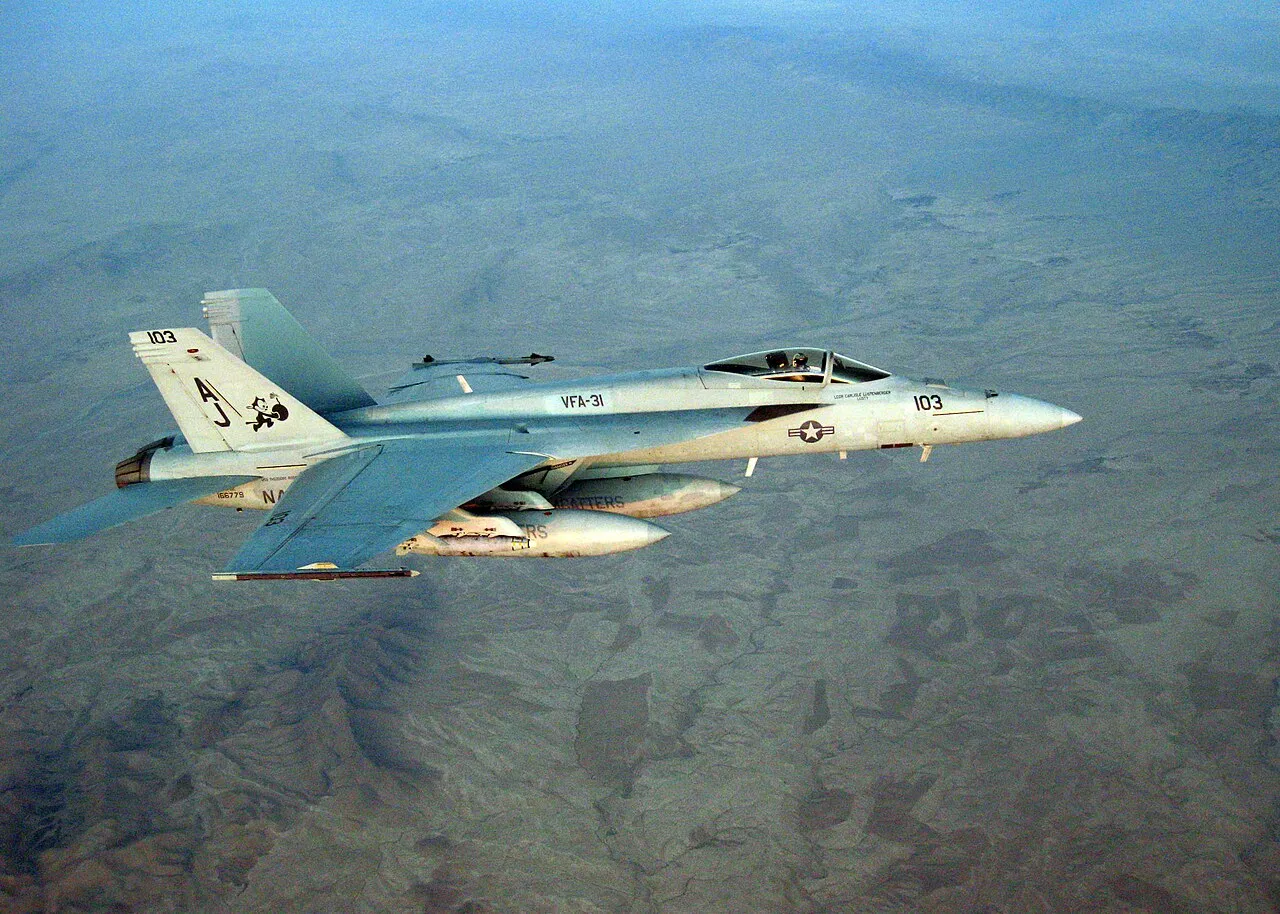
The Boeing F/A-18E/F Super Hornet is a twin-engine, carrier-based strike fighter flown by the US Navy, built as a larger, longer-range successor to the McDonnell Douglas F/A-18 Hornet. The single-seat E model and two-seat F model fly strike, air-superiority, close air support, aerial reconnaissance and aerial refuelling missions1. Development began under McDonnell Douglas before the company’s 1997 merger with Boeing, which has produced the type since.
Design and development
McDonnell Douglas launched the Super Hornet programme to answer the US Navy’s need for a longer-range, higher-payload aircraft than the original Hornet, while keeping a similar look to ease a smooth transition for carrier air wings. The first prototype flew on 29 November 1995. Despite the shared name, the Super Hornet is a substantially new airframe: it is larger than the original Hornet, with a bigger wing and more fuel capacity, and it introduced two General Electric F414-GE-400 turbofans1, a more powerful derivative of the F404 engines that powered the earlier jet.
Boeing continues to market the type alongside the related EA-18G Growler electronic-warfare aircraft, describing the family as a multirole platform for carrier and expeditionary operations2.
Specifications
The Super Hornet is 18.3 metres long with a wingspan of 13.7 metres, and it has a maximum take-off weight of 29,937 kg2. Its ferry range with external tanks and no ordnance is about 3,330 km, though combat radius is much shorter and depends heavily on the mission load, for example about 748 km on a fighter-escort load-out, which also sets its cruise speed of about 893 km/h. The aircraft is powered by two General Electric F414-GE-400 turbofans1.
The single-seat F/A-18E carries one pilot, while the two-seat F/A-18F adds a weapon systems officer behind the pilot to manage sensors and weapons on strike missions. The US Navy’s 2013 procurement cost per aircraft was about US$52 million1.
Variants
The two baseline variants are the single-seat F/A-18E and the two-seat F/A-18F1, which otherwise share the same airframe, engines and mission systems. The related EA-18G Growler, built on the F/A-18F’s two-seat airframe, replaces its cannon and some sensors with dedicated electronic-warfare equipment and is marketed by Boeing as part of the same family rather than as a Super Hornet variant.
Operators and service
The Super Hornet entered front-line service with the US Navy, which remains its main operator, flying from carrier air wings and shore bases. At least 632 had been built as of April 2020, and production was continuing at that point. Outside the United States, the Royal Australian Air Force and the Kuwait Air Force also fly the type as export customers. The aircraft’s status is in service1 with the US Navy, which has used it as its principal carrier-based strike fighter since the type succeeded earlier Hornet variants in that role.
Similar aircraft
- McDonnell Douglas F/A-18 Hornet: the smaller, shorter-range predecessor the Super Hornet was designed to succeed.
- Grumman F-14 Tomcat: the US Navy carrier fighter the Super Hornet replaced in fleet service.
- Lockheed Martin F-35 Lightning II: a newer carrier-capable strike fighter now flying alongside the Super Hornet in US Navy service.
_10Vvmy.webp)