_ZVY5TD.webp)
Contents
The Airbus A300 was the world’s first twin-engine, wide-body airliner, and the founding product of the Airbus consortium. Built by Airbus, it was designed to carry passengers on medium- and long-haul routes with the economics of two engines instead of three or four. Production ended in 2007, but the type remains in wide cargo service1, mainly with freight carriers, while passenger use has become limited.
Design and development
The programme began in September 1967, when manufacturers from France, West Germany and the UK signed a memorandum of understanding to develop a large airliner together. The UK withdrew in April 1969 after the decision to drop the Rolls-Royce RB207 engine in favour of American turbofans, but France and West Germany launched the A300 programme at the Paris Air Show on 29 May 1969. Airbus Industrie GIE was formally established on 18 December 1970, with France and West Germany each holding a 50 percent stake1; Spain’s CASA joined in 1971 and Britain rejoined, via British Aerospace, in 1979.
The first prototype made its first flight on 28 October 1972, and the type was certified by the German and French authorities on 15 March 1974 and by the FAA on 23 May 1974, entering service that same day with Air France on the Paris–London route. Its 5.64-metre-diameter circular fuselage gave eight-abreast seating, and it was the first commercial aircraft to use composite materials, in its fibreglass tail components. In 1977 it became the first aircraft certified under the new ETOPS rules that allow twin-engine airliners on long overwater routes, and later production aircraft introduced a two-crew glass cockpit that eliminated the flight engineer’s position1.
Early sales were slow: the 1973 oil crisis and political pressure favouring domestic manufacturers meant no new orders were placed between December 1975 and May 1977, leaving unsold “whitetail” aircraft stored at Toulouse. The type’s fortunes changed when Airbus loaned Eastern Air Lines four A300B4s for a six-month trial at no cost in 1977; Eastern’s chief executive, Frank Borman, found it burned 30 percent less fuel than the airline’s Lockheed L-1011 TriStars, and Eastern went on to order 23 aircraft, becoming the first major US customer. By 1981 Airbus had sold more than 400 aircraft to over 40 airlines1.
Specifications
The production A300-600 is 54.08 metres long with a wingspan of 44.84 metres. Its maximum take-off weight, in the extended-range A300-600R version, is 171,700 kg, giving that version a range of about 7,500 km. A typical two-class cabin seats 247 passengers, though a single-class, high-density layout can carry up to 345. It is powered by two General Electric CF6-50 or CF6-80C2, or Pratt & Whitney JT9D or PW4000-series turbofans, depending on the version and customer. Airbus built 561 A300s between 1971 and 2007, and the 1972 list price of an early model was about US$17.5 million1.
Variants
The first production model, the A300B2, came in three sub-versions: the B2-100 with a 137-tonne maximum take-off weight (32 built), the B2-200 with Krueger flaps and a 142-tonne weight (25 built), and the Pratt & Whitney-powered B2-320 (4 built). The A300B4 added a centre fuel tank for longer range, in a 157.5-tonne B4-100 (47 built) and a 165-tonne B4-200 with an optional rear cargo-hold tank (136 built); a B4-200 derivative, the B4-200FFCC, became the world’s first wide-body certified for a two-person “forward-facing crew cockpit” in 19821.
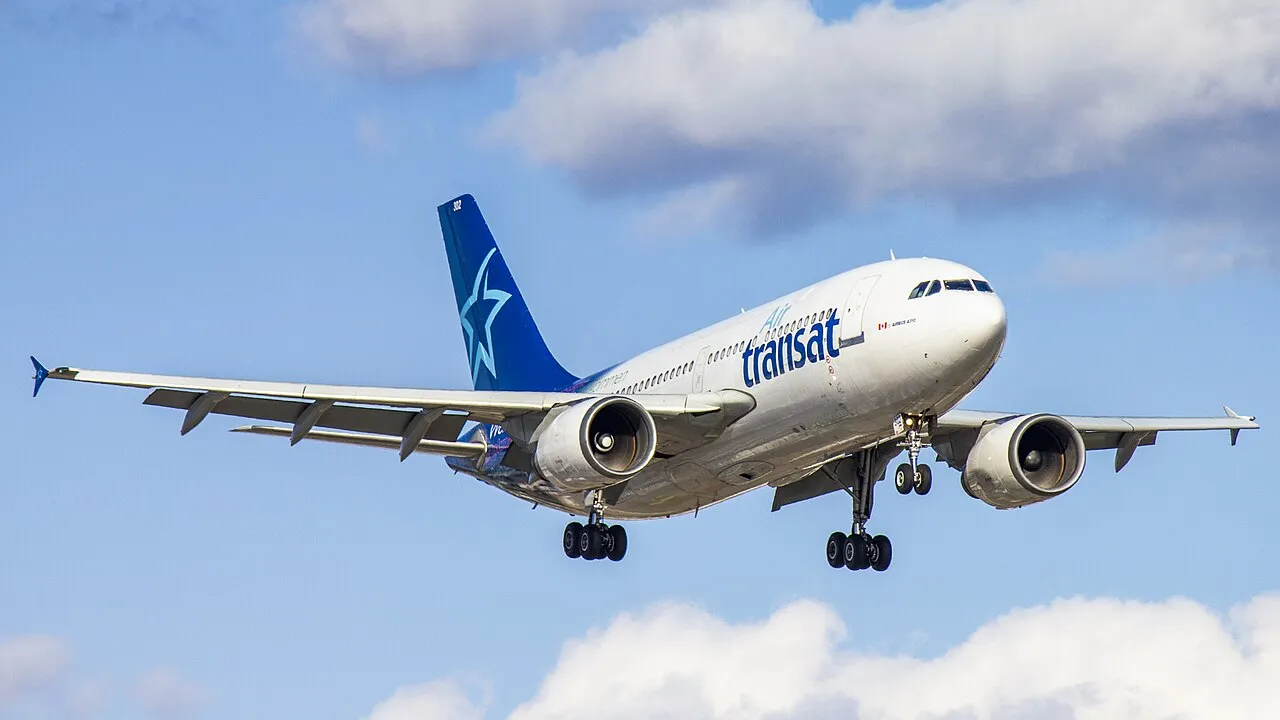
The definitive A300-600 first flew on 8 July 1983, was certified on 9 March 1984, and entered service with Saudi Arabian Airlines in June 1984, with a glass cockpit and an improved wing; Airbus sold 313 aircraft across the -600, the -600F freighter, the extended-range -600R and the -600RF freighter. A shortened derivative, the A310, first flew on 3 April 1982, entered service with Swissair in April 1983 and sold 255 aircraft. Airbus also built the A300-600ST “Beluga,” a specialised wide-bodied freighter used to ferry oversized aircraft components between its own factories1.
Operators and service
Air France was the launch operator, and Korean Air became the first customer outside Europe in September 1974, ordering four A300B4s. Production ended with a final delivery to FedEx Express on 12 July 2007. As passenger airlines retired their A300s, cargo carriers became the type’s main operators: as of April 2025, 209 A300s remained in commercial service, the largest fleets held by FedEx Express (63 aircraft) and UPS Airlines (52 aircraft), with smaller numbers flying for European Air Transport Leipzig, Iran Air and Mahan Air. UPS has extended its A300 freighters’ service life to 2035. Today the type is in limited passenger service and wider cargo service1.
Safety record
As of June 2021, the A300 had been involved in 77 occurrences, including 24 fatal hull-loss accidents that killed 1,133 people, and 36 criminal occurrences or hijackings that killed a further 302. The type’s first fatal accident was an Egyptair A300B4 at Luxor on 21 September 1987, which killed its five crew. The deadliest accident involving an A300 was the shootdown of Iran Air Flight 655 over the Persian Gulf on 3 July 1988, when the US Navy cruiser USS Vincennes mistook the airliner for an attacking aircraft and killed all 290 people on board. Other major hull losses included China Airlines Flight 140 at Nagoya on 26 April 1994 (264 dead), American Airlines Flight 587 in Queens, New York, on 12 November 2001 (265 dead), PIA Flight 268 in Nepal in 1992 (167 dead), Garuda Indonesia Flight 152 near Medan in 1997 (234 dead) and China Airlines Flight 676 at Taipei in 1998 (202 dead)1.
Similar aircraft
- Boeing 767: Boeing’s twin-engine widebody answer to the A300, developed for the same medium- and long-haul market.
- McDonnell Douglas DC-10: an earlier wide-body of similar size and era, though with three engines rather than two.
_Z1SYJMK.webp)
_approaching_JFK_Airport_1b71Hs.webp)
_(cropped)_Z2qDRzS.webp)