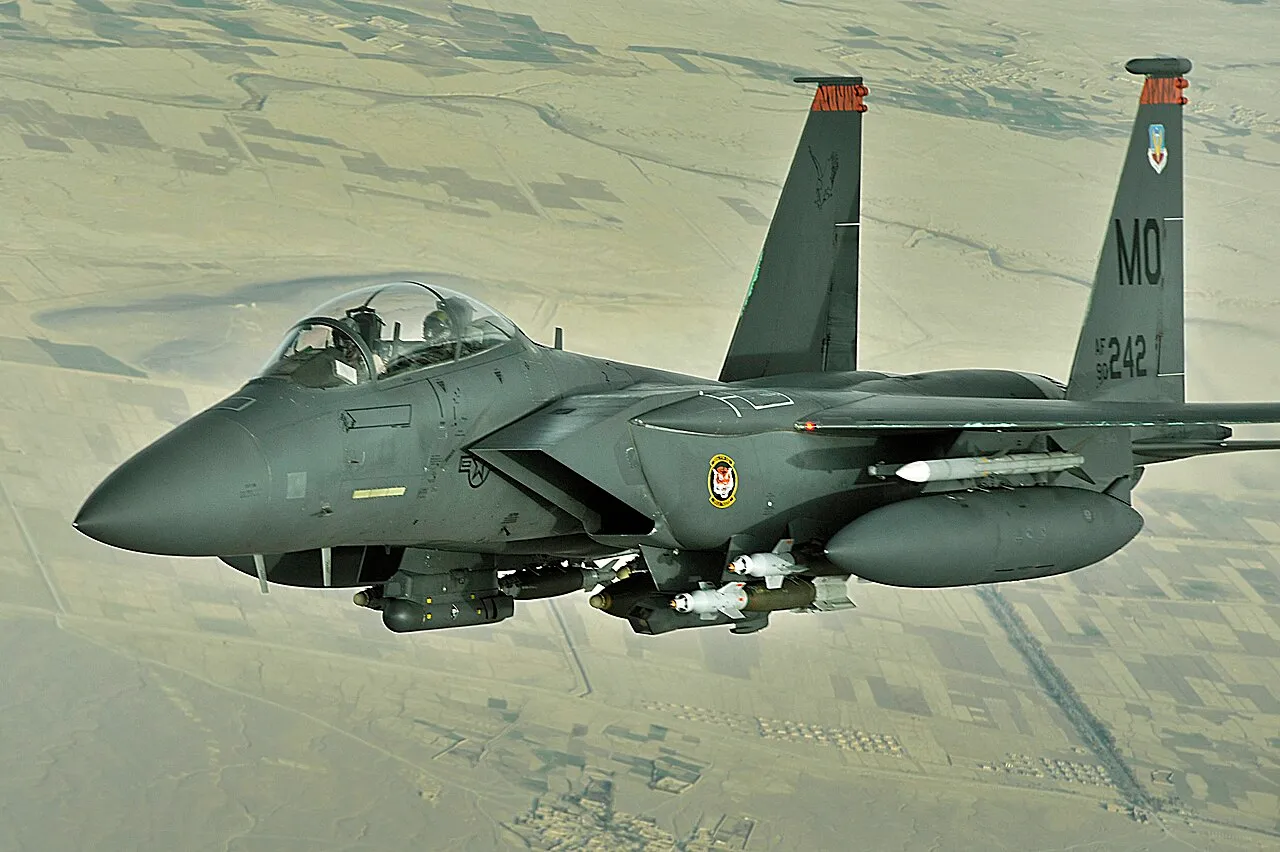
The McDonnell Douglas F-15E Strike Eagle is a two-seat, all-weather strike fighter built by McDonnell Douglas, which Boeing absorbed in a 1997 merger and which now markets the type as Boeing Defense, Space & Security. Built on the airframe of the air-superiority F-15 Eagle, it trades some of that jet’s pure dogfighting focus for a second crew member and a heavy long-range bombing role, while keeping enough of the Eagle’s air-to-air ability to defend itself. It first flew on 11 December 1986 and remains in service1 with the US Air Force and several export customers decades later.
Design and development
The US Air Force wanted an aircraft that could strike targets deep behind enemy lines at night and in bad weather without giving up the F-15’s ability to fight its way there and back. McDonnell Douglas answered with a two-seat derivative of the Eagle, adding a weapon systems officer in the back seat to manage sensors and weapons while the pilot flew and fought. The prototype, a converted two-seat F-15B, first flew on 11 December 19861, and the type entered US Air Force service in 1989 as a dedicated strike variant with the AN/APG-70 radar and LANTIRN targeting pods2 for low-level, all-weather navigation and precision targeting. Conformal fuel tanks fitted along the fuselage sides add range and carry sensors or weapons without the drag penalty of extra external tanks.
Specifications
The F-15E is 19.45 m long with a 13.05 m wingspan and a maximum take-off weight of 36,741 kg, well above the single-seat F-15C’s 30,844 kg2, reflecting its heavier fuel and weapons load. It is powered by two Pratt & Whitney F100-PW-220 afterburning turbofans, with later aircraft fitted with the more powerful F100-PW-229. With conformal tanks and three external fuel tanks fitted, it can ferry about 3,889 km; its unrefuelled combat radius on an air-interdiction mission is far shorter, around 1,270 km. Unlike the single-seat F-15C, the Strike Eagle always carries a crew of two, a pilot and a weapon systems officer1.
Variants
The baseline two-seat F-15E remains the core of the US Air Force fleet. Several export customers received their own designated versions built to similar standards: the F-15I for Israel, the F-15S for Saudi Arabia, the F-15K for South Korea and the F-15SG for Singapore. Across the US Air Force and these export variants, 236 F-15Es were built for the US Air Force between 1985 and 2001, with 435 F-15E-derived aircraft built in total. The newer F-15EX, ordered by the US Air Force from 20201, descends from the export F-15 line rather than directly from the E-model, and is treated separately on the F-15 Eagle page.
Operators and service
The US Air Force is the type’s largest operator, flying the F-15E from multiple bases including deployments supporting operations in the Middle East. Export customers Israel, Saudi Arabia, South Korea and Singapore fly their own F-15E derivatives, each tailored with country-specific avionics and weapons. The type has seen extensive combat use since its combat debut in the 1991 Gulf War1, flying strike, reconnaissance and close air support missions, and the US Air Force expects to keep it flying into the 2030s2 even as the single-seat F-15C/D fleet retires.
Similar aircraft
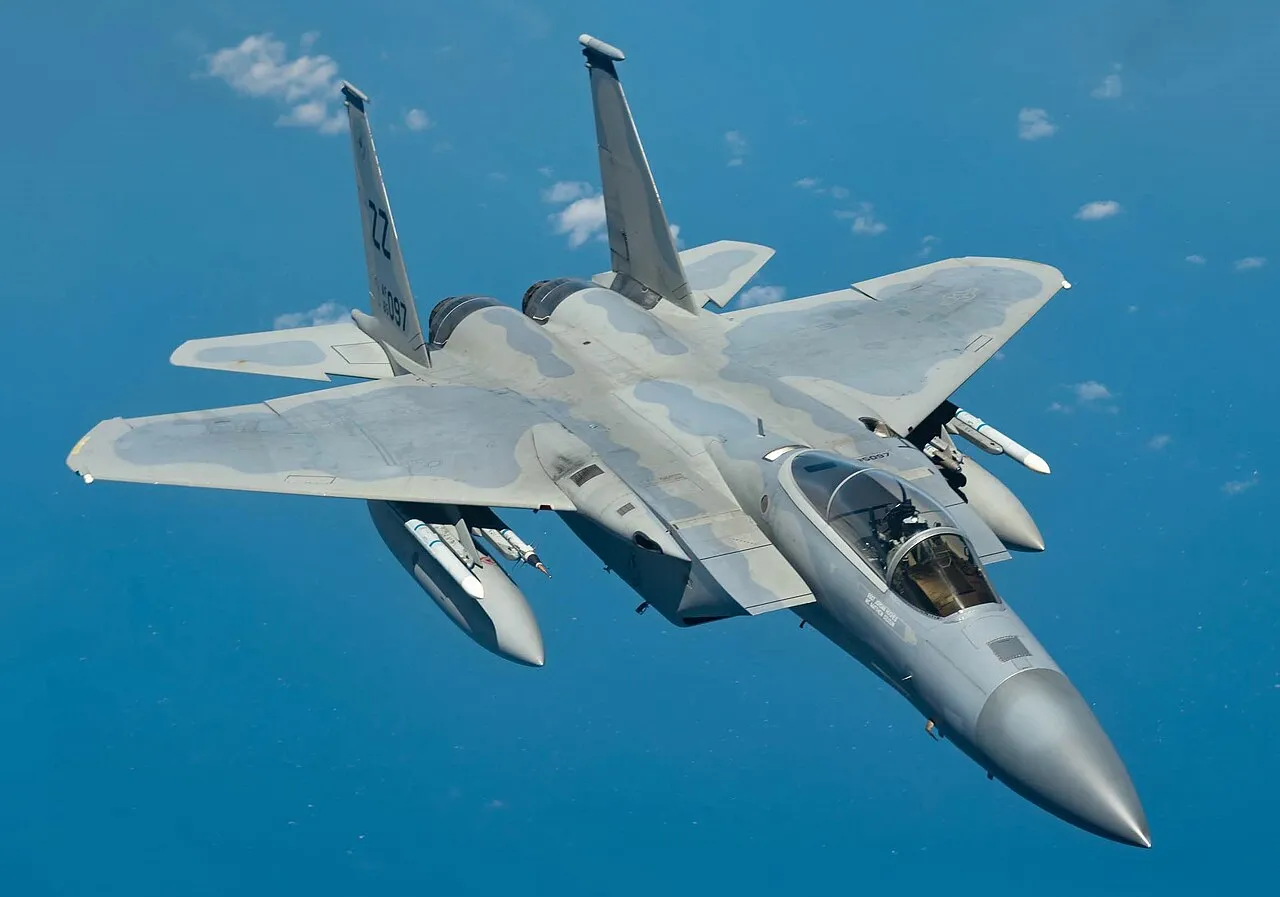
- McDonnell Douglas F-15 Eagle: the single-seat air-superiority fighter the Strike Eagle is derived from, sharing its airframe, engines and much of its avionics heritage.
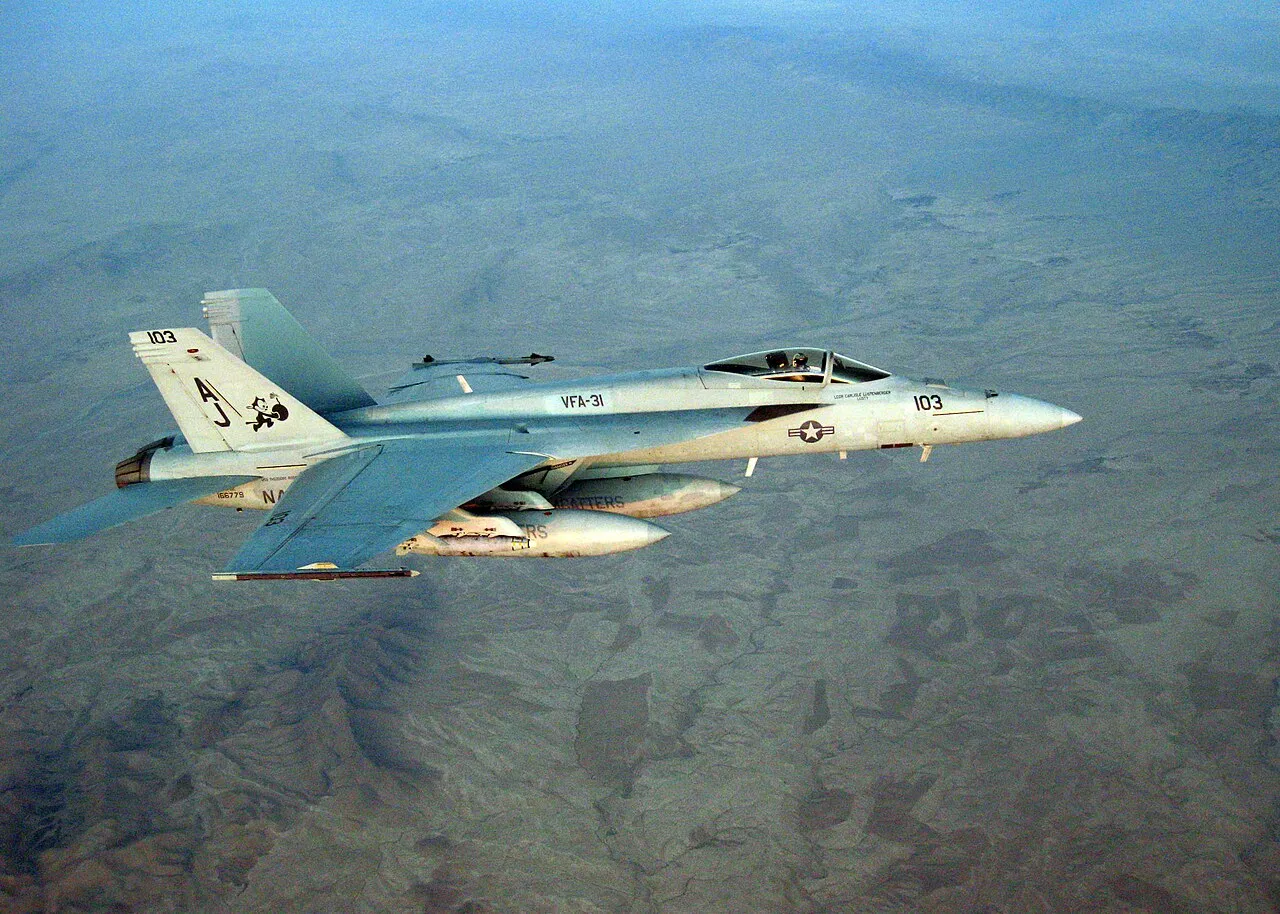
- Sukhoi Su-34: a two-seat, long-range strike fighter built on a fighter airframe for a broadly similar deep-strike role.
_10Vvmy.webp)