Contents
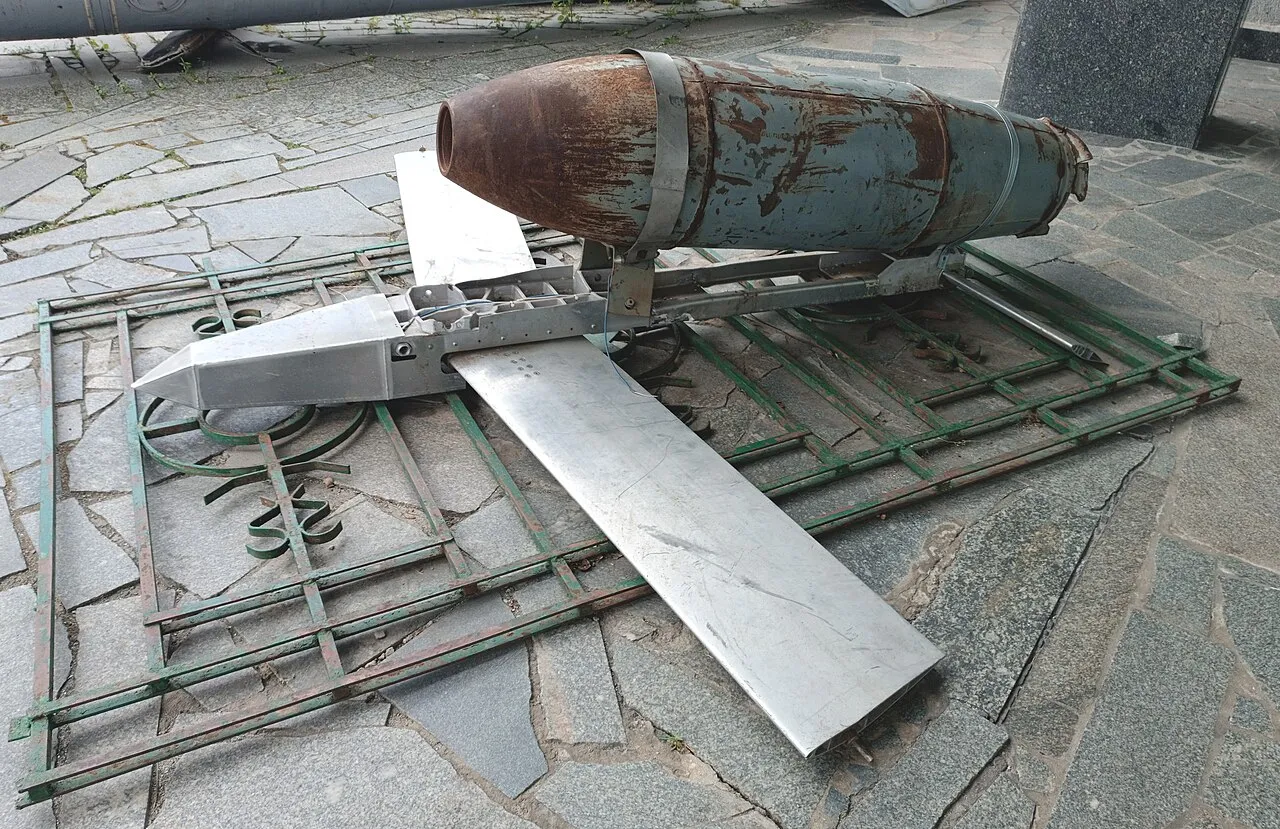
The UMPK is a Russian kit that converts unguided Soviet-era bombs into precision-guided glide bombs. The initials stand for Unifitsirovannyi Modul Planirovaniya i Korrektsii, roughly “unified gliding and correction module”. It is informally called the “Russian JDAM”, although the defence writer Piotr Butowski judged it hardly comparable to the American JDAM. The Bazalt company had proposed a similar module in 20022, while Ukraine’s military intelligence names the Tactical Missiles Corporation as its main developer3. The Russian armed forces have used it in the Russo-Ukrainian war since 20231.
Design and development
Russia first showed a comparable kit at the Farnborough Airshow in 2002, when the Moscow-based GNPP Bazalt offered four versions of an MPK module for the FAB-500M-62 bomb, ranging from a wing alone to a model with a pulsejet engine. According to Butowski, the project was revised several times but never entered production2, and only drawings and models were ever shown.
General-purpose bombs with wing kits were first reported on 4 January 2023 by the Russian Telegram channel Fighterbomber. On 24 March 2023 Ukraine’s Air Force spokesman Yurii Ihnat said that guided aerial bombs launched at Sumy Oblast travel long distances, so the aircraft stay beyond the reach4 of Ukrainian air defence. Russia’s defence ministry confirmed the use of UMPK bombs on 8 May 20232, describing a Su-34 strike near Kharkiv.
The maker of the modules is not officially named1. Butowski wrote in July 2023 that it was not known which company built them2 and thought Bazalt an unlikely candidate. In February 2026 Ukraine’s Defence Intelligence said that 31 Russian companies take part in making the kit, with final assembly of the UMPK-250 and UMPK-500 at Kurganpribor3.
An American JDAM replaces the tail of a bomb, but Russian general-purpose bombs are welded, so the UMPK is built as a self-contained flying unit attached to the bomb; Butowski notes that this lets units in the field fit it. A spring-driven mechanism opens the wing after release2. The kit steers with inertial navigation and a Kometa-M satellite navigation antenna. A Conflict Armament Research investigation in November 2023 found a more complex electronics package1 on a newer module, with a SMART navigation controller and a Kometa satellite navigation module.
Specifications
The distance a bomb glides depends on the altitude and trajectory at release1. Defense Express estimated in May 2024 that a FAB-500 with the kit flies 60 to 65 km5 when released at high altitude and speed, and in June 2025 gave 60 to 80 km depending on launch conditions6. Long War Journal put the standard kit on a FAB-500 M-62 at about 60 to 70 km7, and Ihnat said in May 2023 that the bombs travel about 70 km8. An anonymous online analysis by an employee of a Russian company, cited by Butowski in 2023, found the real range much smaller than social-media claims2 that matched the JDAM-ER.
The same analysis said that a FAB-500 with the module exceeds the 500 kg load rating2 of the most common Russian pylons. The FAB-500 was the first bomb fitted with the kit and the most widely used. Versions followed for the FAB-250 from at least May 2023, the FAB-1500 from at least September 2023 and the FAB-3000, whose first use the Fighterbomber channel claimed on 20 June 2024; Long War Journal says the kit was adapted for bombs of up to 3 tonnes7. Ukraine’s Defence Intelligence also lists the RBK-500 cluster bomb and the ODAB-500 and ODAB-15003 thermobaric bombs. The Fighterbomber channel has put the price of one kit at 2 million roubles1.
Launch platforms
According to The War Zone, Ihnat named the Sukhoi Su-35 and Sukhoi Su-34 as carriers in April 2023, while the Su-34 and the Su-24M variant of the Sukhoi Su-24 appeared with the kit2 in photos and footage. He again named the Su-34 and Su-358 at a briefing on 2 May 2023. In November 2023 Fighterbomber said each aircraft could carry only two UMPK bombs9, and Defense Express reported footage from March 2025 of a Su-34 carrying four FAB-500M62 bombs with extended-range kits6.
Operators and combat use
The kit is used by the Russian armed forces. On 2 May 2023 Ihnat said that about 20 guided bombs a day8 were falling on front-line areas. Forbes wrote in August 2023 that large-scale use of Russian guided bombs had greatly hindered the Ukrainian counteroffensive1 on the Zaporizhzhia front. In November 2023 a video appeared to show RBK-500 cluster bombs with the kit used near Staromaiorske in Donetsk Oblast, which Russia’s defence ministry had not confirmed9.
Long War Journal wrote in October 2025 that Russian jets typically drop 150 or more UMPK or UMPB bombs a day7. In its report of 8 November 2026, Ukraine’s General Staff said Russian forces had dropped 235 guided aerial bombs10 over the previous day, without saying how many carried the UMPK.
Variants
- UMPK-PD: an extended-range version with a larger wing area, which Ukraine’s Defence Intelligence says Russia began using in 2024 on FAB-500T bombs3. Defense Express reported a range of up to 95 km6.
- Jet-powered UMPK: in October 2025 Fighterbomber said Russia had developed a version with an engine, used in limited numbers. Ukrainian intelligence deputy head Vadym Skibitskyi said the newest guided bombs were estimated at 150 to 200 km7.
Similar weapons
- JDAM-ER: the American guidance kit with extra wings for extended range2, which has been supplied to Ukraine.
- UPAB-1500B: a Russian 1.5-tonne glide bomb for fortified targets up to 40 km away; Ihnat confirmed its first use in March 202311, after Defense Express reported drops a few weeks earlier.
- UMPB D-30SN: a Russian glide kit with an engine, estimated at a range 20 to 30 km greater5 than the UMPK.