Contents
The Kh-69 is a Russian stealthy subsonic air-launched cruise missile1 developed from the Kh-59, with a range of at least 400 km and a smaller radar signature than its predecessors; NATO calls it the AS-22 Kazoo. It was developed by the Raduga company, part of Russia’s Tactical Missiles Corporation (KTRV). In September 2023 the International Institute for Strategic Studies described it as a land-attack missile likely comparable to Storm Shadow or Taurus KEPD 3502.
Design and development
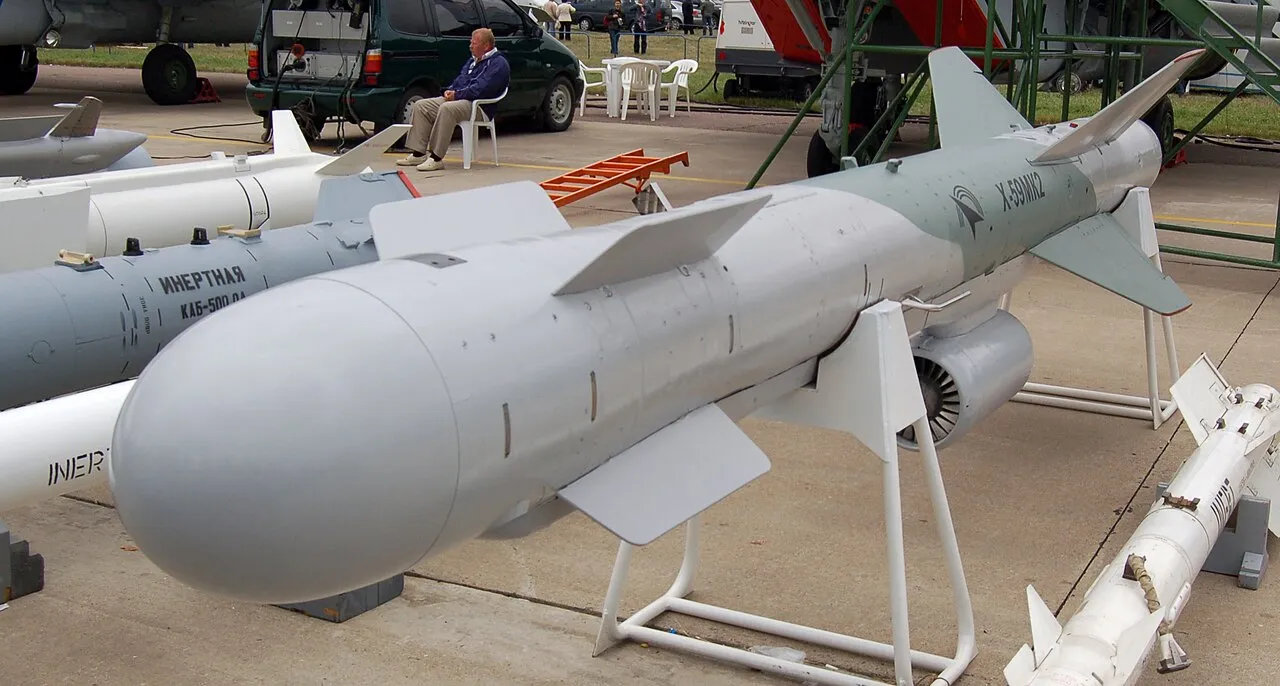
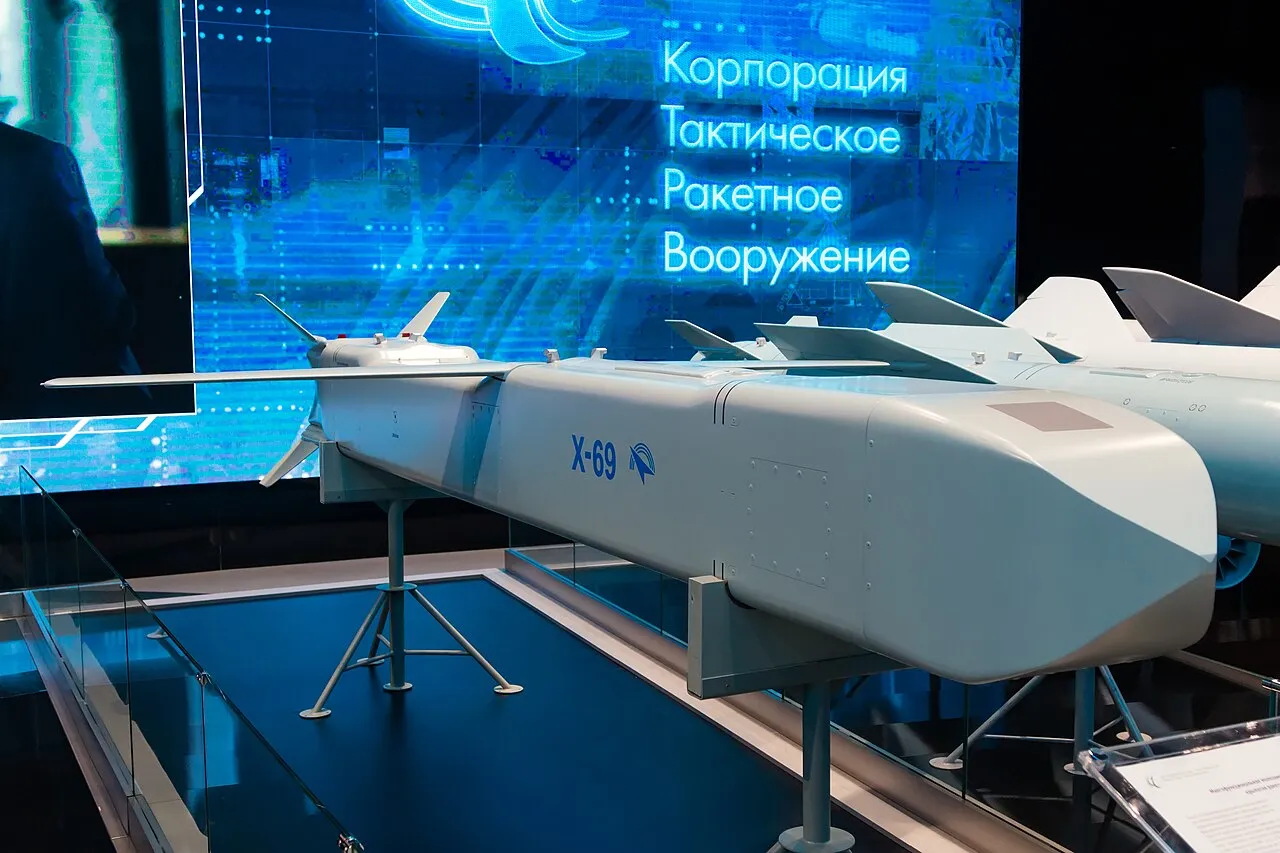
The missile began as the Kh-59MK2, which first appeared in 2009 looking like the anti-ship Kh-59MK, but with inertial navigation updated by GPS and GLONASS and an electro-optical scene-matching system for the run-in to the target. According to TWZ, the design was reworked in 2015 with low-observable features, its external engine nacelle gave way to an internal turbofan, and Raduga then developed a domestic version, the Kh-69, with a simplified nose. Only the guidance system stayed unchanged in that redesign2, which gave the missile a boxy body of trapezoidal section, shaped to fit the weapons bay of the Su-57.
In May 2018 CSIS reported a video showing a Su-57 launching a Kh-59MK23. TWZ described an official video, released after the Su-57’s brief 2018 deployment to Syria, of a Su-57 releasing a Kh-69, and noted that it was possibly footage of a test in Russia, as the red-painted missile suggested. The Kh-69 was first unveiled in August 2022, when a mock-up was shown at Army-2022. IISS assessed in February 2023 that it was likely in the final stages of development or entering production2, and in September 2023 it reported the missile in testing1.
Specifications
TWZ gives the Kh-69 a length of around 13 ft 9 in, roughly 4.2 m, a weight of around 1,700 lb (about 770 kg) and a speed of up to 621 mph (1,000 km/h), with a penetrating or cluster warhead of up to 680 lb. Other reporting says it weighs under 800 kg and carries a warhead of around 300 kg, and Defense Express gave the Kh-59MK2 a 310 kg warhead4. The missile has one pair of wings and four rear fins1 that unfold after launch, and it can reportedly fly as low as 20 m above the ground. It uses GPS and GLONASS satellite navigation with an inertial backup. An electro-optical seeker was reported in 2022, but TWZ notes that the Kh-69’s simplified nose lacks the window of the DSMAC guidance system, and describes the missile as intended mainly for hardened targets with known coordinates2.
In February 2024 TWZ wrote that the missile is said to have a range of at least 186 miles2, about 300 km. After the April 2024 strikes, the Institute for the Study of War said Russian forces had reportedly fired Kh-69s from 400 kilometres away from their targets5, beyond an earlier estimated range of 300 km. In July 2026 Defense Express estimated that one Kh-69 may cost $500,000 to $800,0006.
Launch platforms
TWZ considers the Kh-69 very likely designed for the Su-57, shaped to fit its weapons bay2, and says the manufacturer also names the MiG-29K, MiG-35, Su-30MK, Su-34 and Su-35 as carriers. Over Ukraine, Defense Express reported in 2026 that the Kh-59 and Kh-69 are typically launched from Su-34 and Su-35 aircraft6. In 2024 its makers presented it to Indian Air Force representatives1 as a weapon for the Su-30MKI.
Operators and combat use
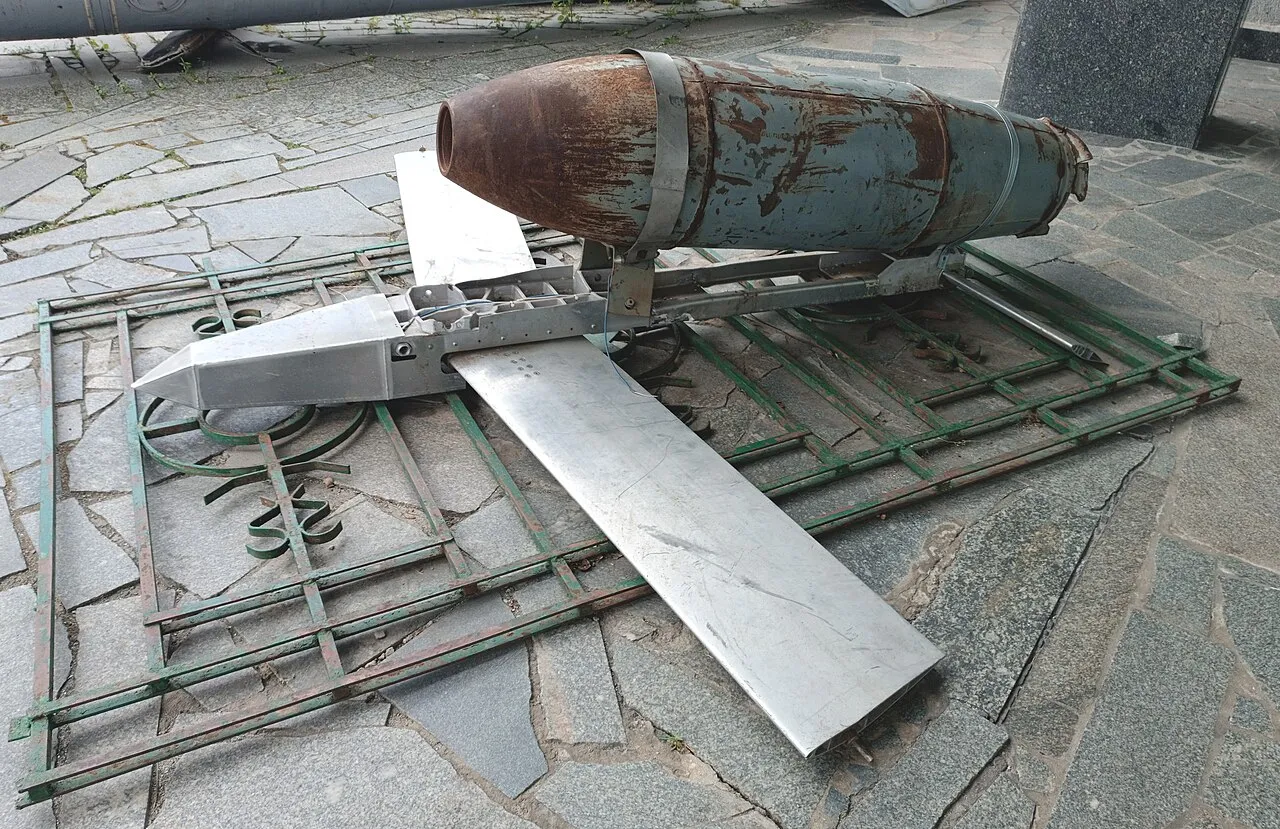
Russia is the only listed operator1. In February 2024 a Ukrainian military blogger posted a photo said to show a rear fin of a Kh-69 downed on 7 February, and an account on X claimed that three Kh-69s and three Kh-59s were launched2 overnight on 7 to 8 February, a use TWZ said it could not yet be sure of.
On 11 April 2024 a Russian attack destroyed the Trypillia thermal power plant in Kyiv Oblast, and the Ukrainian military said the plant was hit by Kh-69 missiles. Air Force spokesperson Illia Yevlash called the Kh-69 an improved version of the Kh-597 and said the missiles contained parts made in 2023, while Defense Express reported that debris found in Kyiv Oblast pointed to the Kh-69. The Institute for the Study of War said in April 2024 that it had not previously observed Russian use5 of the missile in Ukraine.
On 19 October 2024 a Ukrainian Telegram channel reported that a Kh-69 with a cluster warhead8 had been shot down, a payload Militarnyi said had not been seen in Ukraine before. In July 2026 Defense Express reported that Ukraine’s 208th Brigade destroyed a Kh-59/69 missile6 during an attack on Odesa region. Ukraine’s Air Force said Russia launched three Kh-59/69 guided air-launched missiles9 from the Sea of Azov area in the night to 8 November.
Variants
Militarnyi wrote that the first confirmed strikes used a penetrating high-explosive warhead8, and that the missile downed in October 2024 was a new version whose cluster warhead holds metal pellets. Its direct ancestor, the Kh-59MK2, existed in a 2009 form with an external engine2 and in the 2015 low-observable form from which Raduga developed the Kh-69.
Similar weapons
- Kh-59: the older family it grew out of; the 2009 Kh-59MK2 still carried an external engine nacelle2, where the Kh-69 has an internal turbofan and a boxy body.
- Storm Shadow / SCALP EG: the European missile it has been compared with; TWZ puts the Kh-69 at around 13 ft 9 in against 16 ft 9 in2, about two-thirds of the size and payload.
- Kh-101: a much larger Russian air-launched cruise missile, 7.45 m long4, which TWZ calls heavier-hitting and longer-ranged.