_ZbySau.webp)
Contents
The Boeing 727 is a three-engine, narrow-body airliner that Boeing built as a compromise between airlines that wanted different numbers of engines. Airlines flew it on short- and medium-haul routes as a passenger and cargo transport, and its combination of short-field performance and jet speed made it a mainstay of domestic networks for three decades. It is retired from scheduled mainline passenger service, with a small number of airframes still flying in cargo, military and executive roles1.
Design and development
The 727 grew out of conflicting requirements from three airlines Boeing was courting in the early 1960s: United Airlines wanted four engines for high-altitude airports, American Airlines preferred two engines for efficiency, and Eastern Air Lines needed three engines to meet its overwater requirements to the Caribbean. Boeing resolved the disagreement with a trijet layout, two engines on the rear fuselage and one in the tail fed by an S-duct intake. The programme was launched on 5 December 1960 with 40 orders each from United and Eastern1.
Boeing had initially planned to use Allison-built AR963 turbofans, but switched to Pratt & Whitney JT8D engines after airlines pushed for that alternative. The aircraft first flew on 9 February 1963 and entered service with Eastern Air Lines on 1 February 1964. Its rear airstair, usable in flight on early aircraft, let it operate from airports without ground equipment; Boeing later modified the design after hijacker D. B. Cooper used it to parachute from a 727 in 19711.
Specifications
The 727 flew in two main fuselage lengths. The short-body 727-100 measured about 40.59 m long with a typical seating of 106 to 129 passengers and a range of around 4,170 km, while the stretched 727-200 reached about 46.69 m, seating 134 to 155 passengers, with a baseline range of around 3,500 km. Wingspan was unchanged across variants at 32.92 m. Maximum take-off weight ranged from about 76,657 kg on the lightest 727-100 to about 95,000 kg on the 727-200 Advanced, and the type cruised at around 960 km/h. It was powered by three Pratt & Whitney JT8D turbofans1, mounted so that two sat on the rear fuselage and the third drew air through an S-duct in the tail.
Variants
The baseline 727-100 was the original short-body model. The 727-200, launched as a 20-foot stretch of the fuselage, became by far the bigger seller. From 1970 Boeing offered the 727-200 Advanced with more powerful JT8D-9, -15 and -17 engines and a higher maximum take-off weight than the original 727-200, which also extended its range toward the upper end of the 727-200 figures in the specifications above. Boeing built 1,832 aircraft in total between 1962 and 1984, split between 407 727-100s and 1,245 727-200s1, the remainder military and other derivatives.
Operators and service
The 727 sold to airlines across the world as a short- and medium-haul workhorse, and after airlines retired it from frontline passenger service it found a long second life with cargo and charter operators; FedEx Express began flying 727s in 1978 and operated them for decades afterward. By 2013 about 109 aircraft remained in commercial service worldwide. Scheduled passenger flying ended when Iran Aseman Airlines flew the last scheduled 727 passenger service on 13 January 20191. A handful of airframes still fly today in cargo, military and executive roles.
Safety record
As of March 2024, the Boeing 727 had been involved in 353 recorded incidents, including 120 hull-loss accidents with 4,211 fatalities in total. The deadliest was Mexicana Flight 940 on 31 March 1986, which killed 167 people1. Given the type’s size — more than 1,800 built and in service across five decades — its accident record reflects the long operational history and varied conditions of a widely used trijet rather than a single systemic flaw.
Similar aircraft
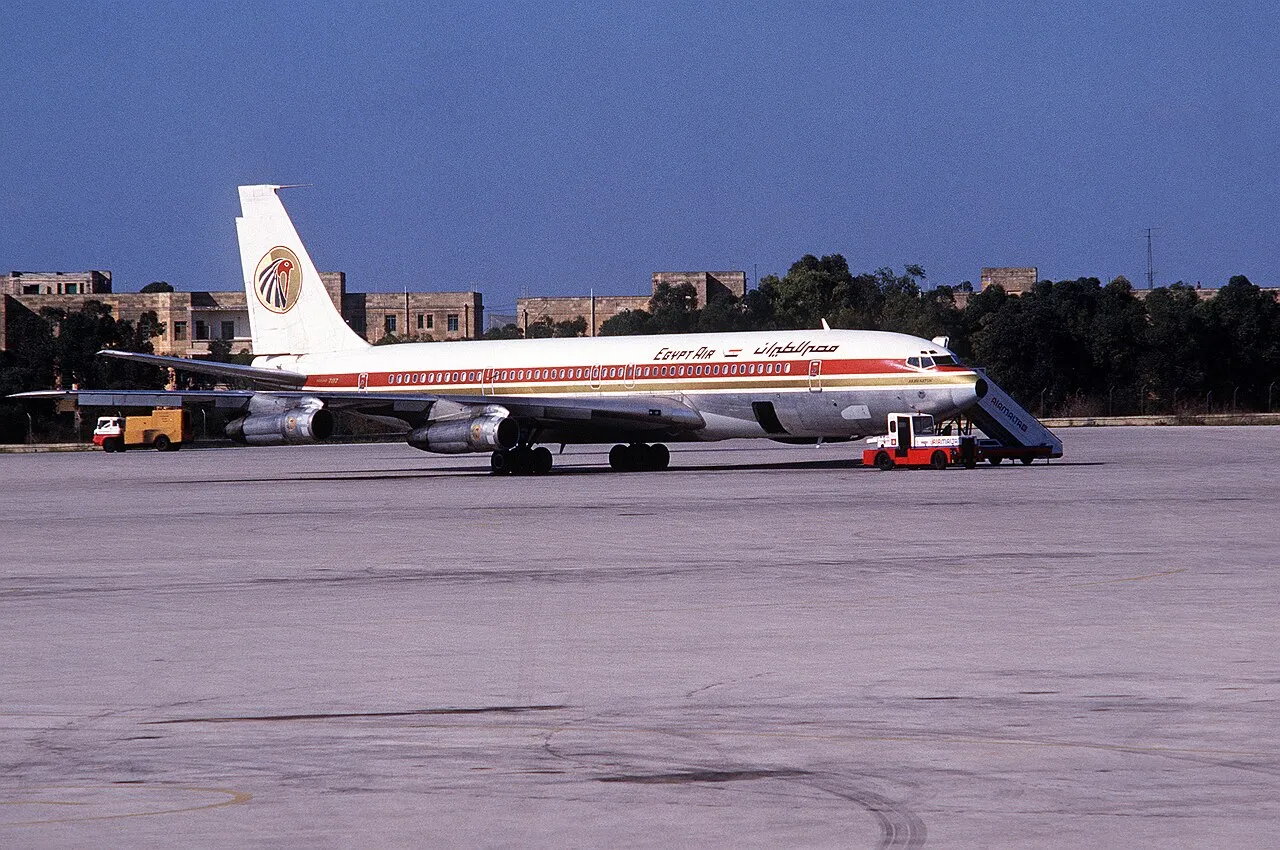
- Boeing 707: Boeing’s earlier four-engine jet, which the 727 followed onto short- and medium-haul routes the larger aircraft was less suited to.
- Boeing 737: Boeing’s twin-engine successor on short-haul routes, which eventually replaced the 727 across most of its network role.
_ZnEDr2.webp)
_Z1wAcy8.webp)