Contents
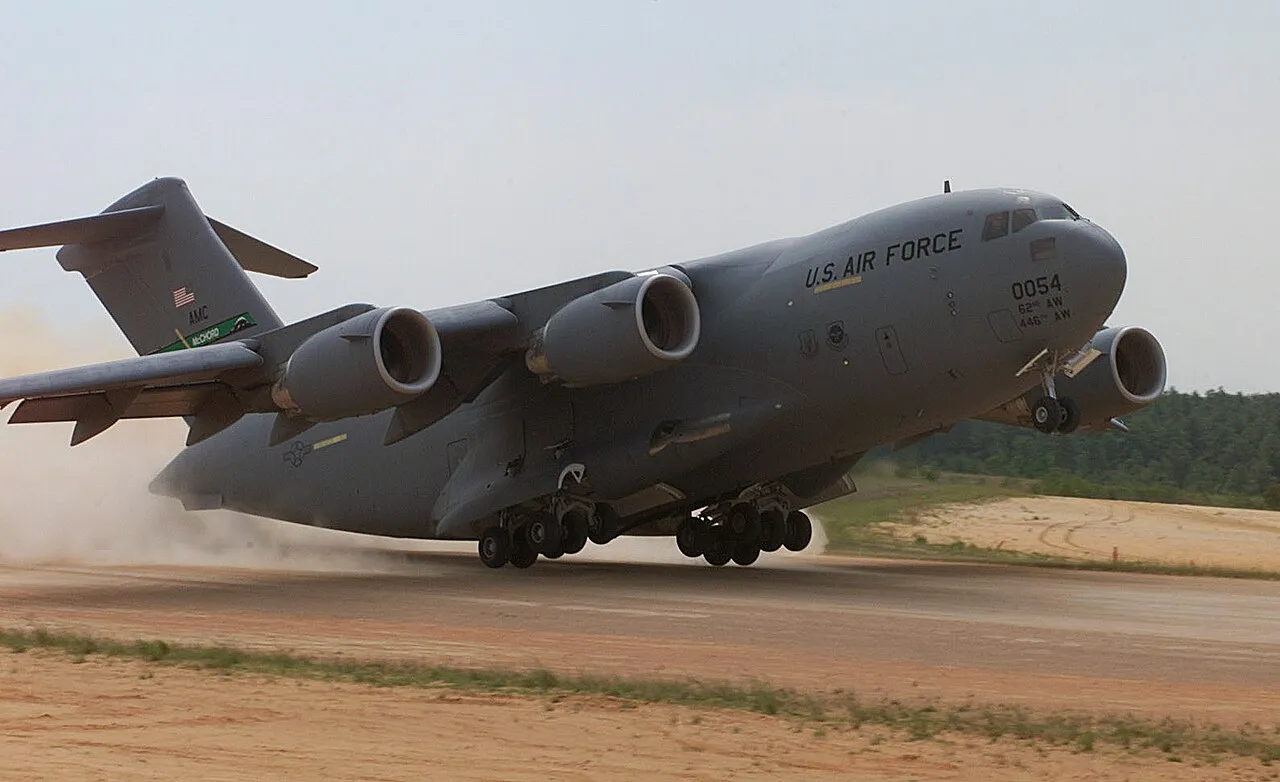
The Boeing C-17 Globemaster III is a large military transport aircraft built to move troops and outsized cargo over long distances and land them on short, unpaved runways. McDonnell Douglas, later absorbed into Boeing, developed it for the United States Air Force to replace the Lockheed C-141 Starlifter and take over some of the duties of the Lockheed C-5 Galaxy. It remains in frontline service with the United States and a group of allied air forces1.
Design and development
McDonnell Douglas developed the C-17 through the 1980s and early 1990s, drawing on the smaller YC-15 airlifter prototype it had built in the 1970s. The programme ran about a year behind schedule, and the company absorbed a loss of nearly US$1.5 billion on the development phase before the first aircraft made its maiden flight on 15 September 1991. The type formally entered United States Air Force service on 17 January 19951.
The design centres on getting heavy loads into places other large transports cannot reach. The C-17 is built to operate from runways as short as 3,500 feet (1,067 m) and as narrow as 90 feet (27 m), including unpaved surfaces. Its engine thrust reversers give it an unusual trick for an aircraft this size: crews can use them to back the aircraft up and turn it around on a narrow taxiway1.
Specifications
The cargo hold is the aircraft’s defining feature: it measures 88 feet (27 m) long, 18 feet (5.5 m) wide and 12 feet 4 inches (3.76 m) high, enough for armoured vehicles, helicopters or palletised cargo, and can carry up to 170,900 pounds (77,519 kg) of payload. The aircraft is 53 metres long with a wingspan of 51.77 metres and a maximum take-off weight of 265,000 kg. It is powered by four Pratt & Whitney F117-PW-100 turbofans and cruises at around 830 km/h. Unloaded, its ferry range reaches about 11,540 km, falling to roughly 4,400 km with a maximum payload (5,200 km on extended-range models). A standard crew of three — two pilots and a loadmaster1 — flies it.
Variants
The initial production version, the C-17A, makes up the bulk of the fleet. From 2001, Boeing built later aircraft to an extended-range “ER” standard with a sealed centre wing fuel tank for extra range. A tactical C-17B and a KC-17 tanker conversion were proposed but never built1.
Operators and service
The United States Air Force operates by far the largest fleet, with 219 aircraft as of January 2026. Export customers include the Indian Air Force (11 aircraft), the Royal Air Force (8), the Royal Australian Air Force (8) and the Qatar Emiri Air Force (8), with smaller numbers flown by Canada, Kuwait and the United Arab Emirates, plus three aircraft based in Hungary under NATO’s Strategic Airlift Capability programme. McDonnell Douglas and then Boeing built the type from 1991 to 2015, for a total of 279 aircraft; the last one rolled out of the Long Beach, California plant and flew in November 20151, closing the line.
Safety record
The C-17 fleet has suffered one fatal hull loss: on 28 July 2010 a USAF C-17 crashed at Elmendorf Air Force Base, Alaska, while practising for an air show, killing all four crew aboard after a stall brought on by pilot error. It remains the only such accident to date1.
Similar aircraft
- Lockheed C-5 Galaxy: the larger US strategic airlifter the C-17 was partly built to supplement, carrying heavier and bulkier loads but needing longer runways.
- Lockheed C-130 Hercules: a smaller, older tactical airlifter the C-17 often works alongside on the same airlift missions.
- Antonov An-124 Ruslan: a Soviet-designed strategic airlifter of similar size and role, flown by Russian and Ukrainian operators.
- Ilyushin Il-76: a smaller Soviet-designed military transport comparable to the C-17 in its short-field capability.
_ZbySau.webp)
_ZnEDr2.webp)