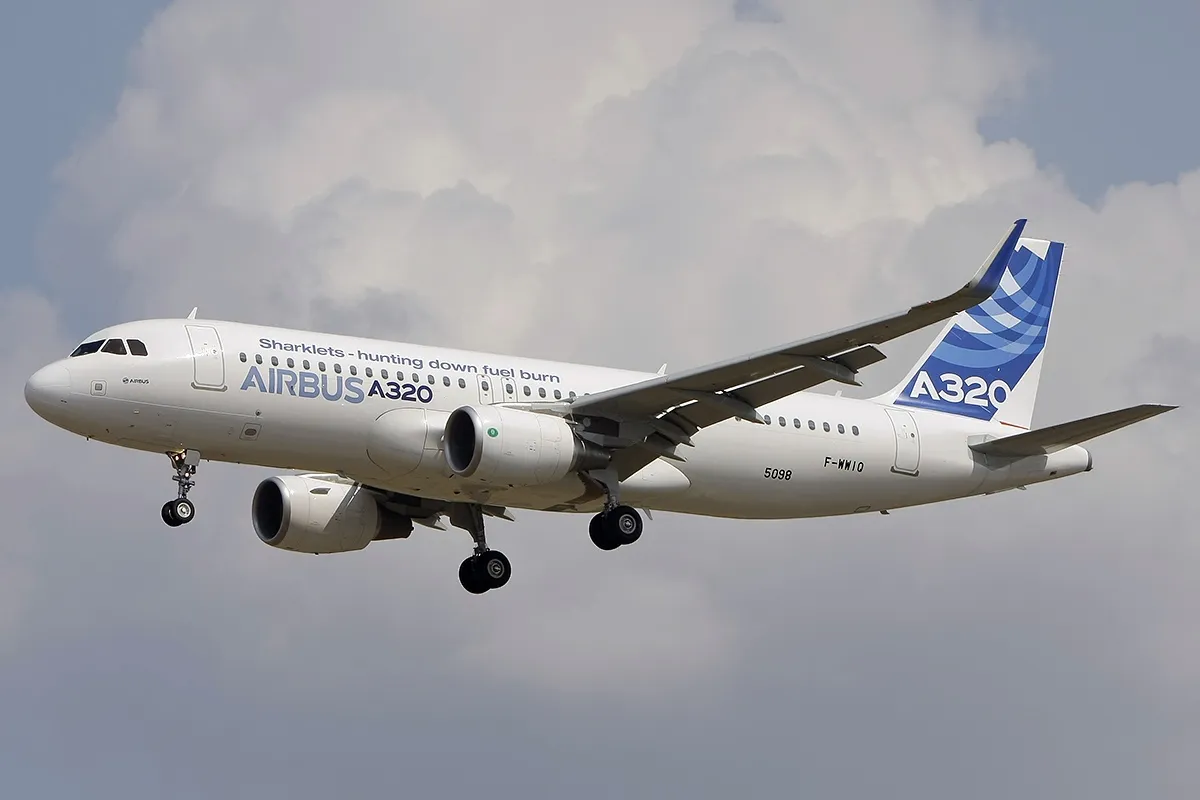
The Airbus A320 family is a narrow-body airliner family built by Airbus, spanning the original ceo generation and the newer neo generation across four fuselage lengths. Airbus designed it as a short-to-medium-range airliner for high-frequency routes, directly challenging the Boeing 737, and the family’s two turbofan engines2 power aircraft that now fly with airlines worldwide. It is in service, with ceo production having largely given way to the A320neo family; in September 2025 the family overtook the Boeing 737 in total deliveries1, making it the best-selling airliner family in history.
Design and development
Airbus launched the programme to offer airlines a modern, fly-by-wire alternative to the Boeing 737 and McDonnell Douglas MD-80 on short and medium-haul routes. The first member of the family, the A320-100 prototype, made its first flight on 22 February 19871, introducing a digital fly-by-wire control system and side-stick controls that were novel on a commercial airliner at the time. Airbus then stretched and shrank the basic A320 airframe to cover a wider span of the market: the smaller A319 and A318 followed, alongside the larger A321, together forming the ceo (“current engine option”) generation.
Airbus later re-engined the family rather than designing a clean-sheet replacement, launching the A320neo (“new engine option”) generation with newer, more efficient turbofans and wingtip sharklets. That update let Airbus keep selling an airframe pedigree already decades old against Boeing’s competing 737 MAX, and by the mid-2020s neo deliveries had come to dominate the order books even as thousands of earlier ceo-generation aircraft remained in daily service.
Specifications
The most common ceo-family member, the A320-200, is 37.6 m long with a wingspan of 33.91 m without sharklets; the wider family ranges from about 31.4 m on the smallest A318 to 44.5 m on the stretched A321. Its maximum take-off weight is 73,500 kg, while the ceo family as a whole spans roughly 68,000 kg on the A318 to 93,500 kg on the A321. Typical two-class seating on the A320-200 is 150 passengers, and across the whole family seating runs from about 107 to 132 on the smallest A318 up to 185 to 230 on the stretched A3211. Range on the A320-200 with 150 passengers in two classes is about 6,100 km2.
Engines vary by era and customer choice: the ceo family is powered by two CFM56-5 or IAE V2500 turbofans, with the A318 also offered with Pratt & Whitney PW6000 engines2; the neo generation switched to newer CFM LEAP-1A or Pratt & Whitney PW1100G engine options not covered by these ceo-era figures. Because the family spans so many fuselage lengths and two engine generations, these specifications describe the representative A320-200; shorter and longer variants, and neo-generation aircraft, differ from them as noted above.
Variants
The family’s four fuselage lengths are the A318, A319, A320 and A321, each offered across the ceo and neo generations. Airbus had built 12,841 A320 family aircraft, ceo and neo combined, as of August 20261. The neo generation, launched later with new engines and sharklets, has become Airbus’s current production focus, with the ceo family now built only in small numbers for specific orders. Airbus also offers corporate jet versions under its ACJ320 Family brand and has supplied military and government variants to several operators.
Operators and service
The A320 family flies with a very broad base of airlines worldwide, from major flag carriers to low-cost operators, reflecting its role as a general-purpose short and medium-haul workhorse rather than a type tied to a handful of launch customers. It has been in continuous production and service since the late 1980s, with the ceo generation now mostly handed over to newer neo-generation deliveries on the busiest routes while older ceo aircraft remain common on short-haul networks. The family’s overtaking of the Boeing 737 in cumulative deliveries in September 20251 marked it as the most-produced jet airliner family.
Similar aircraft
- Boeing 737: the direct competitor that the A320 family overtook in total deliveries in September 20251, and against which it was designed to compete from the start.
- Embraer E-Jet family: a smaller narrow-body family built for regional and short-haul routes of similar role.
_ZVY5TD.webp)
_Z1SYJMK.webp)
_approaching_JFK_Airport_1b71Hs.webp)
_(cropped)_Z2qDRzS.webp)